RARE Bound Newspaper - Full Volume - 1892-93 Hammondsport NY Herald Large Folio

When you click on links to various merchants on this site and make a purchase, this can result in this site earning a commission. Affiliate programs and affiliations include, but are not limited to, the eBay Partner Network.

RARE Bound Newspaper - Full Volume - 1892-93 Hammondsport NY Herald Large Folio:
$595.00
RARE Bound Newspaper Volume
Hammondsport Herald
Hammondsport, New York
Complete Volume - 1892-1893
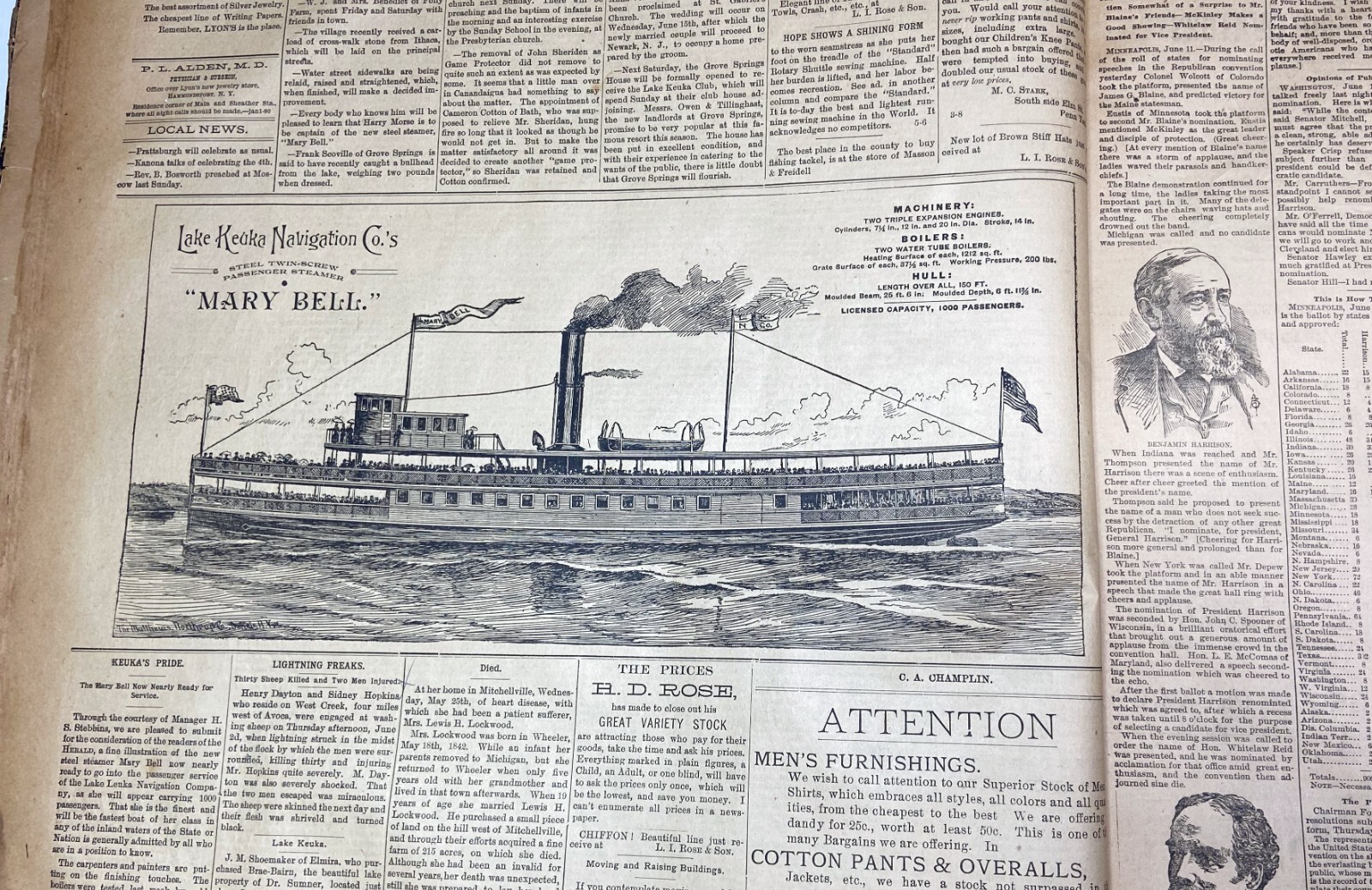
For offer, a rare ORIGINAL bound newspaper volume. Fresh from an estate in Upstate NY. Never offered on the market until now. Vintage, Old, antique, Original - NOT a Reproduction - Guaranteed !!This came out of an estate in Hammondsport. I am also listing a rare paper from Bath as well. Large folio, as shown (yard stick shown ). Large - measures 23 inches tall when closed. V. XIX, no. 1, May 4, 1892 through no. 52, April 26, 1893. Lots of news, including local, and great advertisements throughout. Bicycles, farming, etc. Marbles boards, cloth spine. Overall in good condition. Paper is fragile, with age toning, and there are a few rips here or there. Last page ripped and detached. If you collect Americana history, American papers,United States of America news, advertisement ad, USA, etc., this is one you will not see again. A nice piece for your paper / ephemera collection. Perhaps some genealogy research information as well. Combine shipping on multiple offer wins!2905
Hammondsport is a village at the south end of Keuka Lake, in Steuben County, one of the Finger Lakes of New York, United States.
The Village of Hammondsport is in the Town of Urbana and is northeast of Bath.
Lazarus Hammond founded the village around 1827. The village was incorporated in 1856. The village later became a center for the New York wine industry.[2]
The American motorcycle designer and manufacturer, and recognized expert on gasoline engines Glenn Hammond Curtiss resided at Hammondsport, where he was born in 1878. Early development of aircraft and seaplanes was carried out at Hammondsport by Curtiss who had joined with Alexander Graham Bell and others in the Aerial Experiment Association.
In 1921, five local men purchased a wood barrel factory just south of the present D.W. Putnam Wine Company, and named it the Aerial Service Corporation. Two of these men, Henry Kleckler, the president and William Chadeayne, vice president, were formerly with the Curtiss Aeroplane Company, founded by Curtiss. Today, this company is known as the Mercury Corporation.[3]
Steuben County (stu-BEN) is a county located in the U.S. state of New York. As of the 2020 census, the population was 93,584.[2] Its county seat is Bath.[3] Its name is in honor of Baron von Steuben, a Prussian general who fought on the American side in the American Revolutionary War, though it is not pronounced the same (German: [fɔn ˈʃtɔʏbn̩]).
Steuben County comprises the Corning, NY Micropolitan Statistical Area, which is also included in the Elmira-Corning, NY Combined Statistical Area.HistorySee also: Canisteo, New York; Canisteo (village), New York; Hornell, New York; and Greenwood, New York, insurrection of 1882Ontario County was established in 1789 to govern lands the state of New York had acquired in the Phelps and Gorham Purchase; at the time it covered the entirety of Western New York. Steuben County, much larger than today, was split off from Ontario County on March 8, 1796. In 1823 a portion of Steuben County was combined with a portion of Ontario County to form Yates County. Steuben County was further reduced in size on April 17, 1854, when a portion was combined with portions of Chemung and Tompkins counties to form Schuyler County.
Although it is not much mentioned because it does not fit well into the standard narrative of New York State history, in its earliest years Steuben County was demographically and geographically linked to the Susquehanna River basin in Pennsylvania, leading to the port of Baltimore. The Canisteo River, navigable as far as Arkport, emptied into the Chemung River and it into the Susquehanna. There were no natural barriers, like the Cohoes Falls on the Mohawk, to impede transportation, and timber and other agricultural products were easily shipped downriver from what are today (2019) the towns of Addison, Canisteo, and Hornellsville. Prior to the opening of the Erie Canal in 1825, followed by the railroads, communication with the Hudson Valley and New York City was difficult. Limited to horses, mules, and donkeys, it was far too expensive to be used to ship bulky agricultural products.
In 1892 a bill was introduced in the Legislature to split Steuben County, with Canisteo, Corning, and "the south towns" becoming Lincoln County. It did not pass.[4]
Nearby:
Larger Settlements# Location Population Type Area1 Corning 11,183 City Southeast2 Hornell 8,563 City West3 †Bath 5,786 Village Northeast4 Gang Mills 4,185 CDP Southeast5 Canisteo 2,270 Village West6 Wayland 1,865 Village Northwest7 Painted Post 1,809 Village Southeast8 Addison 1,763 Village Southeast9 South Corning 1,145 Village Southeast10 Avoca 946 Village Northwest11 Arkport 844 Village West12 Cohocton 838 Village Northwest13 Savona 827 Village Northeast14 North Hornell 778 Village West15 Campbell 713 CDP Southeast16 Hammondsport 661 Village Northeast17 ††Prattsburgh 656 CDP Northeast18 Coopers Plains 598 CDP Southeast19 Riverside 497 Village Southeast20 ‡Almond 466 Village West† - County Seat
†† - Former Village
‡ - Not Wholly in this CenterGibsonSouth HornellSouth CanisteoA newspaper is a periodical publication containing written information about current events and is often typed in black ink with a white or gray background.
Newspapers can cover a wide variety of fields such as politics, business, sports and art, and often include materials such as opinion columns, weather forecasts, reviews of local services, obituaries, birth notices, crosswords, editorial cartoons, comic strips, and advice columns.
Most newspapers are businesses, and they pay their expenses with a mixture of subscription revenue, newsstand sales, and advertising revenue. The journalism organizations that publish newspapers are themselves often metonymically called newspapers.
Newspapers have traditionally been published in print (usually on cheap, low-grade paper called newsprint). However, today most newspapers are also published on websites as online newspapers, and some have even abandoned their print versions entirely.
Newspapers developed in the 17th century, as information sheets for merchants. By the early 19th century, many cities in Europe, as well as North and South America, published newspapers.
Some newspapers with high editorial independence, high journalism quality, and large circulation are viewed as newspapers of record.
With the advent of the internet many newspapers are now digital, with their news presented online rather than in a physical format, with there now being a decline in sales for paper copies of newspapers.The history of American newspapers begins in the early 18th century with the publication of the first colonial newspapers. American newspapers began as modest affairs—a sideline for printers. They became a political force in the campaign for American independence. Following independence the first amendment to U.S. Constitution guaranteed freedom of the press. The U.S. Postal Service Act of 1792 provided substantial subsidies: Newspapers were delivered up to 100 miles for a penny and beyond for 1.5 cents, when first class postage ranged from six cents to a quarter.
The American press grew rapidly during the First Party System (1790s-1810s) when both parties sponsored papers to reach their loyal partisans. From the 1830s onward, the Penny press began to play a major role in American journalism. Technological advancements such as the telegraph and faster printing presses in the 1840s also helped to expand the press of the nation as it experienced rapid economic and demographic growth. Editors typically became the local party spokesman, and hard-hitting editorials were widely reprinted.
By 1900 major newspapers had become profitable powerhouses of advocacy, muckraking and sensationalism, along with serious, and objective news-gathering. During the early 20th century, prior to rise of television, the average American read several newspapers per-day. Starting in the 1920s changes in technology again morphed the nature of American journalism as radio and later, television, began to play increasingly important competitive roles.
In the late 20th century, much of American journalism became housed in big media chains. With the coming of digital journalism in the 21st century, all newspapers faced a business crisis as readers turned to the Internet for sources and advertisers followed them.
RARE Bound Newspaper - Full Volume - 1892-93 Hammondsport NY Herald Large Folio:
$595.00
Related Items:

MEXICO bound "umbrella" BANCO NATIONAL DE MEXICO 1904 very rare
$10273.01

SILVER SURFER 1 - 18 COMPLETE BOUND 1968-1970 EXCELLENT CONDITION RARE MARVEL
$7040.23
Rare "Cromwell Bible" - 1679-- Bound by the Queens Book Binder- with Box
$3250.00