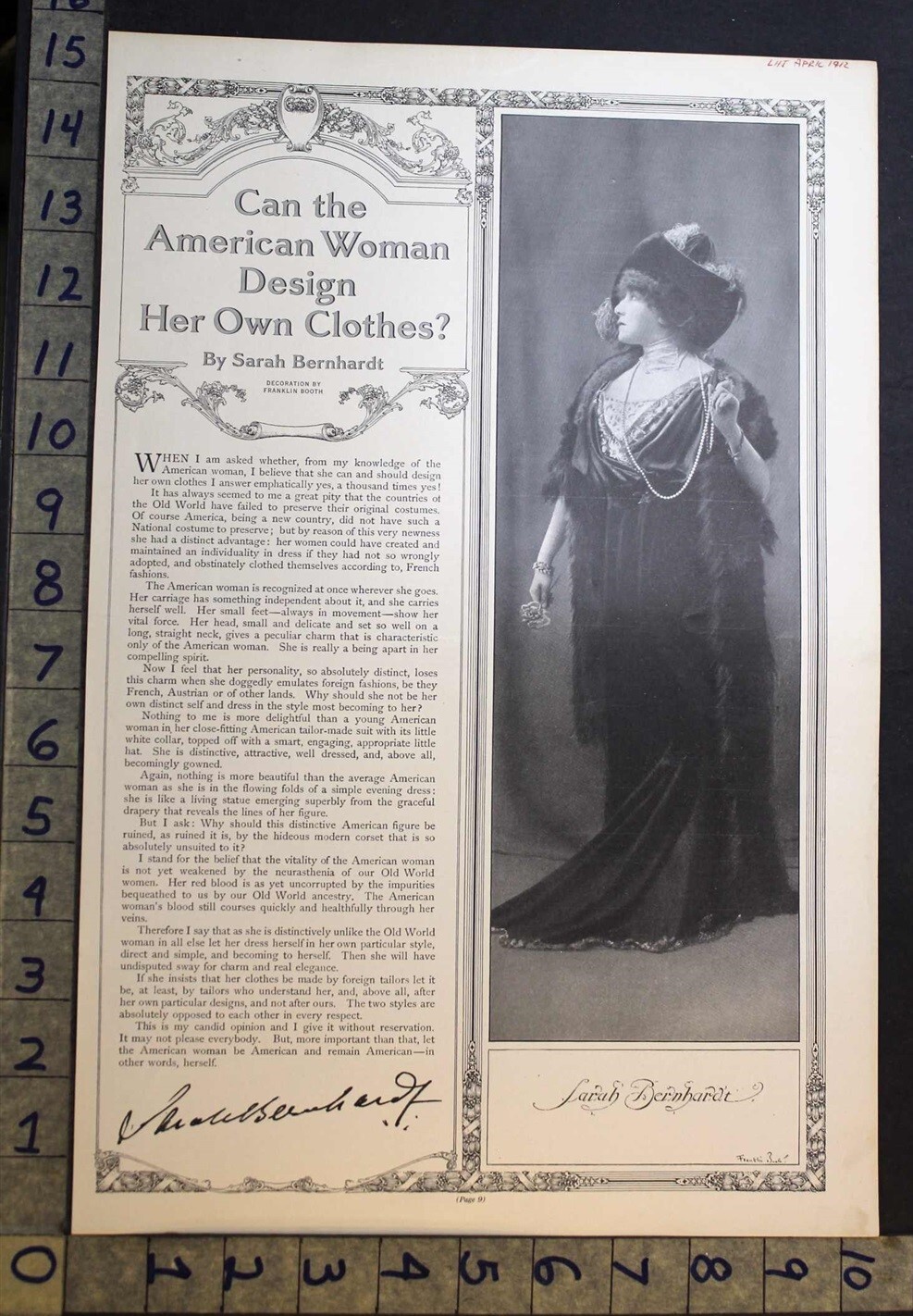
1912 WOMEN FASHION SARAH BERNHARDT DESIGNER FRANKLIN BOOTH ART DECOR PRINT 33768

When you click on links to various merchants on this site and make a purchase, this can result in this site earning a commission. Affiliate programs and affiliations include, but are not limited to, the eBay Partner Network.

1912 WOMEN FASHION SARAH BERNHARDT DESIGNER FRANKLIN BOOTH ART DECOR PRINT 33768:
$64.95
1912 WOMEN FASHION SARAH BERNHARDT DESIGNER FRANKLIN BOOTH ART DECOR PRINT 33768
DATE OF THIS**ORIGINAL** ITEM:1912
THIS ITEM IS A ONE-PAGEPRINTFROM ANORIGINALPERIODICAL.THEREIS ONEPHOTO, SO PLEASELOOK OVER CAREFULLY FOR SIZE AND CONDITION! NOTE: SOME PHOTOS MAY HAVE A BLACK BOX COVERING UP THE NAME OF THE PERIODICAL - IT IS ONLY LAYING ON TOP OF THE ITEM - NOT PERMANENT.
ILLUSTRATOR / ARTIST:
Franklin Booth(July 18, 1874 – August 25, 1948) was an American artist known for his detailed pen-and-ink illustrations. He had a unique illustration style based upon his early recreation of wood engraving illustrations with pen and ink. His skill as a draftsman and style made him a popular magazine illustrator in the early 20th-century. He was one of the first modernex librisdesigners in the United States.
Using watercolor, Booth created book illustrations, such asJames Whitcomb Riley'sThe Flying Islands of the Night. DuringWorld War I, he created posters for recruitment, fundraising, and other efforts. AsArt Decostyle illustrations became popular, his work in latter years was found in commercial publications and catalogs. Although he "believe[d] in schools to a certain extent" at one point in his career, he co-founded thePhoenix Art Instituteand was an educator for 21 years. He was inducted into theSociety of IllustratorsHall of Fame.
Jay Franklin Booth was born in 1874 and raised on a farm nearCarmel, Indiana.[1][2]His parents, Susan Wright and John Thomas Booth, had eight children. Booth, the third child,attended the Quaker Academy atWestfield.
As a boy, he was determined to become an artist. He studied pictures in books and magazines, includingScribner'sandHarper's. His unusual technique was the result of his having scrupulously copied magazine illustrations which he thought were pen-and-ink drawings, but were, in fact,wood engravings. As a result, this led him to developing a style of drawing composed of thousands of lines, whose careful positioning next to one another produced variations in density and shade. The characteristics of his art were his scale extremes with large buildings and forests looming over tiny figures, decorative scrolls and borders, classic hand lettering and gnarled trees.
He expressed his view of formal education, "I believe in schools to a certain extent, yet I think a knowledge of art is not a thing held in trust by any, but is, rather, universal and comes to them who hunger and thirst after it."He took a correspondence course in art while he lived in Indiana,and studied for three months each at theSchool of the Art Institute of Chicagoand theArt Students League of New York.
His skilled draftsmanship and unique style made him a popular illustrator.He was considered "the best pen-and-ink man in America" by an editor of a leading magazine.Despite the laboriousness of his technique, Booth's compositions were characterised by a grand sense of space. As a result, his drawings were often well-matched to poetic or editorial entries.With the advent of the "clean, smooth, and continuous lines" of theArt Decostyle illustrations, his works in latter years were found in commercial publications and catalogs.
Booth's first illustrations, created for his verses, appeared in theIndianapolis News,and he was on the staff there from 1899 to 1904.He then traveled to Rome, Paris and Spain.Beginning in 1904or 1905,he worked on theNew York Daily News.He also worked briefly at newspapers in Boston and Washington as an illustrator.Creator of theNicholsonplate, engraved in copper, he was one of the first modernex librisdesigners in the United States.He created a gift bookplate for the Indiana State Library.
Booth's illustrations appeared in popular magazines, likeScribner's,Good Housekeeping,Collier's,Harper's Magazine,andThe Saturday Evening Post.He illustratedJames Oppenheim's short stories forAmericanmagazine by 1914.
Booth created advertising art for organizations, such asRolls-Royce,Whitman's Candy,Bulova Watches,General Electric,Procter & Gamble,Paramount Pictures,andEstey Organ.He also created illustrations for severalVictor-Victrolarecord covers.
Booth contributed toWorld War Iby illustrating recruitment posters, US savings bonds envelopes, booklets and death certificates for American soldiers who perished in France and Belgium, and work for theRed Cross.
He illustrated books likeJames Whitcomb Riley'sThe Flying Islands of the Night(1913), which included multiple plates of his watercolor images. "It includes Booth's open compositions and attention to classical forms, with skies filled with soft quiet washes of hues in place of fields of tone."The book,A Hoosier Holiday(1916), chronicled the two-week automobile trip that Booth took withTheodore Dreiserfrom New York toTerre Haute, Indiana, Riley's hometown. It included 30 or 32 charcoal sketches of cities, small towns, and rural settings that Booth made along their voyage in Booth's Pathfinder touring car. It was the first book about travel via automobile.He illustratedMark Twain'sThe Prince and the Pauper(1917);Meredith Nicholson'sThe Poet,andFive-Foot Book Shelf, one of theHarvard Classicseditions.
In 1925, he co-founded the Phoenix Art Institute and was an educator there for 21 years.An edition of his work, "Sixty Reproductions from Original Drawings", was published in 1925 by Robert Frank.In 1934 and 1935, he wrote a series of articles about the art of illustration for theProfessional Art Quarterly.
Other contributions include illustrating the annualTelephone Almanacby 1940."A Continent Is Bridged", an illustration by Franklin Booth, was drawn for the Atlantic Telephone & Telegraph Company for the observance of the twenty-fifth anniversary of transcontinental telephone service in 1940.
He created illustrations—like of a black-eyed susan and box turtle—for several stamps for a 1941 wildlife conservation series by theNational Wildlife Federation.[During his career, he helped develop a process of permanent reproduction of line design on titles and aluminum with theReynolds Metals Company.
William H. Block Company sold a number of his drawings in 1946.In 1947, the book20 Franklin Booth Masterpieceswas published.[He was a member of the Guild Freelance Artists and the Society of Illustrators.
OTHER INFO OF CONCERN FOR THIS LISTING - SPECIAL CHARACTERISTICS AND DESCRIPTIVE WORDS:
Sarah BernhardtbornHenriette-Rosine Bernard; 22 October 1844 – 26 March 1923) was a French stage actress who starred in some of the most popular French plays of the late 19th and early 20th centuries, includingLa Dame aux CaméliasbyAlexandre Dumasfils,Ruy BlasbyVictor Hugo,FédoraandLa ToscabyVictorien Sardou, andL'AiglonbyEdmond Rostand. She also played male roles, including Shakespeare'sHamlet. Rostand called her "the queen of the pose and the princess of the gesture", and Hugo praised her "golden voice". She made several theatrical tours around the world, and she was one of the early prominent actresses to make sound recordings and to act in motion pictures.
She is also linked with the success of artistAlphonse Mucha, whose work she helped to publicize. Mucha became one of the more sought-after artists of this period for hisArt Nouveaustyle.
Henriette-Rosine Bernardwas born at 5 rue de L'École-de-Médecine in theLatin Quarterof Paris on 22 October 1844She was the daughter of Judith Bernard (also known as Julie and in France as Youle), a Dutch Jewishcourtesanwith a wealthy or upper-class clientele.The name of her father was not recorded for a long time, but he is known now to have been an attorney inLe Havre.[7]Bernhardt later wrote that her father's family paid for her education, insisted she be baptised as aCatholic, and left a large sum to be paid when she came of age.Her mother travelled frequently, and saw little of her daughter. She placed Bernhardt with a nurse inBrittany, then in a cottage in the Paris suburb ofNeuilly-sur-Seine.
When Bernhardt was seven, her mother sent her to a boarding school for young ladies in the Paris suburb ofAuteuil, paid with funds from her father's family. There, she acted in her first theatrical performance in the playClothilde, where she held the role of theQueen of the Fairies, and performed her first of many dramatic death scenes.While she was in the boarding school, her mother rose to the top ranks of Parisian courtesans, consorting with politicians, bankers, generals, and writers. Her patrons and friends includedCharles de Morny, Duke of Morny, the half-brother of EmperorNapoleon IIIand President of the French legislature.At the age of 10, with the sponsorship of Morny, Bernhardt was admitted to Grandchamp, an exclusive Augustine convent school nearVersailles.At the convent, she performed the part of theArchangel Raphaelin a story based on the book of Tobit.She declared her intention to become a nun, but did not always follow convent rules; she was accused ofsacrilegewhen she arranged a Christian burial, with a procession and ceremony, for her pet lizard.She received her first communion as a Roman Catholic in 1856, and thereafter she was fervently religious. However, she never forgot her Jewish heritage. When asked years later by a reporter if she were a Christian, she replied: "No, I'm a Roman Catholic, and a member of the great Jewish race. I'm waiting until Christians become better."That contrasted her answer, "No, never. I'm an atheist" to an earlier question by composer and compatriotCharles Gounodif she ever prayed.Regardless, she accepted thelast ritesshortly before her death.
In 1857, Bernhardt learned that her father had died overseas.Her mother summoned a family council, including Morny, to decide what to do with her. Morny proposed that Bernhardt should become an actress, an idea that horrified Bernhardt, as she had never been inside a theatre.Morny arranged for her to attend her first theatre performance at theComédie Françaisein a party which included her mother, Morny, and his friendAlexandre Dumaspère. The play they attended wasBritannicus, byJean Racine, followed by the classical comedyAmphitryonbyPlautus. Bernhardt was so moved by the emotion of the play, she began to sob loudly, disturbing the rest of the audience.Morny and others in their party were angry at her and left, but Dumas comforted her, and later told Morny that he believed that she was destined for the stage. After the performance, Dumas called her "my little star".
Morny used his influence with the composerDaniel Auber, the head of theParis Conservatory, to arrange for Bernhardt to audition. She began preparing, as she described it in her memoirs, "with that vivid exaggeration with which I embrace any new enterprise."Dumas coached her. The jury was composed of Auber and five leading actors and actresses from the Comédie Française. She was supposed to recite verses from Racine, but no one had told her that she needed someone to give her cues as she recited. Bernhardt told the jury she would instead recite the fable of the Two Pigeons byLa Fontaine. The jurors were skeptical, but the fervor and pathos of her recitation won them over, and she was invited to become a student.
ADVERTSIZE:SEE RULER SIDES IN PHOTO FOR DIMENSIONS ( ALL DIMENSIONS IN INCHES)
**For multiple purchases please ASK FOR + wait forour combined invoice.Shipping discountareONLYavailable with this method. Thank You.
Our AD's and COVER'Sare ORIGINAL and 100% guaranteed --- (we code all our items to insure authenticity) ---- we stand behind this.
As graphic collectors ourselves, we take great pride in doing the best job we can to preserve and extend the wonderful historic graphics of the past.
PLEASE LOOK AT OUR PHOTO CLOSELY ASIT IS (ALBEIT LOWER RESOLUTION) THE PRODUCT BEING SOLD.....NOT STOCK IMAGES
**NOTE** : PAGES MAY SHOW AGE WEAR AND IMPERFECTIONS TO MARGINS, WITH CLOSED NICKS AND CUTS, WHICH DO NOT AFFECT AD IMAGE OR TEXT WHEN MATTED AND FRAMED. SOMETIMES THE PAGES HAVE BEEN TRIMMED.. PLEASE NOTE THE ACTUAL SIZE OF SELLING AD IN THE ATTACHED PHOTO IMAGE... WHAT YOU SEE IS WHAT YOU GET...
Weship viaUnited States Postal Service.We have a3 day handling time not including weekends or holidays but normally we have all orders processed, packed and shipped within 48 hrs.
A Note to our international buyers (Including Canada). Please read before placing a offer or buying an item:
**Import taxes, duties and charges are not included in the item price or shipping charges. These charges are the buyer's responsibility. Please check with your country's customs office to determine what these additional costs will be prior to offerding/buying on items. These charges are normally collected by the shipping company or when you pick the item up,this is not anadditionalshipping charge. We are not responsible for shipping times to international buyer's. Your country's customs may hold the package for a month or more.
**We pride ourselves on quality products, great service, accurate gradationsand fast shipping.**
BRANCHWATER BOOKS
YOUR AD WILL BE SHIPPED ROLLED IN APROTECTIVE PLASTIC BAG INAN 80mm (TWICE USPSRECOMMENDED) THICK, 2 INCHESIN DIAMETER (SO AS NOT TO STRESS THE PAPER)SHIPPING TUBE WITH PRESS TIGHT PLASTIC END CAPS.
33768
Powered by SixBit's eCommerce Solution
1912 WOMEN FASHION SARAH BERNHARDT DESIGNER FRANKLIN BOOTH ART DECOR PRINT 33768:
$64.95
Related Items:

Mathurin Moreau (1822-1912) Bronze Nude Female Woman Statue Sculpture
$3500.00

RARE antique Military ALBUM Photos Buzuluk Women's Gymnasium graduation 1912
$1999.00
![[ILLINOIS-ST. MARY’S SCHOOL-FEMALE STUDENT LIFE] Album, ca. 202 Photos. Ca. 1912 picture](/store/img/g/ivUAAeSwPmNqDIVc/s-l225/-ILLINOIS-ST-MARY-S-SCHOOL-FEMALE-STUDENT-LIFE-Alb.jpg)
[ILLINOIS-ST. MARY’S SCHOOL-FEMALE STUDENT LIFE] Album, ca. 202 Photos. Ca. 1912
$750.00