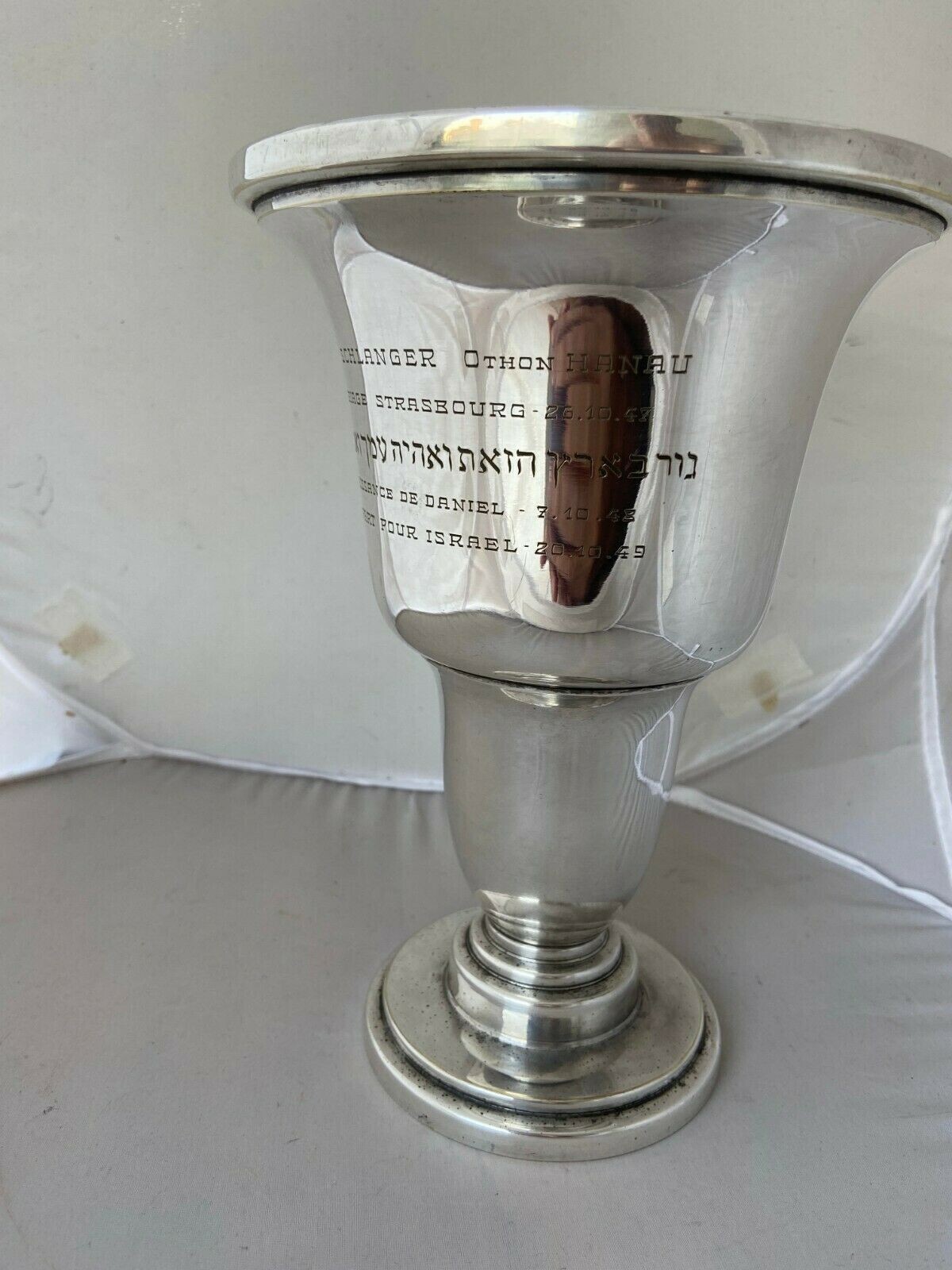
Antique Judaica lise schlanger hanau cup saved rescued jews wwii amazing scarce

When you click on links to various merchants on this site and make a purchase, this can result in this site earning a commission. Affiliate programs and affiliations include, but are not limited to, the eBay Partner Network.

Antique Judaica lise schlanger hanau cup saved rescued jews wwii amazing scarce:
$14450.99
Antique Judaica silver plate cup Given to Lise Hanau (née Schlanger)
RareHeight: 20.5 cm ( about 8.2")Diameter: 15 cm (about 6") upDiameter base: 9.5 cm (about 4")Condition: very good (worn – minor)
Lise Schlanger was born in Strasbourg on January 21, 1925. Raised in this city, she was a scout until the war.Refugee from Alsace, studied nursing in Limoges with exemption from age due to her refugee status. Then she worked at the Rivesaltes camp (see article opposite).She then worked in a home for non-Jewish children under false documents.Immediately after the war, in 1945, she left for Israel, and worked as a nurse at the Assuta Hospital in Tel Aviv, then as an independent.Lise returns to France in 1947 for her sister's wedding, and she meets the man who will be her husband a few months later. A year after the birth of their son, all three returned to Israel, but they had to return to France to replace Lise's father, who was ill in his business.She then became involved in community life in Strasbourg, in particular at the KKL , and assisted the mohel (circumciser) Isi Wertheimer .In 1962, she led the women's team which took care of the care to be given to children and mothers repatriated from North Africa , spending whole days at the community center.She is always available to her friends and so until 1977, when she returns to Israel, when her husband retires. Lise remains active today.Lise Hanau died in Jerusalem on Friday December 28, 2013. She was buried the following Sunday in the Petah Tiqwah cemetery.
Lise Hanau, nee SchlangerLise Hanau, née Schlanger, was born on January 21, 1925 in Strasbourg. She was a member of the Boy Scouts until the war. When the war started, she fled to Limoges. Due to her refugee status, the age limit was not applied to her, so she was allowed to start nursing training there early. After completing her training, she worked for three months at Haus l'Isére.In this non-Jewish facility, unmarried mothers and sick children were cared for. She was relatively protected by false papers. But in 1942 she received an urgent call from Andrée Salomon of the OSE (short for Oeuvre de Secours aux Enfants, i.e. the Jewish children's charity), which she already knew from Strasbourg.Andrée Salomon, née Sulzer, was a paralegal in Strasbourg. She and her husband Tobie had visas and could have emigrated to America or Palestine. In the face of the misery of the persecution of the Jews and the internment camps, they stayed in France. With remarkable energy she organized legal and illegal rescue operations for Jewish children. And she frequented all available forces for this task by telephone or telegram. So she asked Lise to take a train to Rivesaltes (see also Friedel Bohny-Reiter) that same day to take care of the children in the internment camp. When she objected that she was not available at such short notice, she received the answer: Il te faut longtemps pour prendre quelques slips et une brosse à dents? (Translated: Do you need a lot of time to pack a pair of panties and a toothbrush?) Lise immediately traveled to Rivesaltes in her nurse's clothes with the wide nurse's cape, equipped with a permit from Andrée Salomon.In the internment camp, she took over the children's barracks. The children should be collected here in a targeted manner in order to be able to help them better and more specifically. Lise, not even eighteen years old, almost a child herself, worked non-stop. It suited her that she could address the children in French, German, Yiddish or English given the mixture of peoples. For many children she obtained forged papers from a counterfeiting workshop in Marseille when they were released. These identity papers were particularly important for young people over the age of 16, because from this age they were treated the same as adults. So they were made a few months younger in their identity papers.Things got really dicey in September 1942. The deportations of the Jewish internees to the extermination camps began. Again and again she mingled with the people who were waiting to be taken away. She looked for children in the crowd who had not been entrusted to the children's barracks. In a flash, she had the child disappear under her nurse's cloak, often enough under the noses of the guards, sometimes just before boarding the train. As inconspicuously as possible she then went back to her barracks with the child under her cloak to hand them over to the young helpers of her barracks. She immediately marched back to the crowd, again scouting for children to save them from deportation.More and more relatives gave her the children in the hope of finding them safe and sound when they returned. The children's barracks were quickly overcrowded. The OSE, which could rely on the support of the Perpignan prefecture, officially or secretly smuggled the children out of the camp with forged French papers. Lise even brazenly hid two children under the bench of a car that was leaving the camp. All the children in the OSE children's barracks were saved and were later taken into children's homes or foster families.In December 1942 she also left Rivesaltes and moved to the Grenoble region, where she worked in a non-Jewish children's home. In 1945 she moved to Israel, first worked in a hospital in Tel Aviv and then became self-employed. When she traveled to France to marry her sister in 1947, she met her husband. After returning to Israel, she soon had to return to France to take care of her ailing father.In 1962 she accepted a new challenge in France. After tens of thousands of Algerians were massacred by the French army after unrest in Setif and Guelma in 1945, the independence movement in Algeria took off. Algeria gained independence in 1962 after eight years of bloody war. Many Algiers French moved to France. Thousands of Jews were also among the refugees. Rabbi Max Warschawski organized comprehensive integration assistance for Jews from North Africa in Alsace. And Lise Hanau took over the management of the team responsible for the care and health issues of the children and mothers from North Africa
In 1942, Félicie Lise Schlanger Hanau arrived in Grenoble where she was recruitedby Andrée Salomon . She works at the Fort-Paillet camp in Vénissieux in the Lyon region.She arrives at the Rivesaltes camp where she works voluntarily in the children's barracks. She organizes illegalcrossings of children from inside to outside the camp, and accompanies them to Lyon. She brings false papers into thecamp to allow escapes of adults.Arrested for a few hours, she was released thanks to the testimony of an officer; that night, November 11, 1942, theGerman army invaded the southern zone.Lise Hanau continued her activities until the Liberation.Medal of the Fighter against Nazism (IsraeLise Hanau (née Schlanger)The wonderful nurse from Rivesaltes1925-2013by Marianne Picardexcerpt from Mémoire vive , journal of the Aloumim Association (IsraeliAssociation of Children Hidden in France during the Shoa), No. 22-23 June2001 with the kind permission of the author.The text was annotated by Lise HanauShe is so discreet, so modest, that we had difficultyfinding her. Then we had to beg her for permission totalk about the admirable role she played during theHolocaust in France.Lise Hanau, originally from Strasbourg whosecharming intonation she has kept, has lived for manyyears in Israel where, well integrated, she is known forher availability, her generosity, her love for others.We are in 1942. Lise Hanau has just finished hernursing studies and has been working for threemonths in a non-Jewish house in Isère whichwelcomes single mothers and sick children, when shereceives an imperative phone call from AndreeSalomon she knew from Strasbourg and who asks herbluntly: " Take the train this evening and meet me at the Rivesaltes camp, you willbe the nurse for the children of the camp. "Lise hesitates: " It is difficult for me to leave so fast, ”she replies.At the other end of the line, André Salomon's well-timed voice retorts: " Do youneed a long time to take a few briefs and a toothbrush? "When Andrée Salomon gives an order, we can only comply. And Lise leaveswithout her parents objecting, which is remarkable. She receives a pass fromAndrée Salomon who is waiting for her in Perpignan and enters the Rivesaltescamp, in her nurse's uniform, with her large cape and blue veil.Located in the Pyrénées Orientales, a department in southwestern France,Rivesaltes was a concentration camp surrounded by barbed wire and guarded byFrench soldiers. It was soon to become a transit camp to the extermination sites.In this camp, not a blade of grass, remembers Lise, nothing but stones, barrackswhere Jews of foreign nationality arrested during a raid, a check, crossing thedemarcation line or an attempt to cross the Spanish or Swiss border illegally.Whole families live in a total lack of hygiene, the latrines are simple boards withoutdoors; we sleep on straw with, for all bedding, a bad blanket. In the barracks, notable, no chairs, no toiletries. Separated from the women, the men, totally idle, livein perpetual anguish.Andrée Salomon has taken up residence in theRivesaltes camp and Lise becomes the nurse atthe children's hut. It is a building located at theend of the camp where Andrée Salomon and histeam want to bring in as many children aspossible.Lise, who is not yet eighteen, works tirelessly.11/21/21, 4:43 PM Lise HANAURefugee from Alsace, studiednursing in Limoges withexemption from age due to herrefugee status. Then sheworked at the Rivesaltes camp(see article opposite).She then worked in a home fornon-Jewish children under falsedocuments.Immediately after the war, in1945, she left for Israel, andworked as a nurse at theAssuta Hospital in Tel Aviv,then as an independent.Lise returns to France in 1947for her sister's wedding, andshe meets the man who will beher husband a few monthslater. A year after the birth oftheir son, all three returned toIsrael, but they had to return toFrance to replace Lise's father,who was ill in his business.She then became involved incommunity life in Strasbourg, inparticular at the KKL , andassisted the mohel(circumciser) Isi Wertheimer .In 1962, she led the women'steam which took care of thecare to be given to children andmothers repatriated fromNorth Africa , spending wholedays at the community center.She is always available to herfriends and so until 1977, whenshe returns to Israel, when herhusband retires. Lise remainsactive today.Lise Hanau died in Jerusalemon Friday December 28, 2013.She was buried the followingSunday in the Petah Tiqwahcemetery.She is almost alone to take care of about fortyresidents. With the help of three or four youngBelgians, she must distribute the lunch soup tothem, wash them, delous them, blackmail them;Drive them in a row at 4 p.m. to the Swiss rescuehut, which offers them sweetened rice pudding.In addition, she walks around the camp and offersparents to entrust their children to her.who will bebetter off in his hut (1) . Some mothers agree, inthe interest of their offspring, but others, tooanxious, refuse to separate from their young.When she can leave the camp, she takes theopportunity, according to Andrée Salomon'sinstructions, to obtain false identity papersintended for the children (2) . The objective of thisaction is simple: to avoid at all costs thedeportation of these young people.Then comes September 1942: it is during theTishri celebrations that the first departures areorganized, the first deportations. Lise attends thecall of the Jews who leave for Drancy thenAuschwitz. She sees in the group a little boy thathis parents had not wanted to entrust to thechildren's barracks. In a few seconds, sheapproaches him, stuffs him into his large cloakand leads him as quickly andas discreetly aspossible towards his hut (3) .Lise very often undertakes such rescueoperations, under the noses of the police,sometimes just before boarding the train. Barelysaved, terrified, shocked by the separation, thechildren who have just left their parents arrive inthe barracks in tears. Lise immediately organizesa round or a game, she gives each of them a littlesomething and surrounds them with her affection.She speaks to them in French, but also inGerman, Yiddish, English, she finds the words foreveryone.11/21/21, 4:43 PM Lise HANAULise Schlanger (Hanau) in nurse's uniform atRivesaltes in 1942The children of Rivesaltes with Lise Schlanger (left)Comprenant que la situation va en empirant, que les déportations se déroulent àun rythme accéléré, Lise Hanau va de baraque en baraque proposer aux parentsencore réticents de prendre en charge leurs enfants jusqu'à leur retour... Beaucoupacceptent cette séparation que tous espèrent provisoire. Officiellement limité à 35,le nombre des pensionnaires de la baraque est maintenant beaucoup plus élevé.Andrée Salomon et son équipe font sortir les enfants, soit par une filière officielle(4), dotés de faux papiers ou de familles fictives de nationalité française, soit pardes filières clandestines. Lise fait par exemple passer deux enfants cachés sous labanquette d'une voiture.Tous les jeunes qui sont passés par la baraque des enfants ont été sauvés : enquittant Rivesaltes, ils ont rejoint des maisons d'enfants, des familles d'accueil.Lise Hanau quitte Rivesaltes début décembre 1942, les derniers Juifs de ce campayant été conduits à Gurs. Elle rejoint la région de Grenoble.Admirable Lise Hanau ! Mais elle ne tire aucune gloire de ce qu'elle a fait."J'étais jeune, dit-elle, j'aimais l'aventure. En tant que juive, j'étais contente de fairequelque chose de concret pour aider mon peuple, et si j'ai pu contribuer à sauverdes enfants, c'est parce que j'avais sous les yeux l'exemple contagieux d'AndréeSalomon dont la force nous galvanisait. Elle m'a appris à mépriser le danger et àgarder toujours espoir dans l'amour des enfants."11/21/21, 4:43 PM Lise HANAULes deux faces d'une carte postale adressée à Lise Schlanger (Hanau)Notes ajoutées par Lise Hanau au texte de Marianne PicardNous voulions regrouper les enfants dans la baraque d'enfants pour plusieursraisons :- les éloigner de la proximité des adultes- les réunir et les occuper entre eux- et surtout tâcher de les faire libérer au plus vite du campLa préfecture de Perpignan nous était favorable. Andrée Salomon, qui dirigeaitnos équipes a usé de toute son influence, de toute sa ténacité pour faire libérer lesenfants en groupe. Chacun d'eux recevait un certificat de libération de laPréfecture. Ceux des enfants qui n'ont pu être libérés officiellement, ont étéévacués illégalement par nous. Il était impératif que tous les enfants quittentrapidement le camp - à tout moment les ordres de Vichy pouvaient annuler unstatut. Retour au texteLe laboratoire de faux papiers se trouvait à Marseille. Les papiers étaient pour lesjeunes de plus de 16 ans et les adultes. Les jeunes étaient déportables à partir de16 ans, nous les avons rajeunis de quelques mois. Les adultes avaient d'autresproblèmes qui ont été résolus. Retour au texteRoch Hashana 13-9-1942 :Dès le matin tous les internés sont dehors devant chaque baraque. Un bloc depersonnes, hommes, femmes et quelques enfants.... Sur la place devant eux uneestrade pour les autorités du camp.L'appel des partants se fait par haut-parleurs. Les noms de ces malheureuxs'égrènent, lentement. Tous sont à l'écoute le coeur battant. Les personnesappelées commencent à bouger. Elles doivent traverser la place et se rendent del'autre côté, là où se rassemblent les déportés de demain. Ils sont déjà dans unmonde à part. L'appel continue. Lorsque que je vois que des enfants se trouventavec un couple appelé, je suis rapidement a leurs côtés. Je ne dis rien. Ils meconnaissent, nous avons souvent parlé. J'ouvre mes bras et les parents poussentles enfants vers moi. Une courte étreinte entre eux et j'emmène ces enfants à labaraque 67, la baraque d'enfants. Là, ma petite équipe belge les reçoit. Jeretourne à l'appel et continue jusqu'à la fin de la journée à recevoir au derniermoment les enfants qui étaient restés avec leurs parents. Minutes tragiques, mais11/21/21, 4:43 PM Lise HANAUl'action donne des forces. Le but est présent pour eux, pour moi : sauver lesenfants. Bien entendu la baraque était pleine d'enfants qui s'étaient ajoutés dans lajournée, 30-40 et plus, mais l'espoir était en nous. Il fallait seulement agirrapidement.The next day, Andrée Salomon will work for their release. The OSE will take care ofthem, they will be guarded and if D. wants it, it is through the OSE that they willmeet again one day. Back to textThanks to the interventions of Andrée Salomon, the prefecture of the EasternPyrenees allows a large number of children to leave the camp
Antique Judaica lise schlanger hanau cup saved rescued jews wwii amazing scarce:
$14450.99
Related Items:
Antique Massive Hanukkah Menorah Judaica Museum Level
$55000.00

19th Century Antique Brass Sign Plaque England Jewish Orphanage English Judaica
$25000.00
Antique Judaica Painting of a woman writing a religious script
$23500.00