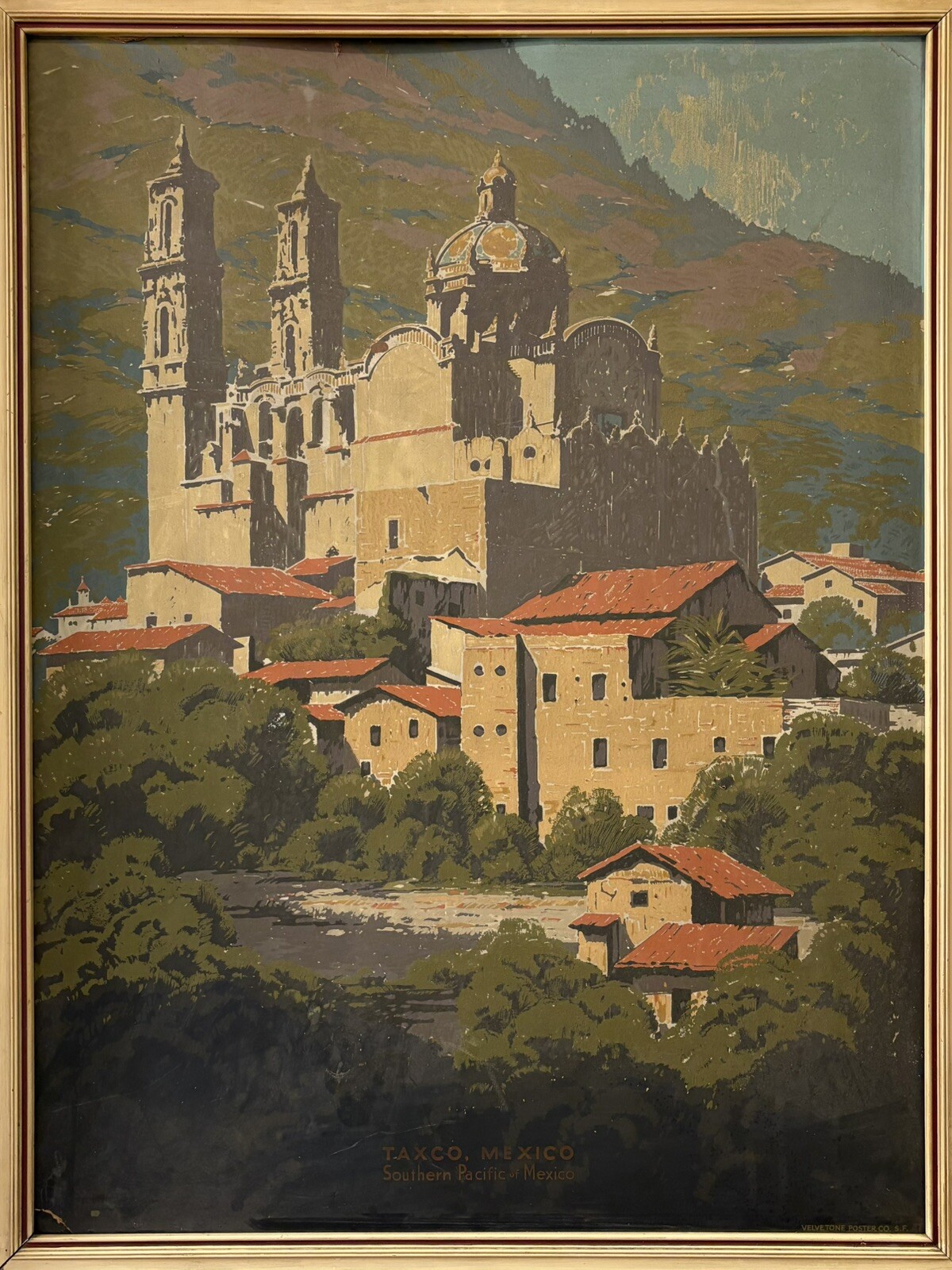
🔥 Very RARE Antique 1930s Southern Pacific RAILROAD Mexico TAXCO Travel Poster

When you click on links to various merchants on this site and make a purchase, this can result in this site earning a commission. Affiliate programs and affiliations include, but are not limited to, the eBay Partner Network.

🔥 Very RARE Antique 1930s Southern Pacific RAILROAD Mexico TAXCO Travel Poster:
$6500.00
This is an Incredible andVery RARE Antique 1930s Southern Pacific RAILROAD Mexico TAXCO Advertisement Travel Poster, Silkscreen on Board, for Southern Pacific of Mexico, a short-lived railway line by the Southern Pacific Railroad Company that existed from 1911 - 1951. This poster is based on a beautiful and originalplein air oil painting of Taxco, Mexico by California Impressionist luminary, Sam Hyde Harris (1889 - 1977,) which is currently displayed in the permanent collections of the Casa Romantica Cultural Center and Gardens in San Clemente, California (see photo 24.) This poster depicts the historic Church of Santa Prisca de Taxco, small outlying buildings, surrounding woodlands and lavender hued mountains in the distance. This piece is signed on plate: "Sam Hyde Harris" in the lower left corner, and titled: "TAXCO, MEXICO. Southern Pacific of Mexico" at the lower center edge and bears the printer's name: "VELVETONE POSTER CO. S.F." in the lower right corner. Approximately 33 1/8 x 43 1/8 inches (including frame.) Actual artwork is approximately 30 x 40 inches. This piece can confidently be dated to the late 1920's - early 1930's. Very good condition for nearly a century of age and storage, with moderate scuffing, scratches, edge wear and paint loss to the original period antique painted wood frame. Additionally, heavy layers of surface dust, scuffing, light scratches, and mild paint loss along corners of this poster are visible (please see photos carefully.) I have not attempted to clean the majority of the surface dust, due to the delicate nature of this very old and historically significant silkscreen artwork. This task, if desired, is left to the discretion of the buyer. In conclusion, this poster is museum worthy for several reasons: 1. It is the only original Southern Pacific of Mexicotravel poster known to exist in the world. 2. It is the only known extant example of this poster, and likely the only one to ever surface again (it has never been seen before by scholars, collectors or Southern Pacific Railroad historians.) 3. It is one of only a handful of known Southern Pacific Railroad posters that the legendary California landscape painter, Sam Hyde Harris, personally contributed his artwork and designs towards. PRICED TO SELL. I will give special consideration to any Offers from Museum or Educational institutions. Acquired from an old estate collection in Los Angeles, California. If you lie what you see, I encourage you to make an Offer. Please check out my other listings for more wonderful and unique artworks!
About the Artist:
Samuel Hyde HarrisBorn:1889 - Middlesex, England
Died:1977 - Los Angeles, CaliforniaKnown for:Landscape and marine painting, illustration, mural
Samuel Hyde Harris (1889 - 1977) was active/lived in California.Samuel Harris is known for Landscape and marine painting, illustration, mural.Sam Hyde Harris Paints the Desert
Though born in England in 1881, Sam Hyde Harriswas an artist for the Southwest: though he did not move to the United States until he was 15, he was already drawing scenes of what he imagined the West looked like when he was just 12. When his family did move, they settled in Los Angeles, and for all his life Sam's artreflected the region’s sun-drenched hues.
In 1920, the Santa Fe Railway, which was resuming its advertising efforts after World War I, hired Harris to design posters and ads. Harris’ reds, yellows, and blues were perfect for the Santa Fe’s continuing theme of deserts, Indians, and the Grand Canyon.
The Santa Fe used his paintings in posters as well as brochures, magazine ads, and other advertising. He won numerous awards for his fine art works and a great deal of recognition for his commercial art.Harris also did some work for the Southern Pacific, including this poster for the railroad’s premiereSunset Limited. The Eucalyptus trees in the foreground together with the mountain background says this poster is in California, not Louisiana, the other end of theSunset's journey.Harris eventually settled in the LA suburb of Alhambra, home to a noted artists’ colony, and was known as one of “the Eight” leading artists in the city. He outlived the other seven, remaining in Alhambra until his death at the age of 96 in 1977.At 14 years of age Sam Hyde Harris was already a successful commercial artist. A 1903 letter of recommendation from Andre & Sleigh, stated that, "We have the pleasure in stating that Samuel Harris (aged 14 ½ years) has given every satisfaction during the 8 or 9 months he has been engaged in our Artists Department."
After moving to California with his family Harris got a job as painter of signs, billboards and hand-lettered show cards in 1906. He developed a reputation for doing excellent commercial work and opened his own commercial art studio by 1914. His commercial art business received a boost in 1920 when he was hired by the Atchison, Topeka, and Santa Fe Railway Company to work on their poster advertising. He was later hired to do artwork Southern Pacific Railways as well.
He began studying painting with Hanson Puthuff in 1906 and continued studying throughout much of his life. As early as 1920 he was exhibiting with the California Art Club. He continued exhibiting his paintings for the next fifty plus years including with the Painters and Sculptors of Southern California, the Pacific Advertising Club Association (1929), the San Gabriel Artists Guild, the Laguna Beach Art Association and many other venues.
He won countless awards in hundreds of exhibitions throughout Southern and Northern California. Sam Hyde Harris was "Highly recognizable because of his six-foot-three stature and cigar." He "was known for his jovial personality and his love for his adopted California and her landscape." He preferred painting en plein air to the studio. He loved the outdoors. Harris's paintings employ a progressive composition, pushing the viewers eye to an unexpected place. He taught art classes at the Chouinard School of Art (1935) and for many Clubs and Groups.
He met and married Marion Dodge in 1945. They moved to Alhambra in 1946. He bought Jack Wilkinson Smith's "Artists' Alley" studio on Champion Place in 1950. He loved looking at the San Gabriel Mountains from his Champion Place studio.
Biography submitted by Maurine St. Gaudens, Administrator, Marion Dodge Harris Estate:
Sources:
Maurine St. Gaudens, Marian Yoshiki-Kovinick, Gary Lang, Dr. Martin A. Folb,Sam Hyde Harris: 1889 - 1977 a Retrospective: A Pictorial Biography of His Life and WorkSam Hyde Harris (1889-1977) (Los Angeles)
Los Angeles painter, teacher, commercial artist, who sketched in Morro Bay, 1950.
“Artist Praises Eucalyptus Trees at Morro Bay” (unidentified newspaper clipping dated August 10, 1951, in MBAA Scrapbook, 1951-55, p. (29)) that says “ ‘At the town of Morro Bay on the high ground overlooking the blue Pacific there is a parade of beautiful eucalyptus. No two are alike, endless variety … they make a marvelous silhouette many blocks long at the water’s edge.’
Sam Hyde Harris, instructor of art at Business Men’s Art Institute, Los Angeles, prepared the article this description was taken from, printed in the BMAI Art Beacon in December 1950. To his readers Harris suggests Morro Bay and its trees as subjects worthy of big canvas and big painters. ‘… in almost any direction there is subject matter without end. A magnificent hill form, rock and tree content, running almost straight up from the ocean, with three distinct avenues of eucalyptus … houses nestling at the base giving scale to the magnificent shape.’
One of these houses is owned by Aaron Kilpatrick, a strong painter of the traditional school who expressed it this way to Harris. ‘Well, Sam, I have traveled from Mexico to Oregon and this is my selection for a home and studio. I feel there is more painting material within a radius of fifteen miles of Morro Bay than any place I know.’ Harris’ own comment was simply, ‘I think he is about right. Occasionally one encounters man’s ruthless cutting down of beautiful trees, but for the most part, at present, this area is unspoiled.’”
Source: Nancy Dustin Wall Moure, MORRO BAY (including LOS OSOS, BAYWOOD PARK and CAYUCOS) ART AND PHOTOGRAPHY BEFORE 1960 (Publications in [Southern] California Art, vol. 13, no. I), Los Angeles: Dustin Publications, 2016.Biography fromAmerican Legacy Fine Arts
Samuel “Sam” Hyde Harris was born on February 9, 1889 in Brentford, Middlesex, England. His father was David Remnant Harris (1854-1919), a regular working-class man, and his mother was Eliza Hyde Harris (1859-1892), second wife to David Harris. Sam was one of seven children. His mother passed away when he was only three years old, leaving his father to raise a large family alone. An elderly neighbor befriended Sam and encouraged him to pursue his art-making interests.
At fourteen years of age Sam Hyde Harris was already a productive commercial artist. A 1903 letter of recommendation from the British photo-engraving firm, Andre & Sleigh, where he worked wrote, "We have the pleasure in stating that Samuel Harris has given every satisfaction during the eight or nine months he has been engaged in our Artists Department."
On November 27, 1903 Harris and his family arrived to America on Ellis Island after sailing The Cedric from Liverpool. The family settled in Los Angeles and his father and half-brothers began a slate tile and roofing business. Sam Hyde Harris enrolled in classes at the Los Angeles Art Students League and the Canon Art School, where he studied with the Impressionist painters, Frank Tolles Chamberlin (1873-1961), Hanson Duvall Puthuff (1875-1972), and the early modernist Stanton McDonald-Wright (1890-1973).
Harris began working with Puthuff in 1906 and the two became life-long friends. Harris’ early works particularly show a strong influence from Puthuff, with similarities in their fluid brushstrokes, and plein air subject matter. His first American employment was in 1906 with Charles R. Mogel and Aaron E. Kilpatrick where he worked primarily as a sign and billboard painter.
In 1913 Sam Hyde Harris returned to Europe and spent five and a half months traveling through England, France, and Belgium studying the works of old masters in museums and visiting art galleries. He found particular inspiration from the paintings of John Constable (1776-1837) and J.M.W. Turner (1775-1851). After he returned to Los Angeles, he continued his commercial art business and furthered his enthusiasm to develop his fine art work.
On January 15, 1917 Harris married Phoebe Katherine Mulholland (1896-1978), the niece of William Mulholland (1855-1935), the self-taught civil engineer who designed and built the 233-mile-long Los Angeles Aqueduct to move water from Owens Valley to San Fernando Valley. The aqueduct project began in 1905 and was completed in 1913, four years before Phoebe and Sam were married. At the time of their marriage, the Mulholland name in Los Angeles was well known. Sam and Phoebe had three sons, Donald Hyde, Samuel Hugh, and Bruce Richard.
The six-foot-three outgoing Harris developed a reputation for doing excellent commercial art work and at age twenty-five he opened his own studio at 113 West 6th Street in Los Angeles. His business began to flourish in 1920 when he was hired by the Atchison, Topeka, and Santa Fe Railway Company to work on their poster advertising campaign. Harris’ roster of prestigious clients included Southern Pacific Railroad, Union Pacific Railroad, Santa Fe Railway, and the Pacific Electric “Red Cars.” As a side-note, Harris never learned to drive and relied on the Red Car for Los Angeles-area transportation. One of his most recognizable commercial works was for Van de Kamp Bakeries for whom he created the famous Blue Windmill logo and lettering.
In 1919 Harris moved his business, “Sam H. Harris, Posters, Art Titles, Letterings,” to 631 S. Spring Street on the 6th floor of the Realty Board Building, where it continued until a 1938 fire destroyed the building. Harris’ prolific work with the railroads was recognized in 1997 when the California State Railroad Museum in Sacramento held an exhibition titled Sam Hyde Harris: Railroad Advertising Artist.
As his commercial business was increasing, Harris felt freer to begin exhibiting his plein air works. His first recorded exhibition was in 1920 when he joined the California Art Club. He exhibited Sand Dunes at the club’s 11th Annual Gold Medal Exhibition held at the Los Angeles Museum of Science, History, and Art in Exposition Park (now, Natural History Museum of Los Angeles County). From that time, he continued exhibiting his work and winning numerous awards.
Harris became involved with several art organizations, including Artists of the Southwest, Mid-Valley Artists' Guild, San Gabriel Fine Arts Association, Glendale Art Association, Valley Art Guild, and San Fernando Art Association. He served as president of the San Gabriel Artists' Guild, as well as Laguna Art Association, and Whittier Art Association. His honors included recognition as a fellow of the American Institute of Fine Arts and life membership in the California Art Club.
While developing his fine art work, Sam Hyde Harris created many paintings of his immediate surroundings of the San Gabriel Valley and nearby San Pedro Harbor.
In the 1920s and 1930s, he and Hanson Puthuff went on numerous painting trips together, particularly to pristine areas of Arizona and California, traveling in pursuit of atmospheric landscapes. Aside from landscape painting, Harris also painted scenes of the working-class life, a subject familiar to him from his early upbringing. Unlike his commercial work, Harris did not create his fine art to win mass appeal. Nevertheless, his fine art achieved popular acclaim and sold well and received abundant recognition from his peers. He was the recipient of more than 100 awards and purchase prizes from colleges, community organizations, and leading art associations.
In 1935 Harris began teaching at the Chouinard School of Art as well as privately for several years. He emphasized composition to his students as the “backbone of art” and stressed to “Keep it simple.” Los Angeles Times art critic, Arthur Millier, wrote on Augst 31, 1941 in a review of Harris’ solo exhibition held at Armand DuVannes Gallery in Los Angeles, Harris' finest piece is Rain, a scene of hills under cloud and sun. It achieves dignity through fine space composition and variety through color and atmosphere. This Southland painter knows trees as the poetic The Grove and Arcadia testify. His best pictures present broad effects. When he overcrowds with details the results are less distinguished. Harbor and city provide subjects which he paints descriptively and poetically.
The 1930s brought on the Great Depression and Modernism. Modernist artworks were beginning to show up in prominent exhibitions, and many artists were indignant. In 1936 the Society for Sanity in Art was founded in Chicago by Josephine Hancock Logan, a leading patron of the Art Institute of Chicago, in support of representational art forms. The society’s branches grew around the country and Harris became a strong advocate. Later, the Society for Sanity in Art in Southern California was renamed Artists of the Southwest.
The outspoken Sam Hyde Harris is quoted as saying, The modernists rule the roost now. I won't even enter some of my paintings in their contests. I've seen some I liked, but most of it is non-understandable. There are three criteria for judging a painting. What did the artist have to say, did he say it and was it worth saying. If an artist can answer those three questions, then he has a work of art. (Alhambra Artist, 82, continues in career begun 67 years ago, Alhambra Post-Advocate, February 16, 1971, p. B-1)
In 1944 at the age of fifty-five and after twenty-seven years of marriage, Sam and Phoebe Harris divorced. On August 28, 1945 Sam married Marion Dodge (1904-1998), a UCLA librarian whom he had met at one of his evening art classes. He moved his home and commercial art business from West Los Angeles to 222 Hidalgo Street in Alhambra in an area known as “Artists’ Alley.” During the 1930s and 1940s, this area was home to western landscape artists Jack Wilkinson Smith (1873-1949), Clyde Forsythe (1885-1962), Frank Tenney Johnson (1874-1939), and animal sculptor Eli Harvey (1860-1957). During the summers, Norman Rockwell (1894-1978) stayed and painted at Artists’ Alley.
In its heyday, Artists’ Alley attracted leading western-genre personalities and artists, including Will Rogers (1879-1935), Charles M. Russell (1864-1926), Edward Borein (1872-1945), Maynard Dixon (1875-1946), and James “Jimmy” Swinnerton (1875-1974) — together they shared many painting trips to California’s Mohave Desert. Harris became friends with Swinnerton who inspired Harris to paint desert scenes. In addition, the nearby Arroyo Seco, Chavez Ravine, and San Pedro Harbor became favorite locations of inspiration for Harris to paint. The spirit of the Old West and the tradition of landscape painting at Artists’ Alley was conducive to Harris’ own interest as an artist. In 1950 after Jack Wilkinson Smith and his wife Emma had passed away, Harris purchased Smith’s studio located at 16 Champion Place and became the last artist at Artists’ Alley.
Los Angeles Examiner art editor, Howard Burke, described Harris’ charisma in a June 5, 1960 article titled Harris’ Brush Imparts Drama: “This debonair artist has a sunny personality that is transmitted directly to his paintings, reflecting the light, atmosphere and cheerful California scene to the fullest.” An avid plein-aire painter, Harris is quoted as saying, “I love the outdoors. I don't belong to any church, but I approach my work with reverence. You have to want to paint landscapes, you must love the outdoors and you have to be willing to sweat.” (Arthur Millier, "Art Parade Reviewed", Los Angeles Times, August 31, 1941)
A retrospective exhibition of Sam Hyde Harris’ work was held at the Alhambra Community Hospital and opened just twelve days before his passing on May 30, 1977. The San Gabriel Sun wrote about the exhibition, “With his strong compositions and subtle colors, San Hyde Harris captured a time and a feeling long past in a motorized and suburbanized Southern California. …The past lives on in the eloquence of his paintings.”
Written and submitted by Elaine Adams, Director
American Legacy Fine Arts
About the Southern Pacific Railroad:
Introduction
The history of the Southern Pacific stretches from 1865 to 1998 and ultimately provided rail transportation services in 13 states throughout the American West and Southwest. The Southern Pacific was represented by three railroads throughout its life. The original company was called Southern Pacific Railroad, the second was called Southern Pacific Company and the third was called Southern Pacific Transportation Company. The third Southern Pacific railroad, the Southern Pacific Transportation Company, is now operating as the current incarnation of the Union Pacific Railroad.
Origins
One of the original ancestor-railroads of SP, the Galveston and Red River Railway (GRR), was chartered on March 11, 1848 by Ebenezer Allen, although the company did not become active until 1852 after a series of meetings at Chappell Hill, Texas, and Houston, Texas. The original aim was to construct a railroad from Galveston Bay to a point on the Red River near a trading post known as Coffee’s Station. Ground was broken in 1853. The GRR built 2 miles (3.2 km) of track in Houston in 1855. Track laying began in earnest in 1856 and on 1 September 1856 GRR was renamed the Houston and Texas Central Railway (H&TC). SP acquired H&TC in 1883 but it continued to operate as a subsidiary under its own management until 1927, when it was leased to another SP-owned railroad, the Texas and New Orleans Railroad.
The Buffalo Bayou, Brazos and Colorado Railway (BBB&C), was chartered in Texas on February 11, 1850 by a group that included General Sidney Sherman. BBB&C was the first railroad to commence operation in Texas and the first component of SP to commence operation. Surveying of the route alignment commenced at Harrisburg, Texas, in 1851 and construction between Houston and Alleyton, Texas, commenced later that year. The first 20 miles (32 km) of track opened in August 1853.
Southern Pacific Railroad and Southern Pacific Company
The original SP was founded in San Francisco in 1865 by a group of businessmen led by Timothy Phelps with the aim of building a rail connection between San Francisco and San Diego, California. The company was purchased in September 1868 by a group of businessmen known as the Associates, commonly referred to as the Big Four: Charles Crocker, Leland Stanford, Mark Hopkins, Jr. and C. P. Huntington. The Big Four had, in 1861, created the Central Pacific Rail Road (CPRR). CPRR was merged into SP in 1869.
Southern Pacific Railroad and Southern Pacific Company Timeline
June 1873: The Southern Pacific builds its first locomotive at the railroad’s Sacramento shops as CP’s 2nd number 55, a 4-4-0.
November 8, 1874: Southern Pacific tracks reach Bakersfield, California and work begins on the Tehachapi Loop.
September 5, 1876: The first through train from San Francisco arrives in Los Angeles, California after traveling over the newly completed Tehachapi Loop.
February 16, 1877: Before it was the Southern Pacific, the line between Houston and San Antonio was known as the Galveston Harrisburg, & San Antonio line, the GH&SA inaugural run was met along the lines from farms and towns between modern day Houston and San Antonio. The line was originally intended to run to Austin. It was redirected after financial failure and later became part of the SP.
1877: Southern Pacific tracks from Los Angeles cross the Colorado River at Yuma, Arizona. Southern Pacific purchases the Houston and Texas Central Railway.
1879: Southern Pacific engineers experiment with the first oil-fired locomotives.
March 20, 1880: The first Southern Pacific train reaches Tucson, Arizona.
May 11, 1880: The Mussel Slough Tragedy (a dispute over property rights with SP) takes place in Hanford, California.
1881: Southern Pacific gains control of the Texas and New Orleans Railroad and the Louisiana Western Railroad.
May 19, 1881: Southern Pacific tracks reach El Paso, Texas, beating the rival Atchison, Topeka and Santa Fe Railway to El Paso.
December 15, 1881: Southern Pacific (under the GH&SA RR) meets the Texas and Pacific at Sierra Blanca, Texas in Hudspeth County. Texas was getting close to completing the nation’s second transcontinental railroad.
January 12, 1883: The Southern section of the second transcontinental railroad line is completed as the Southern Pacific tracks from Los Angeles meet the Galveston, Harrisburg and San Antonio Railway at a location three miles West of the Pecos River near to Langtry, Texas. The sterling silver spikes were alternatively driven by James Campbell and James Converse with the other driven by Col. Tom Pierce, the GH&SA president. These spikes were thereafter quickly removed. This became the first year-round all weather transcontinental railroad. Almost ten years later, March 31, 1892, the Pecos River High Bridge was opened. This moved the lineup and out of the Rio Grande Canyon and simplified the alignment. The line now extends to San Antonio and Houston along the Sunset Route.
March 17, 1884: The Southern Pacific is incorporated in Kentucky to take advantage of original jurisdiction in federal courts since the company did not operate within the Commonwealth.
February 17, 1885: The Southern Pacific and Central Pacific are combined under a holding company named the Southern Pacific Company.
April 1, 1885: The Southern Pacific takes over all operation of the Central Pacific. Effectively, the CP no longer exists as a separate company.
1886: The first refrigerator cars on the Southern Pacific enter operation; the loading of refrigerator cars with oranges, first performed at Los Angeles, California on February 14, contributed to an economic boom in the famous citrus industry of Southern California, by making deliveries of perishable fruits and vegetables to the Eastern United States possible.
1886: Southern Pacific wins the landmark Supreme Court case Santa Clara County v. Southern Pacific Railroad which establishes equal rights under the law to corporations.
1887: Southern Pacific gains full control of the Oregon and California Railroad giving it a route through northern California all the way across Oregon-to-Oregon main port city of Portland. However, outright ownership of the railroad wouldn’t occur until 1927.
1893: Southern Pacific train bandits John Sontag and Chris Evans are apprehended in the Battle of Stone Corral near Visalia, California.
1898: Sunset magazine is founded as a promotional tool of the Southern Pacific.
October 1899: Southern Pacific gains control of the Houston East and West Texas Railway.
July 6, 1901: The Southern Pacific Terminal Company is chartered as an independent operating entity to provide rail service to the Southern Pacific’s steamer docks in Galveston, Texas.
1901: Union Pacific Railroad acquires control of Southern Pacific. In the following years, many SP operating procedures and equipment purchases follow patterns established by Union Pacific. UP adopts many SP common standards.
1903: Southern Pacific gains 50% control of the Pacific Electric system in Los Angeles.
March 8, 1904: SP opens the Lucin Cutoff across the Great Salt Lake, bypassing Promontory, UT for the railroad’s mainline.
March 20, 1904: SP’s Coast Line is completed between Los Angeles and Santa Barbara, CA.
April 18, 1906: The great 1906 San Francisco earthquake strikes, damaging the railroad’s headquarters building and destroying several mansions of the now-deceased Big Four.
1906: SP and UP jointly form the Pacific Fruit Express (PFE) refrigerator car line.
January 8, 1907: With Santa Fe, Southern Pacific forms Northwestern Pacific, unifying several SP- and Santa Fe-owned subsidiaries into one jointly owned railroad serving northwestern California.
May 22, 1907: The Coast Line Limited of the Southern Pacific Railroad is derailed west of Glendale, California. The accident causes several deaths and injuries, and its cause linked to anarchists.
1909: The Southern Pacific of Mexico, the railroad’s subsidiary south of the U.S. border, is incorporated.
1913: The Supreme Court of the United States orders the Union Pacific to sell all of its stock in the Southern Pacific.
1917: Southern Pacific moves into its new headquarters in San Francisco at One Market Street
December 28, 1917: The federal government takes control of American railroads in preparation for World War I
1923: The Interstate Commerce Commission allows the SP’s control of the Central Pacific to continue, ruling that the control is in the public’s interest.
March 1, 1927: Various Texas and Louisiana SP subsidiaries are leased to the SP-controlled Texas and New Orleans Railroad, including the Galveston, Harrisburg and San Antonio Railway, the Houston and Texas Central Railway, the Houston East and West Texas Railway, the San Antonio and Aransas Pass Railway, and the Southern Pacific Terminal Company.
1928: The SP purchases the Texas Midland Railroad and leases the line to the SP-controlled Texas and New Orleans Railroad.
1929: Santa Fe sells its interest in Northwestern Pacific to SP. NWP becomes a wholly owned subsidiary of SP.
1931: Automatic block signals were added on all Southern Pacific main lines.
April 14, 1932: The SP gains 87% control of the Cotton Belt Railroad.
June 30, 1934: All Texas and Louisiana SP subsidiaries previously leased to the SP-controlled Texas and New Orleans Railroad—with the exception of the Southern Pacific Terminal Company—are formally merged with the T&NO, thus creating the largest railroad in Texas, with 3,713 mi (5,975 km) of track.
May 1939: UP, SP and Santa Fe passenger trains in Los Angeles are united into a single terminal as Los Angeles Union Passenger Terminal opens.
1947: The first road diesel locomotives owned solely by SP (i.e., aside from yard switchers) enter operation on the SP. Southern Pacific is reincorporated in Delaware (formerly Kentucky) and entered their first main-line diesel locomotives into service.
1951: Southern Pacific subsidiary Southern Pacific of Mexico is sold to the Mexican government.
1952: A difficult year for the SP in California opens with the City of San Francisco train marooned for three days in heavy snow on Donner Pass; in July the Kern County earthquake hits Tehachapi pass, closing the line over Tehachapi Loop from 21 July to 15 August.
1953: The first Trailer-On-Flat-Car (TOFC, or “piggyback”) equipment enters service on the SP.
January 1957: The last standard gauge steam locomotives in regular operation on the SP are retired; the railroad is now dieselized except for fan excursions.
August 25, 1959: The last revenue steam powered freight is operated on the system by narrow gauge #9.
1959: Southern Pacific moved more ton-miles of freight than any other US railroad (the Pennsylvania Railroad had been number one for decades).
November 1, 1961: The Texas and New Orleans Railroad—which by this time encompassed all of the SP’s Texas and Louisiana holdings except for the lines of the Southern Pacific Terminal Company and Cotton Belt—is merged with the Southern Pacific. The SPTC, having been previously leased to the T&NO, is leased to the SP the same day. The SPTC would formally merge with the SP on August 31, 1962.
1965: ICC rejects Southern Pacific’s offer for control of the Western Pacific.
1967: SP opens the longest stretch of new railroad in a quarter century as trains roll over the Palmdale Cutoff through Cajon Pass between Palmdale, California and Colton, California, so that trains could bypass Los Angeles altogether.
Southern Pacific Transportation Company
The Southern Pacific Transportation Company (initials: SPTC, SPTCo and SPT) was established in 1969 and absorbed the Southern Pacific Company, the Southern Pacific Transportation Company becomes the last incarnation of the Southern Pacific railroad. The “Southern Pacific Company” name became available and a new Southern Pacific Company was formed, this time a holding company for the Southern Pacific Transportation Company which replaced the original Southern Pacific Company.
Southern Pacific Transportation Company Timeline
May 1, 1971: Amtrak takes over long-distance passenger trains in the United States; the only SP revenue passenger trains thereafter were the commutes between San Francisco and San Jose.
1972: Southern Pacific Communications began selling surplus capacity on its microwave and fiber optic telecom system (laid along their railroad rights of way) to corporations for use as private lines. This service became part of Sprint (the name coming from the acronym for Southern Pacific Railroad Internal Networking Telephony.)
1976: SP is awarded Dow Chemical’s first annual Rail Safety Achievement Award in recognition of the railroad’s handling of Dow products in 1975.
1980: Now owning a 98.34% control of the Cotton Belt, the Southern Pacific extends the Cotton Belt from St. Louis to Santa Rosa, New Mexico through acquisition of part of the former Rock Island Railroad.
SP 8033, a GE Dash 8-39B, leads a westbound train through Eola, Illinois (just east of Aurora), October 6, 1992.
1984: Northern portion of subsidiary Northwestern Pacific sold to independent shortline Eureka Southern Railroad which begins operation on November 1.
1984: The second Southern Pacific Company merges into Santa Fe Industries, parent of the Atchison, Topeka and Santa Fe Railway, to form Santa Fe Southern Pacific Corporation. When the Interstate Commerce Commission refuses permission for the planned merger of the railroad subsidiaries as the Southern Pacific Santa Fe Railroad, SPSF shortens its name to Santa Fe Pacific Corporation and puts the Southern Pacific Transportation Company up for sale while retaining the non-rail assets of the second Southern Pacific Company.
1985: New Caltrain locomotives and rolling stock replace SP equipment on the Peninsula Commute, marking the end of Southern Pacific passenger service with SP equipment.
August 9, 1988: The Interstate Commerce Commission approves the purchase of the Southern Pacific Transportation Company by Rio Grande Industries, the company that controlled the Denver and Rio Grande Western Railroad.
October 13, 1988: Rio Grande Industries takes control of the Southern Pacific Transportation Company. The Southern Pacific Transportation Company and the Denver and Rio Grande Western Railroad did not come together, but the Denver and Rio Grande Western became a subsidiary of the Southern Pacific Transportation Company; this allowed the combined Rio Grande Industries railroad system to operate under the name “Southern Pacific” for all railroad operations while still having the system being represented by two railroads instead of one.
1989: Southern Pacific acquires 223 miles of former Alton trackage between St. Louis and Joliet from the Chicago, Missouri & Western. For the first time the Southern Pacific served the Chicago area on its own rails.
March 17, 1991: The Southern Pacific changes its corporate image, replacing the century-old Roman Lettering with the Rio Grande-inspired Speed Lettering.
1992: Northwestern Pacific is merged into SP, ending NWP’s existence as a corporate subsidiary of SP and leaving the Cotton Belt as SP’s only remaining major railroad subsidiary. The Northwestern Pacific’s south end would eventually be sold off by UP and turned into a “new” Northwestern Pacific.
1996-1998: The Union Pacific Corporation finishes the acquisition that was effectively begun almost a century before with the purchase of the original Southern Pacific railroad by the Union Pacific Railroad in 1901, until divestiture was ordered in 1913. Ironically, although the Union Pacific Corporation was the dominant parent company, taking complete control of the Southern Pacific Transportation Company, the Union Pacific Railroad was not the dominant railroad and instead the Union Pacific Railroad was merged into the Southern Pacific Transportation Company, the Southern Pacific Transportation Company becomes the “surviving railroad”; the Southern Pacific Transportation Company changed its name to Union Pacific Railroad. The former Southern Pacific Transportation Company retains the name “Union Pacific” for all railroad operations. The former Southern Pacific Transportation Company becomes the current Union Pacific Railroad.
Morgan Line and the Sunset–Gulf Route
Southern Pacific’s Atlantic Steamship Lines, known in operation as the Morgan Line, provided a link between the western rail system through Galveston with freight and New Orleans with both freight and passenger service to New York. In 1915 the New York terminus in the North River included piers 49–52 at the foot of 11th Street.
The steamer service and later operating name began with a small fleet of side wheel steamers owned by Charles Morgan operating out of Gulf ports and later extending to New York. That line was bought by the Morgans, Louisiana & Texas Railroad & Steamship Company that became part of the Southern Pacific system with Pacific Coast to New York service under single management begun February 1, 1883. The Morgan Line, by 1900, had been operating from New Orleans to Cuba for over thirty years and as a result of the war with Spain benefited with the increased trade. Southern Pacific claimed Morgan’s blue Flag with a white star and red-hulled ships were as familiar to Cubans as the lions of Castile as it advertised its new freighters El Norte, El Sud, El Rio as they plied between the company’s wharves at Algiers to Havana by way of Key West. By 1899 the company was noting that the railway system, stretching from the Columbia river to the Gulf of Mexico, in conjunction with its steamship lines stretched from New Orleans to New York, Havana and Central American ports and with its Pacific service from San Francisco to Honolulu, Yokohama, Hong Kong and Manila.
In a 1912 report to the United States Senate the Special Commissioner on Panama Traffic and Tolls reported the Southern Pacific’s “Sunset—Gulf Route” enabled the line to be the only railroad to control a route between the Atlantic and Pacific Seaboards. The other railroads serving the Pacific Coast largely ran from the Midwest with only one other, the American-Hawaiian Steamship Company competing directly with ships serving Hawaii and the Pacific Coast transshipping cargo and passengers across the Isthmus of Tehuantepec by the Tehuantepec National Railway to meet its ships running to New York. Southern Pacific, using that route under single corporate management, began “active warfare” against its competitors securing a large share of the coast-to-coast traffic. In 1909 the lines rates were equal to the all rail rates of other railroad lines through a system in which the line absorbed costs getting freight from interior Eastern origins to New York and shipping via the water—rail route that took an average time of fifteen days, five hours.
Five of the line’s new ships were among the first six built by the new shipyard at Newport News, Virginia that became Newport News Shipbuilding and the contracts were instrumental in the early success of the company. All five, the tug El Toro and the liners El Sol, El Norte, El Sud and El Rio, were taken by the Navy as a Navy tug and as cruisers for the Spanish–American War. The ships were not returned requiring new construction and temporarily crippling the line. Another, El Cid completed in 1893 was sold to Brazil. Ships were leased and in 1899—1901 a new group built including some of the previous name: El Norte, El Dia, El Sud, El Cid, El Rio, El Valle, El Alba, El Siglo and others with a new El Sol built in 1910 along with three others of the same type. Again war took ships, even newly constructed ones such as El Capitan, and the passenger ship Antilles. By 1921 the fleet consisted of five passenger ships, seventeen freighters and two tank ships with more being constructed.
Ferry Service
The Central Pacific Railroad (and later the Southern Pacific) maintained and operated a fleet of ferry boats that connected Oakland with San Francisco by water. For this purpose, a massive pier, the Oakland Long Wharf, was built out into San Francisco Bay in the 1870s which served both local and mainline passengers. Early on, the Central Pacific gained control of the existing ferry lines for the purpose of linking the northern rail lines with those from the south and east; during the late 1860s the company purchased nearly every bayside plot in Oakland, creating what author and historian Oscar Lewis described as a “wall around the waterfront” that put the town’s fate squarely in the hands of the corporation. Competitors for ferry passengers or dock space were ruthlessly run out of business, and not even stage coach lines could escape the group’s notice, or wrath.
By 1930, the Southern Pacific owned the world’s largest ferry fleet (which was subsidized by other railroad activities), carrying 40 million passengers and 60 million vehicles annually aboard 43 vessels. The Southern Pacific had also established ferry service across the Mississippi River between Avondale and Harahan, Louisiana and in New Orleans by 1932. However, the opening of the Huey P. Long Bridge in 1935 and the San Francisco–Oakland Bay Bridge in 1936 initiated the slow decline in demand for ferry service, and by 1951 only 6 ships remained active. Mississippi River service ceased by 1953 and SP ferry service was discontinued altogether in 1958.
A Listing of Major Predecessor and Subsidiary Railroads:
Arizona
- Arizona Eastern Railroad 1910–1955
- Arizona Eastern Railroad Company of New Mexico 1904–1910
- Arizona and Colorado Railroad 1902–1910
- Gila Valley, Globe and Northern Railway 1894–1910 later AZER
- Maricopa and Phoenix Railroad (of 1907) 1908–1910
- Maricopa and Phoenix and Salt River Valley Railroad 1895–1908
- Maricopa and Phoenix Railroad (of 1886) 1887–1895
- Arizona Central Railroad 1881–1887
- Phoenix, Tempe and Mesa Railway 1894–1895
- Arizona and Colorado Railroad Company of New Mexico 1904–1910
- El Paso and Southwestern Railroad
- Arizona and New Mexico Railway 1883–1935
- Clifton and Southern Pacific Railway 1883 (Narrow Gauge)
- Clifton and Lordsburg Railway
- Arizona and South Eastern Railroad 1888–1902
- Mexico and Colorado Railroad 1908–1910
- Southwestern Railroad of Arizona 1900–1901
- Southwestern Railroad of New Mexico 1901–1902
- New Mexico and Arizona Railroad 1882–1897 ATSF Subsidiary, 1897–1934 Non-operating SP subsidiary
- Phoenix and Eastern Railroad 1903–1934
- Tucson and Nogales Railroad 1910–1934
- Twin Buttes Railroad 1906–1929; Tucson-Sahuarita line sold to above in 1910. Sahuarita-Twin Buttes line scrapped in 1934.
California
- California Pacific Railroad (Vallejo, California to Sacramento, California)
- Central Pacific Railroad
- Interurban Electric Railway
- Los Angeles & San Pedro Railroad
- Northern Railway
- Northwestern Pacific Railroad
- Oregon and California Railroad
- Pacific Electric Railway
- Sacramento Southern Railroad
- San Diego and Arizona Railway
- San Diego and Arizona Eastern Railway
- San Francisco and San Jose Rail Road
- South Pacific Coast Railroad
- Ventura and Ojai Valley Railroad
- Visalia Electric Railroad
- Western Pacific Railroad (1862-1870) (San Jose, California to Sacramento, California)
- West Side and Mendocino Railroad (Willows, California to Fruto, California)
New Mexico
- El Paso and Southwestern Railroad
- El Paso and NorthEastern Railway
Oregon
- Oregon and California Railroad 1869–1927
- Oregon Central Railroad 1867–1870
- Portland Traction Company, owned jointly with Union Pacific Railroad and operated independently 1962–1989 Portland, Oregon to Oregon City, Oregon and Boring, Oregon
Texas
- Austin and Northwestern Railroad
- Galveston, Harrisburg and San Antonio Railway
- Houston East and West Texas Railway
- Houston and Texas Central Railroad
- San Antonio and Aransas Pass Railway, downgraded to secondary status in favor of San Antonio, Uvalde and Gulf Railroad
- Southern Pacific Terminal Company
- Texas Midland Railroad
- Texas and New Orleans Railroad
- El Paso and NorthEastern Railway
- El Paso and Southwestern Railroad
Mexico
- Southern Pacific of Mexico
TheSouthern Pacific Railroad of Mexico(reporting markSPM)was a railroadsubsidiaryof theSouthern Pacific RailroadinMexico, operating fromNogales, Sonora, toMazatlán, Sinaloa. TheSonora Railwaywas constructed by theAtchison, Topeka and Santa Fe Railwaybetween 1879 and 1882. In 1898 the Santa Fe leased the Sonora Railway to the Southern Pacific in return for the latter railroad's line from Needles to Mojave, California. This arrangement continued until December 1911, when the Southern Pacific purchased both the Sonora Railway and the New Mexico and Arizona. The following June, the Sonora Railway became part of the Southern Pacific Railroad in Mexico."
The main line ran 1,095 miles from the Sonoran town of Nogales, just across the border from Arizona to the city ofGuadalajara, stopping at several northwestern cities and port towns along the way.Owned by the Southern Pacific Company, which operated a highly profitable railroad system north of the border, the SP de Mex transported millions of passengers as well as millions of tons of freight over the years, both within Mexico and across its northern border. Daniel Lewis (2007) reports it rarely turned a profit, and contends that SP executives, urged on by the media of the day, operated with a reflexive imperialism that kept the company committed to the railroad long after it ceased to make business sense.
It was sold to theMexican governmentin 1951, becoming theFerrocarril del Pacifico.
Passenger operationsUntil the mid-20th century it operated several local andmixed trains, in addition to the following long distancenighttrain:
- El Costeno,#9 northbound, #10 southbound --Nogales-Guadalajara-Mexico City, D.F., with coordinated service with theSouthern Pacific Railroad'sArgonauttrain toLos Angeles(#6 eastbound, #5 westbound).
The train was renamed asEl Yaqui,#9 northbound, #10 southbound by 1949, with a bus replacing the section between Tucson and Nogales.When the SP of Mexico was absorbed into the Ferrocarril de PacificoEl Yaquitook the numbers #1 northbound, #2 southbound
The question of how and when screen printing began has long been one of the greatest mysteries in the graphic arts. One common misconception—a story you may have heard the first time you saw someone pulling a squeegee—is that the process goes back centuries to ancient China or Japan. In fact, it turns out that screen printing is just over than a century old, with distinctly American roots and a clandestine past filled with enough colorful characters, legal maneuvering, and plot twists for a prime-time drama.
The question of how and when screen printing began has long been one of the greatest mysteries in the graphic arts. One common misconception—a story you may have heard the first time you saw someone pulling a squeegee—is that the process goes back centuries to ancient China or Japan. In fact, it turns out that screen printing is just over than a century old, with distinctly American roots and a clandestine past filled with enough colorful characters, legal maneuvering, and plot twists for a prime-time drama.
This fascinating story has come to light through the recently published book,A History of Screen Printing: How an Art Evolved into an Industry. Painstakingly researched and gorgeously illustrated, the book traces the development of screen printing in the first half of the 20th century, from the first screen-printed pennants and display cards to the industrialization of the industry in the years following World War II.
In his foreword, Richard S. Fields, curator emeritus of prints, drawings, and photographs for Yale University Art Gallery calls the book a definitive, comprehensive history of the medium. “Anyone who but skims through these pages will gasp at the heretofore unimagined visual resources that have been gathered…(with) hundreds of images that had all but disappeared from the public record.” Enjoy a sampling of this marvelous book and meet its inquisitive author.
Before ScreenPrinting
Some have speculated that screen printing developed from the stencil duplicating machines of the late 19th century, such as the Edison Mimeograph and Gestetner’s Neo-Cyclostyle. Others have pointed to Japanese stencil printsand the open stencils used in Europe and America to decorate building facades, which also date from the 19th century. But a 1902 patent filed by Antoine Véricel for a carousel-like, multicolor textile-printing machineis the clearest antecedent.
Early Screen Printing on Pennants
Felt pennants, immensely popular in the early 20th century, were most likely the first items to be screen printed. The earliest known examples come from New York and the Midwestern US, such as the example at, produced by The Reproduction Company of New York City.
Velvetone: The First Graphics Screen Printer?
Around 1912 in San Francisco, a handful of pioneers adapted the pennant-printing process to image signs, posters, and more. Chief among these innovators was the Brant & Garner Company, in the earliest known photo showing the screen-printing process. Later known as the Velvetone Poster Co., the company was an innovator in developing advertising displaysand other printed products, as showcased in early exhibitions of screen-printed products. The company remained an innovator into the 1970s and was finally liquidated in 1991.
Selectasine: Printing Pioneers Turned Patent Enforcers
Founded to compete with Brant & Garner in 1915, Selectasine was initially a printing pioneer, producing the first large format multisheet screen-printed posterin 1916, and the booklet cover of a 1917 advertising fair in San Francisco. But the company saw a bigger opportunity to patent a single-screen version of the new printing processselling licenses to printing businesses around the world. Selectasine also marketed some of the first screen-printing presses, including the first automatic cylinder presses in 1924. With the advent of hand-cut stencil films, the process and its patents were obsolete by the mid 1930s.
Growth During the Great Depression
Screen printing grew dramatically during the Great Depression, thanks in part to the US government’s Works Projects Administration (WPA). Government-run printing plantsproduced over 300,000 postersover an 18-month period. Fine-art serigraphyalso grew during this period as government contracts were awarded to thousands of artists across the country.
New Applications
Due to its versatility, screen printing was rapidly adapted to a host of other applications including enamel signage, glass cups and bottles, textiles, and decals.
ScreenPrinting During World War II
Screen printing was used extensively by the military during World War IIto produce propaganda posters, first-aid kits, decals for aircraft, and the first printed circuits. The government also gave thousands of military personnel the training they would need to join the rapidly growing industry after the war. A soldier works from a print shop in newly liberated France near the end of the war.
🔥 Very RARE Antique 1930s Southern Pacific RAILROAD Mexico TAXCO Travel Poster:
$6500.00
Related Items:
Sporty sleek blue pen its a very sexy blue pen, the Sexiest
$10000000.00

PSA 10 Breadbug Pikmin 2 E-Card No. 060. ONE OF A KIND. VERY SPECIAL. MEGA RARE.
$4200000.01
$1000000.00