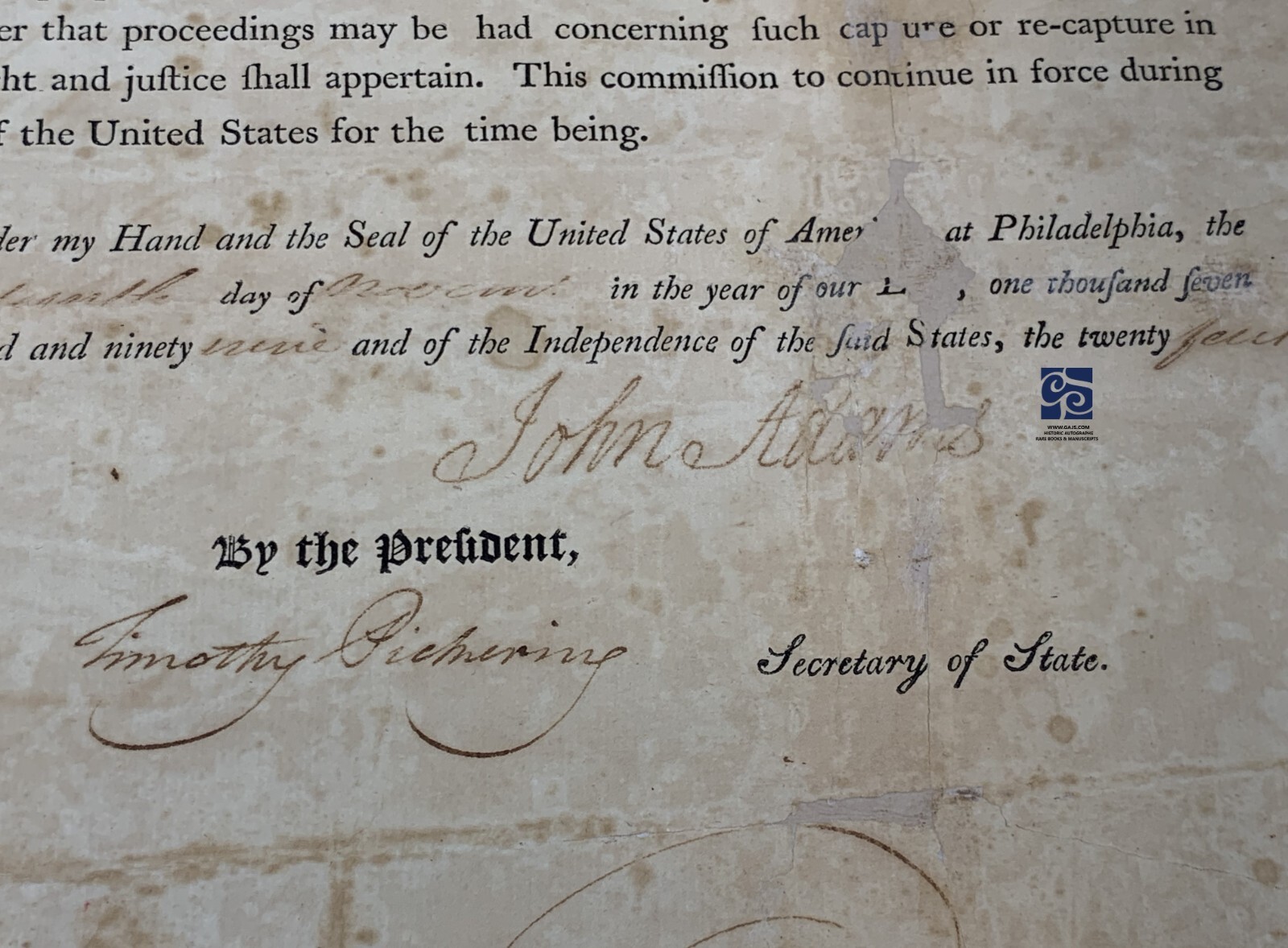
JOHN ADAMS EXCEEDINGLY-RARE PRIVATEER’S COMMISSION SIGNED QUASI-WAR FRANCE 1799

When you click on links to various merchants on this site and make a purchase, this can result in this site earning a commission. Affiliate programs and affiliations include, but are not limited to, the eBay Partner Network.

JOHN ADAMS EXCEEDINGLY-RARE PRIVATEER’S COMMISSION SIGNED QUASI-WAR FRANCE 1799:
$18000.00
JOHN ADAMS
AN EXCEEDINGLY-RARE PRIVATEER’S COMMISSION SIGNEDDURING THE UNDECLARED “QUASI-WAR” WITH FRANCE
ADAMS, JOHN. (1735-1826). SecondPresident of the United States;Signer of the Declaration of Independence; VicePresident; and Minister to Holland and England. Exceedingly-rarePartly-Printed Document Signed, as President. One page, large folio.[approximately 16 x 13 inches]. Philadelphia, November14, 1799. Countersigned by TIMOTHY PICKERING, Secretary of State. Large embossed white paper wafer Seal of Stateaffixed with red wax at lower left. Professionalarchival repair to right center fold, as seen in illustration accompanying thisdescription. The rarity of this form ofPresidential document, can not be understated.In our nearly 50 years of handling the finest of Presidential material,we have only offered one other like it, and by comparison, we have offered 5William Henry Harrison’s documents signed as President. So, we are honored to be able to offer thefollowing. It reads:
With the signing of the Treaty ofParis in 1783, the American Revolutionary War came to an end, and officialhostilities between the United Statesand Britainceased. The new nation, seeking to create a stable economic base and hoping toleave war behind, allowed the U.S. Army to dwindle to only 700 men and sold thelast remaining vessel of the Continental Navy, the frigate Alliance [in 1785]. Then, with the beginning of the FrenchRevolution in 1793, British warships began interfering with American trade withFrance, and French warshipswith American trade with Great Britain. The continued seizure of Americanmerchant vessels by French privateers, as well as the increasingly tensediplomatic relations between the two nations, led the U.S. Congress to pass aseries of acts aimed at improving and expanding the small United States Navy.Among these defensive measures was “An Act to Further Protect the Commerce ofthe United States.”Passed on July 9, 1798, this act permitted President Adams to issue specialcommissions to private vessels. These private vessels were thus given the “license and authority for the subduing, seizing andcapturing any armed French vessel, and for the recapture of the vessels, goodsand effects of the people of the United States”.
Another area of genuine danger toAmerican commerce came from corsairs of North Africa's Barbary Coast. Raiders sailing from the ports of Morocco, Algiers,Tripoli, and Tunishad made it necessary for European powers to either maintain naval squadrons inthe Mediterranean or to pay annual tribute inorder to assure their merchant vessels would not be interfered with. Prior tothe American Revolution, American merchants in that region enjoyed theprotection of the British government, but that protection evaporated with Independence. Thecombination of these events made clear the importance of establishing a U.S.Navy, and in 1794 construction was begun on the first six American frigates.This same year, John Jay, Chief Justice of the Supreme Court, was sent to England to address American grievances with Britainstemming, in part, from the continued seizure of American ships. The result,Jay’s Treaty, improved relations between the two Anglo nations, but left France’s Revolutionarygovernment, known as: “the Directory”, incensed.
Feeling that the broad definitionof ‘contraband’ outlined in Jay’s Treaty violated the “free ships free goods”principle of their 1778 treaty with the U.S., France grew increasinglyhostile. In 1795 alone, French vesselsseized 316 American ships. Seizures, detrimental to the fledgling economy ofthe United Statesand an affront to its pride, were not the only source of tension between thetwo nations. When Charles Cotesworth Pinckney, the U.S.minister to France, arrivedin Paris in1796 the Directory not only refused to meet with him, but also drove him out ofthe city. President John Adams, seeking to avoid a war with the Frenchpowerhouse, sent a second delegation to France for continued negotiations.Arriving in Paris, these envoys were met by aFrench demand that the United States pay $250,000 if they wished torestore diplomatic relations between the two nations. When word of this reachedAmericashores in 1798, President Adams informed Congress, and the event, known as the “XYZAffair”, became international news. In the wake of this event, Congressrescinded the 1778 treaty with Franceand authorized U.S.vessels to capture armed French ships anywhere at sea.
The United States continued torely on privateers throughout the Quasi-War as it’s maritime force expanded andCongress authorized the issuance of privateer contracts to supplement the newlycreated Navy. Over the next two years, American ships made prizes ofapproximately eighty-five French vessels, and the newly created U.S. Navyexpanded to thirty ships. The aggressiveness of U.S.cruisers, coupled with the continued attacks on French vessels by the RoyalNavy, finally forced Franceto adopt a more diplomatic stance toward America. Aggressive French maritimeactivity lessened dramatically, and in mid-December 1800 news reached Americanshores that the Quasi-War, America’sfirst armed conflict with a foreign nation, had ended with the signing of theTreaty of Mortefontaine on September 30.
Thus, we offer this simplysuperb, exceedingly-rare, piece of history!
ABOUT: WWW-GAJS-COM
We are full time professional dealers in historicautographs, manuscripts, signed photographs and important signed books. Our experience spans six decades, and we havebeen members of the ABAA and ILAB for over 40 years and aoffere by their code ofethics. We fully guarantee the authenticity of the material we sell. Additionalterms are found on our website.Condition of the item is as shown in the illustrations that accompanythe listing.
JOHN ADAMS EXCEEDINGLY-RARE PRIVATEER’S COMMISSION SIGNED QUASI-WAR FRANCE 1799:
$18000.00
Related Items:
John Adams Signed & Framed 1783 Handwritten Letter To John Handcock BAS LOA
$74999.99
John Adams Signed 8x9.75 1815 Handwritten Recommendation Letter BAS Slabbed
$21999.99
Ship's Passport Signed by President John Adams , Sec. of State Timothy Pickering
$19000.00