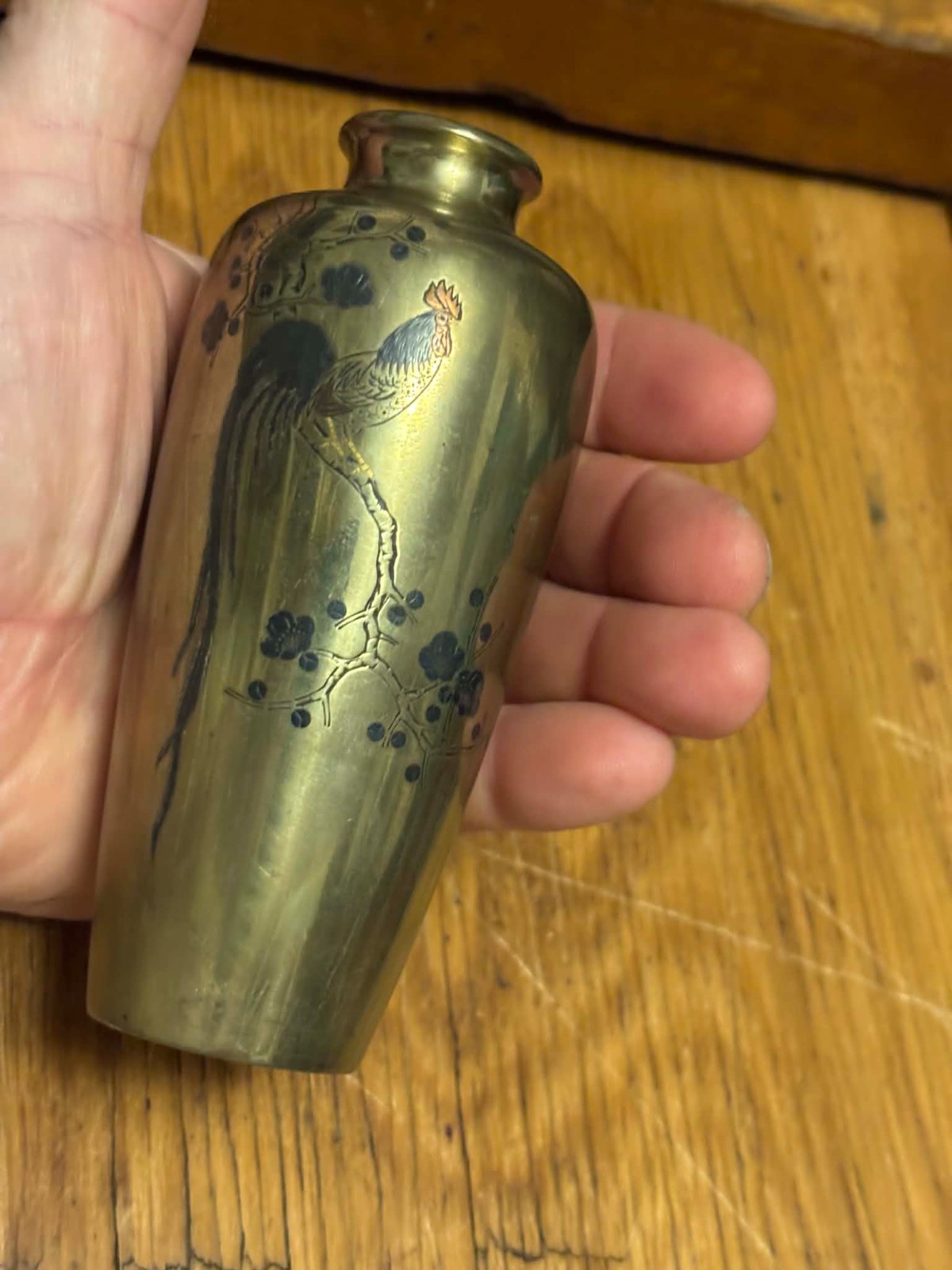
ANTQ VTG BRONZE SCHOLAR VASE ASIAN MEIJI JAPAN CHIINESE ROOSTER CHICKEN CHERRY

When you click on links to various merchants on this site and make a purchase, this can result in this site earning a commission. Affiliate programs and affiliations include, but are not limited to, the eBay Partner Network.

ANTQ VTG BRONZE SCHOLAR VASE ASIAN MEIJI JAPAN CHIINESE ROOSTER CHICKEN CHERRY:
$295.00
Description
ANTQ VTG BRONZE SCHOLAR VASE ASIAN MEIJI JAPAN CHINESE ROOSTER CHICKEN CHERRY
GREETINGS, FEEL FREE
TO
"SHOP NAKED."©
We deal in items we believe others will enjoy and want to purchase.
We are not experts.
We welcome any comments, questions, or concerns.
WE ARE TARGETING A GLOBAL MARKET PLACE.
Thanks in advance for your patronage.
Please Be sure to add WDG to your favorites list!
NOW FOR YOUR VIEWING PLEASURE…
The image is an Asian / Chinese or Japanese.A mixed-metal bronze vase, likely from the late 19th or early 20th century, during the Meiji period. The vase features intricate inlays of different metals, including silver, gold, and copper, to create the detailed design. The central motif is an Onagadori rooster, known for its long tail feathers, perched on a blossoming plum or cherry branch. This style, known as iroe takazogan or hirazogan, was a popular decorative technique for high-quality bronzes during this era. Such items are often signed by the artist or manufacturer and were produced for both domestic use and export. A vintage or antique Japanese mixed metal vase. The vase features an inlay design of a rooster perched on a flowering branch, a common motif in Japanese metalwork. Key DetailsOrigin: The vase is Japanese in origin. Similar items are often dated to the Meiji period (late 19th to early 20th century).Material: It is likely made of bronze or brass, featuring mixed-metal inlays of silver and copper to create the detailed rooster and flower design.Design: The intricate design, known as iroe takazogan, hirazogan, and shishiaibori, is characteristic of this period. The rooster (Onagadori, known for its long tail feathers) is a significant motif in Japanese culture, considered a natural monument.Identification: These types of vases are often part of a pair and may have an artist's signature or a mark on the base. The specific size suggests it might be a miniature or scholar's vase. ORThe object in the image is a small, metallic vase, likely made of bronze or brass, which the hallmark identifies as Chinese. This makes it an item of Chinese decorative art, possibly an antique, with significant cultural and symbolic meaning. Material and Craftsmanship: The item is likely a bronze or brass vase with mixed metal inlay (possibly gold, silver, or copper) used for the rooster and floral designs. Similar items are found from various periods, including the late 19th or early 20th century. Symbolism: The rooster is a highly auspicious emblem in Chinese culture. The pronunciation of "rooster" in Chinese, ji (鸡), is a homophone for "auspiciousness" (ji, 吉). Roosters crowing at sunrise are considered propitious yang creatures capable of frightening off evil spirits. The rooster's crown (guan, 冠) is a homophone for "official" or "public post" (guan, 官), symbolizing a path to wealth and power. Vases in the shape of a "heavenly rooster" (tianjizun) have a long history, dating back to the Song dynasty antiquarians and collected by emperors like Qianlong. Function and Type: The item is a decorative vase. Similar pieces are part of a long tradition of Chinese bronze and metalwork. AI is fickle…
-----------------------
FYI
The chicken (Gallus gallus domesticus) is a domesticated fowl, a subspecies of the Red Junglefowl. As one of the most common and widespread domestic animals, and with a population of more than 24 billion in 2003, there are more chickens in the world than any other species of bird. Humans keep chickens primarily as a source of food, consuming both their meat and their eggs.
Recent evidence suggests that domestication of the chicken was already under way in Thailand, Vietnam and the South East Asian jungles over 10,000 years ago, and spread into neighboring regions to the east such as China, and towards the west in India where it was conventionally thought to have been domesticated From India the domesticated fowl made its way to the Persianized kingdom of Lydia in western Asia Minor, and domestic fowl were imported to Greece by the fifth century BC. Fowl had been known in Egypt since the 18th Dynasty, with the "bird that lays every day" having come to Egypt from the land between Syria and Shinar, Babylonia, according to the annals of Tutmose III.
TerminologyIn the UK and Ireland adult male chickens are primarily known as cocks, whereas in America, Canada and Australia they are more commonly called roosters. Males under a year old are cockerels. Castrated roosters are called capons (surgical and chemical castration are now illegal in some parts of the world). Females over a year old are known as hens, and younger females are pullets. In Australia and New Zealand (also sometimes in Britain), there is a generic term chook (pronounced /'t??k/: rhymes with "book") to describe all ages and both sexes. Babies are called chicks, and the meat is called chicken.
"Chicken" originally referred to chicks, not the species itself. The species as a whole was then called domestic fowl, or just fowl. This use of "chicken" survives in the phrase "Hen and Chickens", sometimes used as a British public house or theatre name, and to name groups of one large and many small rocks or islands in the sea (see for example Hen and Chicken Islands).
Chickens as foodThe meat of the chicken, also called "chicken", is a type of poultry meat. Because of its relatively low cost, chicken is one of the most used meats in the world. Nearly all parts of the bird can be used for food, and the meat can be cooked in many different ways. Popular chicken dishes include roasted chicken, fried chicken, chicken soup, Buffalo wings, tandoori chicken, butter chicken, and chicken rice. Chicken is also a staple of many fast food restaurants.
Chickens as petsChickens are sometimes kept as pets and can be tamed by hand feeding, but roosters can sometimes become aggressive and noisy. Some have advised against keeping them around very young children. Certain breeds, however, such as silkies and many bantam varieties are generally docile and are often recommended as good pets around children with disabilities. Some people find chickens' behaviour entertaining and educational.
Chickens in religion and mythologyIn Indonesia the chicken has great significance during the Hindu cremation ceremony. A chicken is considered a channel for evil spirits which may be present during the ceremony. A chicken is tethered by the leg and kept present at the ceremony for its duration to ensure that any evil spirits present during the ceremony go into the chicken and not the family members present. The chicken is then taken home and returns to its normal life.
In ancient Greece, the chicken was not normally used for sacrifices, perhaps because it was still considered an exotic animal. Because of its valor, the cock is found as an attribute of Ares, Heracles, and Athena. The alleged last words of Socrates as he died from hemlock poisoning, as recounted by Plato, were "Crito, I owe a cock to Asclepius; will you remember to pay the debt?", signifying that death was a cure for the illness of life.
The Greeks believed that even lions were afraid of cocks. Several of Aesop's Fables reference this belief.
In the New Testament, Jesus prophesied the betrayal by Peter: "Jesus answered, 'I tell you, Peter, before the rooster crows today, you will deny three times that you know me.'" (Luke 22:34) Thus it happened (Luke 22:61), and Peter cried bitterly. This made the cock a symbol for both vigilance and betrayal.
Earlier, Jesus compares himself to a mother hen when talking about Jerusalem: "O Jerusalem, Jerusalem, you who kill the prophets and stone those sent to you, how often I have longed to gather your children together, as a hen gathers her chicks under her wings, but you were not willing." (Matthew 23:37; also Luke 13:34).
In many Central European folk tales, the devil is believed to flee at the first crowing of a cock.
In traditional Jewish practice, a kosher animal is swung around the head and then slaughtered on the afternoon before Yom Kippur, the Day of Atonement, in a ritual called kapparos. A chicken or fish is typically used because it is commonly available (and small enough to hold). The sacrifice of the animal is to receive atonement, for the animal symbolically takes on all the person's sins in kapparos. The meat is then donated to the poor. A woman brings a hen for the ceremony, while a man brings a rooster. Although not actually a sacrifice in the biblical sense, the death of the animal reminds the penitent sinner that his or her life is in God's hands.
The Talmud speaks of learning "courtesy toward one's mate" from the rooster. This might refer to the fact that when a rooster finds something good to eat, he calls his hens to eat first.
The chicken is one of the Zodiac symbols of the Chinese calendar. Also in Chinese religion, a cooked chicken as a religious offering is usually limited to ancestor veneration and worship of village deities. Vegetarian deities such as the Buddha are not one of the recipients of such offerings. Under some observations, an offering of chicken is presented with "serious" prayer (while roasted pork is offered during a joyous celebration). In Confucian Chinese Weddings, a chicken can be used as a substitute for one who is seriously ill or not available (e.g. sudden death) to attend the ceremony. A red silk scarf is placed on the chicken's head and a close relative of the absent bride/groom holds the chicken so the ceremony may proceed. However, this practice is rare today.
A cockatrice was supposed to have been born from an egg laid by a rooster, as well as killed by a Rooster's call.(THIS PICTURE FOR DISPLAY ONLY)---------------------------
Thanks for choosing this sale. You may email for alternate payment arrangements. We combine shipping. Please pay promptly after the sale. The item will be shipped upon receipt of funds.
WE ARE GOING GREEN, SO WE DO SOMETIMES USE CLEAN RECYCLED MATERIALS TO SHIP.
Please leave response when you have received the item and are satisfied. Please respond when you have received the item.
*****
5*'s
*****
If you were pleased with this transaction, please respond with all 5 stars! If you are not pleased, let us know via e-mail. Our goal is for 5-star service. We want you to be a satisfied, return customer.
Please express any concerns or questions. More pictures are available upon request. The winning offer will incur the cost of S/H INSURED FEDEX OR USPS. See rate calculator or email FOR ESTIMATE. International buyers are Welcome but be mindful if your country is excluded from safe shipping.
Thanks for perusing THIS and ALL our sales.
Please Check out our other items!
WE like the curious and odd.
BUY, BYE!!
i
Track Page Views With
Auctiva's Counter
ANTQ VTG BRONZE SCHOLAR VASE ASIAN MEIJI JAPAN CHIINESE ROOSTER CHICKEN CHERRY:
$295.00
Related Items:
Disney Pixar Toy Story 2 Bo Peep Christmas Ornament Vintage 1999 Rare Antq
$260.35
vtg/antq? fine gold leaf overlay hand painted flowers flora limoges france egg
$300.00
ANTQ VTG BRONZE SCHOLAR VASE ASIAN MEIJI JAPAN CHIINESE ROOSTER CHICKEN CHERRY
$295.00