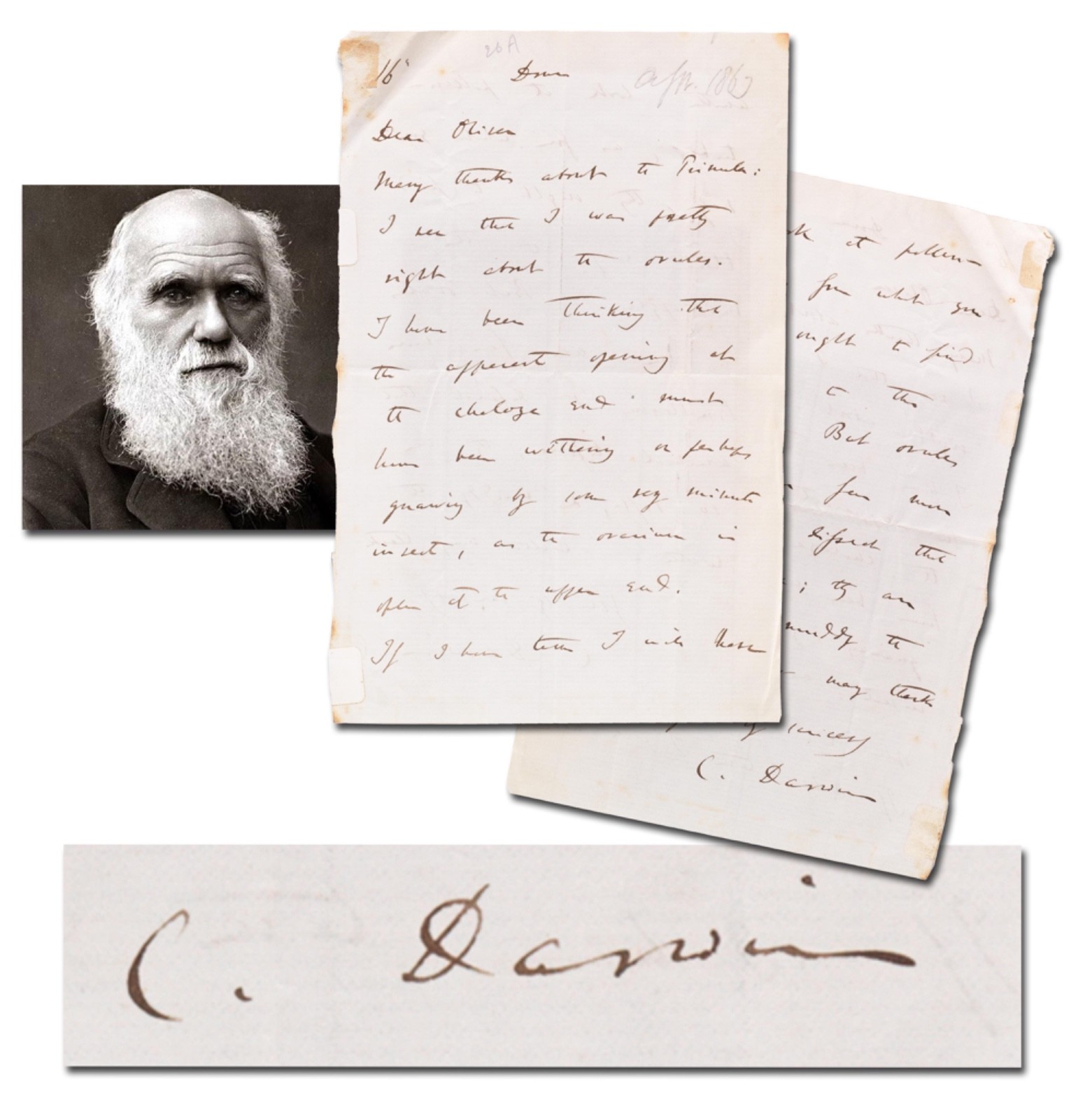
Important Charles Darwin Autograph Signed Letter to Fellow Botanist re: Primula

When you click on links to various merchants on this site and make a purchase, this can result in this site earning a commission. Affiliate programs and affiliations include, but are not limited to, the eBay Partner Network.

Important Charles Darwin Autograph Signed Letter to Fellow Botanist re: Primula:
$14750.00
Charles Darwin
Bromley, Kent, England, [after April 14, 1863]
Charles Darwin Important ALS to Fellow Botanist Daniel Oliver Re: Primula, the Plant Whose Reproductive Behavior Fascinated Him
ALS Charles Darwin (1809-1882). Autograph Letter Signed, "C. Darwin," 2pp, on one leaf of laid paper measuring 5" x 7.5", Down, Bromley, Kent, [after April 14, 1863]. "16a" penned in upper left corner in Darwin's hand; small pencil inscriptions "26a" and "Apr. 1863" at upper margin in a later hand. Expected folds and creases. Unevenly cut left edge. Mounting remnants along left margin. Minor age toning with light scattered staining. In near fine condition. The letter is addressed to Daniel Oliver, FRS (1830-1916), an esteemed English botanist. Oliver was Librarian of the Herbarium, Royal Botanic Gardens, Kew, from 1860-90 and Keeper there from 1864-90, as well as Professor of Botany at University College, London, from 1861-88. The year prior to the writing of this letter, Darwin had published a paper conveying his discovery of the dimorphic structure of Primula flowers in 1862, titled "On the two forms, or dimorphic condition, in the species of Primula, and on their remarkable sexual relations," and he would feature primrose flowers prominently in his 1877 book "Different Forms of Flowers." In full: "Dear Oliver, Many thanks about the Primula: I see that I was pretty right about the ovules. I have been thinking that the apparent opening at the chalaza end must have been withering or perhaps gnawing by some very minute insects, as the ovarium is open at the upper end. If I have time I will have another look at pollen-tubes, as from what you say they ought to find their way to the micropyle. But ovules to me are far more troublesome to dissect than animal tissue; they are so soft, and muddy the water. With many thanks,
Yours very sincerely,
C. Darwin." Darwin was fascinated by the structure of primula flowers. In his autobiography, he wrote, "No little discovery of mine ever gave me so much pleasure as the making out the meaning of heterostyled flowers" (Recollections, 419). There are two forms of primrose flowers, which look almost identical apart from the position of the stigma (female part) and the anthers (male part holding the pollen) in the flower tube in the center. These are "pin-eyed" primroses and "thrum-eyed" primroses. In the pin-eyed the style and stigma are taller than the surrounding stamens; in the thrum-eyed flowers the stamens are taller than the style and stigma. The two flower types were first described by Charles Darwin in 1862 who also observed that the pollen produced by the pin flowers was smaller than that of the thrum flowers. He performed a number of crosses (taking pollen from one flower and placing it on the stigma of another) and proved that pollination between the two flower types, where the pollen of the differently formed flowers resulted in greater seed production than pollination between the same forms. Both flower types contain nectar at the bottom of the flower tube to attract insects to mediate pollination of the flowers. Darwin thought that the reciprocal positions of the anthers and the stigma in the two flower types would promote cross-fertilization. He suggested that when an insect visits a pin flower it inserts its proboscis into the flower tube to feed on the nectar, and pollen from the anthers would stick onto the proboscis about halfway down. If the insect then visits a thrum flower, the pollen already on its proboscis is at the right level to meet and stick to the stigma about halfway down the flower tube, leading to cross-fertilization. At the same time, pollen from the anthers at the top of the thrum flower tube is likely to stick to the top of the insect proboscis, the perfect position for cross-fertilizing the next pin flower the insect visits. Primrose flowers also have a "self-incompatibility" mechanism that prevents the eggs being fertilized by pollen that is genetically identical. Therefore, the vast majority of successful pollinations in a wild population of primroses are between pin and thrum plants. Darwin published these discoveries in his paper, "On the two forms, or dimorphic condition, in the species of Primula, and on their remarkable sexual relations," read November 21, 1861, and published in the "Journal of the Proceedings of the Linnean Society" (Botany) 6 (1862), pp. 77-96; subsequently incorporated, with many alterations, into his 1877 book "Different Forms of Flowers", pp. 14-30. Darwin Correspondence Project 4095. Also published in "The Correspondence of Charles Darwin," Volume 11. (The date of this letter is inferred from two other related letters in the DCP, the first from Darwin to Oliver, dated April 12, 1863, in which Darwin asked about the position of the ovule in Primula; the second from Oliver to Darwin, dated April 14, 1863, to which the letter offered here is the reply. This item comes with a Certificate from John Reznikoff, a premier authenticator for both major 3rd party authentication services, PSA and JSA (James Spence Authentications), as well as numerous sale houses.
Important Charles Darwin Autograph Signed Letter to Fellow Botanist re: Primula:
$14750.00
Related Items:
Important Charles Darwin Autograph Signed Letter to Fellow Botanist re: Primula
$14750.00
CHARLES GEORGES FERVILLE SUAN 19 CENTURY 19"H BRONZE FIGURINE VASE IMPORTANT
$8800.00
VERY IMPORTANT VINTAGE HOPI CHARLES SUPPLEE STERLING SILVER 1984 BRACELET
$2903.99