Scarce WW1 Australian Army Warrant Officer P1902 Khaki Field Service Tunic 1918

When you click on links to various merchants on this site and make a purchase, this can result in this site earning a commission. Affiliate programs and affiliations include, but are not limited to, the eBay Partner Network.

Scarce WW1 Australian Army Warrant Officer P1902 Khaki Field Service Tunic 1918:
$2999.00
Scarce WW1 Australian Army Warrant Officer P1902 Khaki Field Service Tunic 1918
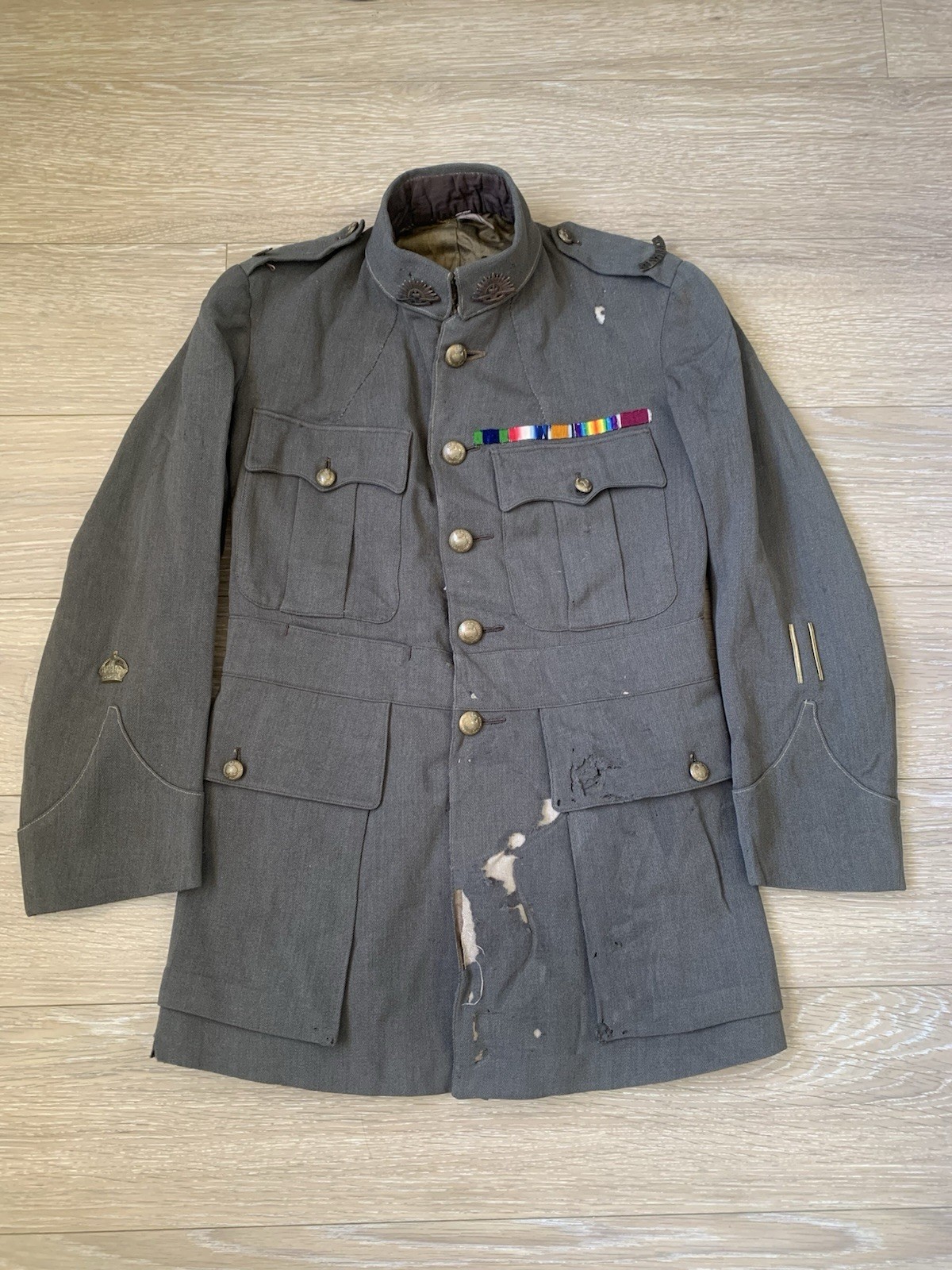
Uniform Jacket: Standard khaki greenish brown coloured four outer pocket Australian wool jacket lined in green cotton or silk with an inner pocket for a field dressing or personal items; there's also a leather flap. The white cotton lining of one sleeve is stamped in bold black ink 'A 1918'.
The collar is a stand-and-fall style with two black metal clips to join each part and with a matching pair of 'rising sun' badges attached. The brass crown on the right hand sleeve indicates the wearer held the rank of a Warrant Officer Class 2. The two gold stripes on the left hand sleeve are wound stripes.
Back of collar: Hanging loop.
Collar: Matched pair of Australian 'Rising Sun' collar badges.
Shoulder: Matched pair of 'AUSTRALIA' shoulder titles on the epaulettes.
Tunic - General: Medal ribbon insignia of the India General Service Medal 1908-1935 and the 1914-15 Star, British War and Victory Medals. Officers' quality gilded brass buttons on the epaulettes, tunic front and four pockets and a W/O's rank insignia on the lower part of one sleeve and two wound stripes on the other.
Condition: Australian 'Rising Sun' collar badges, a pair of 'AUSTRALIA' shoulder titles (these being the type with the lugs close together), Officer's quality gilt brass buttons (solid type manufacture), a single crown on the lower right hand sleeve and two long wire bullion stripes on the lower part of the left sleeve. There's extensive moth damage on the left hand side upper shoulder, middle and lower left pocket areas).
The pictures refer: In any event, this tunic is quiyte a rare rare item to an Australian officer with WW1 service in France & Flanders and post Great War service on the Indian North West Frontier, likely Waziristan 1919-21, perhaps to 1924 and who stayed in long enough to receive the Long Service & Good Conduct Medal (Army). The pictures refer and form part of the item description.
The uniforms of the Australian Army have changed significantly over the past century, although the accoutrements worn over this period have remained relatively similar. The forces of the Australian colonies and the early forces of the Commonwealth post-Federation in 1901 closely followed the uniforms of the British Army. Since then it has continued to be influenced by British but also US styles, as well as including some distinctly Australian designs, reflecting local conditions and trends.
Post 1901 Federation
On 1 March 1901 the Australian Army was formed following the transfer of colonial forces. Universal service dress was introduced in 1902 and was worn at all times, including in the field, except for formal occasions requiring full dress. This uniform included a peaked cap, tunic, and trousers, with officers wearing a Sam Browne belt. Officers of the mounted arm wore breeches and boots, while the rest wore puttees. The different arms and corps were distinguished by the colour of the braid trimming on the shoulder straps. A wide-brimmed slouch hat was worn with one side turned up by troops overseas. The rising sun badge was first worn at this time by battalions of the Australian Commonwealth Horse on active service in South Africa, while some Queensland units wore emu plumes in their hats. During this period it remained common to follow the British system, with the uniform subsequently adopted by the Commonwealth consisting of a General Service Dress which, in order to achieve financial savings, could be converted into Full Dress for ceremonial occasions simply by the addition of a number of lace accoutrements, including aiguillettes, as well as breast-lines and girdles. The uniform consisted of a khaki serge jacket, with slouch hat and breeches. Cloth collar patches were worn, as well as coloured piping on the jacket, with rosettes or plumes on the hat, and regimental badges. The introduction of universal service in 1912 resulted in the adoption of a number of changes due to the need to economise following the rapid expansion of the Army. The uniform provide for at this time was relatively simple, consisting of a hat, heavy woollen khaki shirt, cord breeches and boots. To distinguish between units and corps a coloured cloth hat band with a metal numeral was worn. Officers kept their jackets, and later approval was given to wear open collars with shirt and tie.
Great War and interbellum
The pre-war Australian Army uniform formed the basis of that worn by the First Australian Imperial Force (1st AIF), which adopted the broad-brimmed slouch hat and rising sun badge. Peak caps were initially also worn by the infantry, while light horsemen often wore a distinctive emu plume in their slouch hats. A standard khaki puggaree was worn by all arms. From 1916 the British steel Brodie helmet was issued for use by infantry on the Western Front. A loose-fitting four-pocket service dress jacket was worn, along with baggy knee breeches, puttees, and tan ankle-boots. A heavy woollen greatcoat was worn during cold weather. The uniform was a drab "pea soup" or khaki colour, while all buttons and badges were oxidised to prevent shine. All personnel wore a shoulder title bearing the word "Australia". Rank insignia followed the British Army pattern and were worn on the upper arms (or shoulders for officers). Identical hat and collar badges were worn by all units, which were initially only distinguished by small metal numerals and letters on the shoulder straps (or collars for officers). However, in 1915 a system of Unit Colour Patches was adopted, worn on the upper arm of a soldier's jacket. Uniforms worn by the Australian Flying Corps (AFC) were similar to those of the rest of the AIF, although some officers wore a double-breasted "maternity jacket". AFC "wings" were worn on the left breast, while an AFC colour patch and standard rising sun badges were also worn.
In Australia, the outbreak of World War I was greeted with considerable enthusiasm. Even before Britain declared war on Germany on 4 August 1914, the nation pledged its support alongside other states of the British Empire and almost immediately began preparations to send forces overseas to engage in the conflict. The first campaign that Australians were involved in was in German New Guinea after a hastily raised force known as the Australian Naval and Military Expeditionary Force was dispatched in September 1914 from Australia and seized and held German possessions in the Pacific. At the same time another expeditionary force, initially consisting of 20,000 men and known as the Australian Imperial Force (AIF), was raised for service overseas.
The AIF departed Australia in November 1914 and, after several delays due to the presence of German naval vessels in the Indian Ocean, arrived in Egypt, where they were initially used to defend the Suez Canal. In early 1915, it was decided to carry out an amphibious landing on the Gallipoli peninsula with the goal of opening up a second front and securing the passage of the Dardanelles. The Australians and New Zealanders, grouped together as the Australian and New Zealand Army Corps (ANZAC), went ashore on 25 April 1915 and for the next eight months the Anzacs, alongside their British, French and other allies, fought a costly and ultimately unsuccessful campaign against the Turks.
The force was evacuated from the peninsula in December 1915 and returned to Egypt, where the AIF was expanded. In early 1916 it was decided that the infantry divisions would be sent to France, where they took part in many of the major battles fought on the Western Front. Most of the light horse units remained in the Middle East until the end of the war, carrying out further operations against the Turks in Egypt and Palestine. Small numbers of Australians served in other theatres of war. Although the main focus of the Australian military's effort was the ground war, air and naval forces were also committed. Squadrons of the Australian Flying Corps served in the Middle East and on the Western Front, and elements of the Royal Australian Navy carried out operations in the Atlantic, North Sea, Adriatic and Black Sea, as well as the Pacific and Indian Oceans.
By the end of the war, Australians were far more circumspect. The nation's involvement cost more than 60,000 Australian lives and many more were left unable to work as a result of their injuries. The impact of the war was felt in many other areas as well. Financially it was very costly. The effect on the social and political landscape was considerable and threatened to cause serious divides in the nation's social fabric. Conscription was possibly the most contentious issue and ultimately, despite having conscription for home service, Australia was one of only three combatants not to use conscripts in the fighting. For many Australians the nation's involvement in World War I and the Gallipoli campaign was seen as a symbol of its emergence as an international actor; many of the notions of the Australian character and nationhood that exist today have their origins in the war, and Anzac Day is commemorated as a national holiday.
The First Australian Imperial Force (1st AIF) was the main expeditionary force of the Australian Army during the First World War. It was formed as the Australian Imperial Force (AIF) on 15 August 1914 following Britain's declaration of war on Germany, with an initial strength of one infantry division and one light horse brigade. The infantry division subsequently fought at Gallipoli between April and December 1915, with a newly raised second division, as well as three light horse brigades, reinforcing the committed units.
After being evacuated to Egypt, the AIF was expanded to five infantry divisions, which were committed to the fighting in France and Belgium along the Western Front in March 1916. A sixth infantry division was partially raised in 1917 in the United Kingdom, but was broken up and used as reinforcements following heavy casualties on the Western Front. Meanwhile, two mounted divisions remained in the Middle East to fight against Turkish forces in the Sinai and Palestine. The AIF included the Australian Flying Corps (AFC), the predecessor to the Royal Australian Air Force, which consisted of four combat and four training squadrons that were deployed to the United Kingdom, the Western Front and the Middle East throughout the war.
An all volunteer force, by the end of the war the AIF had gained a reputation as being a well-trained and highly effective military force, playing a significant role in the final Allied victory. However, this reputation came at a heavy cost with a casualty rate among the highest of any belligerent for the war. The remaining troops were repatriated until the disbandment of the 1st AIF between 1919 and 1921. After the war, the achievements of the AIF and its soldiers, known colloquially as "Diggers", became central to the national mythology of the "Anzac legend". Generally known at the time as the AIF, it is today referred to as the 1st AIF to distinguish it from the Second Australian Imperial Force raised during World War II.
[🐨
Scarce WW1 Australian Army Warrant Officer P1902 Khaki Field Service Tunic 1918:
$2999.00
Related Items:
Scarce WW1 Australian Army Warrant Officer P1902 Khaki Field Service Tunic 1918
$2999.00
Scarce WW1 Austro-Hungarian Imperial Army Soldier M1908 Field Cap (1908-1916)
$1999.00
WW1 Webley MkVI Pritchard Greener Pistol Bayonet .455 British scarce
$2000.00