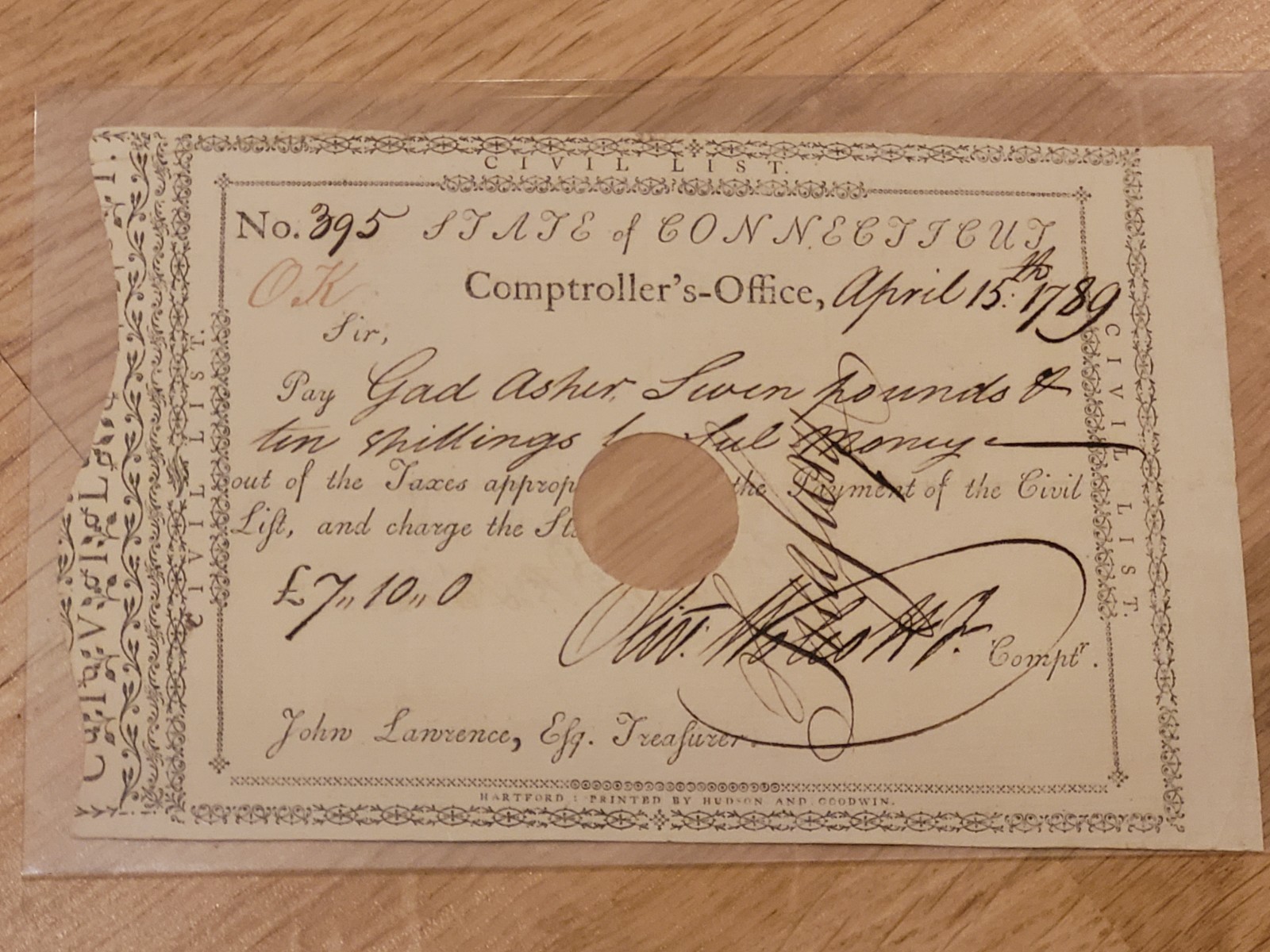
1789 CT Pay Order Gad Asher Black Revolutionary War Soldier Oliver Wolcott Sig

When you click on links to various merchants on this site and make a purchase, this can result in this site earning a commission. Affiliate programs and affiliations include, but are not limited to, the eBay Partner Network.

1789 CT Pay Order Gad Asher Black Revolutionary War Soldier Oliver Wolcott Sig:
$30000.00
I will attempt to transcribe this Revolutionary War documentt to the best of my ability
Front of Document:
No. 395
STATE of CONNECTICUT
Pay Gad Asher, Seven pounds & ten shillings Lawful Money—edu
out of the Taxes appropriated for the Payment of the Civil List, and charge the State.
£ 7,, 10,, 0
Signed: Oliv. Wolcott Jr. Compt-r
To: John Lawrence, Esq. Treasurer
Bottom Margin: HARTFORD : PRINTED BY HUDSON AND GOODWIN.
Back of Document:
Handwritten Signature: "Gad Asher" (appearing through the paper or on the reverse side).
Pink Research Note (in Mylar):
CT. 700.-
GAD ASHER (signature at back?)
GUILFORD, 1777-83
CIVIL LIST PAY ORDER
£ 7,, 10,, 0
OLIV. WOLCOTT JR AUTOGRAPH
Gad Asher (c. 1759–1835): Gad Asher was a Black soldier from Guilford, Connecticut, who served in the Continental Army during the American Revolution. He enlisted in 1777 and served until 1783, most notably with the 1st Connecticut Regiment. As a "Pensioner," he was officially recognized by the government for his military service. This 1789 document represents a payment from the "Civil List" issued during the same year the U.S. Constitution took effect.
Oliver Wolcott Jr. (1760–1833): The document is hand-signed by Oliver Wolcott Jr. in his capacity as the Comptroller of Connecticut. Wolcott was a significant figure in early American finance, eventually succeeding Alexander Hamilton as the 2nd U.S. Secretary of the Treasury under Presidents George Washington and John Adams.
The Document: This is an original printed and manuscript pay order from the famous Hartford printing shop of Hudson and Goodwin. It features a circular "cancelation" punch in the center, indicating the payment was successfully processed by the State Treasurer.
Listing Details & KeywordsItem Type: Original 18th Century Manuscript / Ephemera.
Condition: Housed in a protective mylar sleeve with an associated research note.
Keywords: Black Americana, African American History, Revolutionary War, Continental Army, Connecticut History, Oliver Wolcott Jr, Alexander Hamilton era, 1780s Manuscript, Rare Ephemera, Guilford CT, Gad Asher, Antique Document.
Gad Asher was an enslaved man who gained his freedom by fighting in the American Revolutionary War, serving as a substitute for his owner, and later became a significant figure in Black history, known through his famous preacher grandson, Rev. Jeremiah Asher, who also fought for freedom in the Civil War and served as a chaplain for the 6th USCT. Gad's service highlights the many African Americans who risked everything for liberty during the Revolution, often earning their freedom or a pension in the process.Gad Asher's Story
- Enslaved Opportunity: As an enslaved person, Gad Asher was offered his freedom if he would serve in the Continental Army, a common path for Black men seeking liberty during the war.
- Revolutionary Service: He seized this chance, fighting in the Revolution and earning his freedom and a pension for his service.
- Legacy through Family: Gad's story was passed down through generations, notably by his grandson, the prominent abolitionist and minister Jeremiah Asher.
- Grandfather's Influence: Jeremiah Asher, born in 1812, grew up hearing about his grandfather Gad's bravery and independent spirit, which fueled his own fight for freedom.
- Civil War Chaplain: Jeremiah became a chaplain for the 6th Regiment of the U.S. Colored Troops (USCT) during the Civil War, continuing the family's fight for liberation.
- Gad Asher represents many enslaved and free Black individuals who served in the Revolution, contributing to American independence while seeking their own freedom. His story underscores the complex role of African Americans in the founding of the United States.
Key Facts about Gad Asher: Enslaved Origin: Gad was enslaved as a child but seized the opportunity to fight for the American cause.
Revolutionary Service: He served in the Revolutionary War, fighting for the colonists, and later earned his freedom and a pension for his service.
Pension: A pension receipt from 1795, signed with his mark, confirms his service and receipt of benefits.
Legacy: His story of freedom and service was a powerful legacy for his grandson, the notable Reverend Jeremiah Asher, who became the first African-American chaplain to die in military service during the Civil War.Connection to Jeremiah Asher: Gad's actions directly influenced his grandson, Jeremiah Asher, who became a fervent advocate for Black freedom, serving as a minister and Civil War chaplain.
The family's journey from enslavement and revolutionary service to prominent roles in the fight for equality highlights significant Black contributions to American history, notes the North Branford Libraries and the Cheltenham Township websiteGad was born about 1745. According to the autobiography of his grandson, Jeremiah Asher, he was born in what is now Guinea, kidnapped, and enslaved.[1]Between May 20, 1777, and April 10, 1783, Gad served in the Seventh and Second Regiments of the Connecticut Line of the Continental Army.[2][3]In the 1790 census, Gad was enumerated in Branford, New Haven, Connecticut, United States.[4]In the 1800 census, Gad was enumerated in Branford, New Haven, Connecticut, United States.[5]In the 1810 census, Gad was enumerated in North Haven, New Haven, Connecticut, United States.[6]In the 1820 census, Gad was enumerated in Branford, New Haven, Connecticut, United States.[7]In the 1830 census, Gad was enumerated in Branford, New Haven, Connecticut, United States.[8]Gad was in the military and died on November 28, 1835 in Connecticut, United States.[9]
Research NotesGad's grandson's autobiography give the name of Gad's enslaver as LInus Bishop, but this needs to be confirmed through primary Asher was an enslaved man who gained his freedom by fighting in the American Revolutionary War, serving as a soldier and later receiving a pension, becoming a notable figure whose story was passed down through his famous grandson, Rev. Jeremiah Asher, a prominent Civil War-era Black chaplain and minister. Gad's service exemplified the path many Black patriots took, exchanging service for liberty, with records showing his 1795 pension receipt signed with his mark, highlighting his military contribution and subsequent freedom.
Key Facts about Gad Asher: Enslaved Origin: Gad was enslaved as a child but seized the opportunity to fight for the American cause.
Revolutionary Service: He served in the Revolutionary War, fighting for the colonists, and later earned his freedom and a pension for his service.
Pension: A pension receipt from 1795, signed with his mark, confirms his service and receipt of benefits.
Legacy: His story of freedom and service was a powerful legacy for his grandson, the notable Reverend Jeremiah Asher, who became the first African-American chaplain to die in military service during the Civil War.Connection to Jeremiah Asher: Gad's actions directly influenced his grandson, Jeremiah Asher, who became a fervent advocate for Black freedom, serving as a minister and Civil War chaplain.
The family's journey from enslavement and revolutionary service to prominent roles in the fight for equality highlights significant Black contributions to American history, notes the North Branford Libraries and the Cheltenham Township websiteGad was born about 1745. According to the autobiography of his grandson, Jeremiah Asher, he was born in what is now Guinea, kidnapped, and enslaved.[1]Between May 20, 1777, and April 10, 1783, Gad served in the Seventh and Second Regiments of the Connecticut Line of the Continental Army.[2][3]In the 1790 census, Gad was enumerated in Branford, New Haven, Connecticut, United States.[4]In the 1800 census, Gad was enumerated in Branford, New Haven, Connecticut, United States.[5]In the 1810 census, Gad was enumerated in North Haven, New Haven, Connecticut, United States.[6]In the 1820 census, Gad was enumerated in Branford, New Haven, Connecticut, United States.[7]In the 1830 census, Gad was enumerated in Branford, New Haven, Connecticut, United States.[8]Gad was in the military and died on November 28, 1835 in Connecticut, United States.[9]
Research NotesGad's grandson's autobiography give the name of Gad's enslaver as LInus Bishop, but this needs to be confirmed through primary sources.[1]1
Migrant of Necessity
Growing up in New England thirty-odd years after the
American Revolution, Holdridge Primus would have heard
family stories of slavery and tales of black soldiers' battlefield
heroics. More than likely, he heard the stories from his
maternal grandfather, Gad Asher. The events of Asher's life
embody a past that underlay the identity of many African
Americans in the Northern states at the time. Jeremiah
Asher, a cousin of Holdridge, preserved their grandfather's
recollected experience in two memoirs.' Filtered by time and
undoubtedly altered in its details, the story linked Holdridge
and Jeremiah and all of Gad Asher's progeny to the founding
of the Republic and reinforced their claim to citizenship.
Later, as an activist Baptist minister, Jeremiah wrote the
story of his life twice, and in both works he emphasized the
importance of his grandfather's experiences as a slave, a
soldier, and a free man.
According to Jeremiah, Gad Asher was born on his
father's farm in Guinea, West Africa. From the age of
four he was sent to the fields with an older brother,
2
charged with scaring off the birds.2 Keeping watch on
their raised platform one day, the boys saw two white
men approaching. Alarmed, the youngsters ran for
home. The older boy got away, but his young brother
did not. The kidnappers gagged the child and carried
him to the coast, where he was put aboard a slave
ship. Frightened and confused, he was nevertheless
spared "many of the worst horrors of the middle passage."' The crew treated him kindly—possibly out of
sympathy, but also to make sure that a saleable bit of
the cargo was not lost. When the ship reached its
destination, the boy was put up for sale.
The destination, we are told, was Guilford in the
colony of Connecticut. This would have been somewhat
unusual, because slave traders generally
3
4
5
Possibly related to these doubts, the naming of
slaves in both North and South betrayed some
reservation about the concept of one human being
owning another. Historian Ira Berlin characterizes as a
"cosmic jest" the custom of assigning heroic names—
Pompey, Jupiter, Cato, Hercules—to slaves, mocking
their lowly status.10 Whether in this spirit or simply taking
note of the boy's forced migration, his owner chose for
him the names of two of the tribes of Israel." Gad and
Asher were the sons of Jacob and Zilpah, servant of
Jacob's first wife, Leah. Young Gad Asher was somewhat
unusual in having two names—the second of which came
to be used as his surname.12
Slavery persisted in the North because of the need
for workers.'3 Unlike plantation slaves in the South, most
in Connecticut were isolated, with no more than two or
three in a household. As was true in the South, some
were trained in specific skills, some served aboard ships,
and others worked in the master's house or in the
fields.14 Venture Smith, a contemporary of Gad Asher,
6
was also captured as a child in Guinea. His narrative
details his experiences as a slave on Long Island and
later in Stonington, Connecticut.1
$ In his youth, Venture
carded wool, pounded corn, and served as waiter and
"cup bearer." As an adult, he worked at different trades:
boatman, all-round farmhand, and trusted tradesman.
Gad Asher may have worked as a domestic servant, or
he could have served as a carpenter's apprentice,
learning the trade of his owner. What is clear in the lives
of both Venture Smith and Gad Asher is that in seeking
their freedom and then living as free men they embraced
the ways and to some extent the ideas of white men.
Whether joining a church, buying property, or naming
and educating their children, both assumed that they
were entitled to the opportunities available to citizens.
Jeremiah offers no details of his grandfather's
upbringing, but Gad Asher would not have been treated
as a member of the Bishop family. As for claims that
Northern slavery was milder than that in the South, Ira
Berlin notes that masters, Northern or Southern, "treated
their slaves with extreme callousness and cruelty at times
7
because this was the way they treated all subordinates,
whether indentured servants, debtors, prisoners-of-war,
pawns, peasants, or simply poor folks."" This provides
ample explanation for the fact that, however "fond" Bishop
may have been of the small boy he had bought, he later
treated him less than honorably.
When the Revolutionary War was going badly for the
colonists, Gad's owner was called up for military service.
"Preferring the comforts of home to the dangers and
hardships of a campaign," he made use of a Connecticut
law that enabled an owner to free a slave and "allow"
him to volunteer as substitute in the Army or Navy.17
Gad Asher enlisted in May 1777 for the duration of the
war.'8 He told Jeremiah that he "fought side by side with
white men in two or three important battles.."19 When he
returned to Guilford in 1783, he learned that Bishop now
demanded repayment of the forty pounds Asher had
cost him.2
°
Gad had already paid a price for his freedom. The
source, nature, and extent of his injury remain unknown,
but the Revolution had cost him his sight. Jeremiah said
8
the old man attributed the loss to the combination of
"intense heat, and inhaling the dense smoke of
gunpowder, and exposure to the dew of heaven by
night."2
' A double-edged piece of luck, the disability
qualified him for a government pension, so that he was
able to save the amount necessary to buy his freedom.
This experience again resembles that of Venture Smith,
who was tricked into buying himself several times over.22
Both men achieved freedom through their own efforts.
Starting his life as a free man, Gad would have
been at least forty years old and, according to
Jeremiah, already married to a free woman named
Temperance.~3 Little is recorded about Temperance—
not even her maiden name—but a contemporary white
man wrote that in June 1823 she was called to the
bedside of a dying pastor, showing that the community
recognized her as a healer.24 The practice of medicine
was largely in the hands of housewives in the
eighteenth century. The uses and application of herbs
were handed down from mother to daughter, so
Temperance probably had learned from her mother,
9
who was most likely a slave. African remedies may well
have been among those she used.
Once freed, slaves tended to move away from the
oversight of their former owners, and not surprisingly
one of Gad's first acts as a free man was to settle his
family in the northern section of Branford, the town west
of Guilford.25 Because Temperance was not a slave,
their children were free. Among those who lived beyond
infancy, the following have been identified: Temperance
(mother of Holdridge Primus), Ruel (father of Jeremiah
Asher), Henrietta, Marietta, and Brunella.26 Note that
these are not African names. Rather, they conform to
naming patterns common among white colonial New
Englanders. These fell into four categories: biblical,
hortatory, traditional English, and "other"—a category
that reflected secularization and other influences of the
Enlightenment.27 Based on naming practices of the time,
we might guess that young Temperance, named for her
mother, was the firstborn daughter. Ruel is biblical
(Moses's father-in-law), and the others may have been
named after relatives or friends. Henrietta is a feminine
10
form of Henry; Marietta is a diminutive of Maria; and
BruneHa's name could be a reminder that some of the
German troops had not returned home after the
Revolutionary War. These Asher names suggest a New
England identity, reflecting the adoption, reluctant or
willing, of the dominant culture.
If Gad Asher was trained in his youth as a
carpenter, blindness made such work impossible. He
turned to farming, the most common occupation of all
Connecticut householders in the eighteenth and early
nineteenth centuries. By 1792, no doubt with the help of
his pension, he bought two and a half acres of land in
North Branford.28 His son Ruel and other members of
the family lived and worked on the farm. Ruel's son,
Jeremiah, born in 1812, became the old man's "eyes"
and the audience for many repetitions of his life story.
Jeremiah's autobiography emphasizes the importance
of the Revolutionary cause to his generation of African
Americans and ties his own lifelong quest for equality to
Gad Asher's military service.
11
Two other black veterans who lived in North
Branford often visited Gad Asher, and the three told and
retold their experiences in the "terrible and never-to-beforgotten battle for American Liberty."~9 Young Jeremiah
"became so accustomed to hear these men talk, until I
almost fancied to myself that I had more rights than any
white man in the town . . . Thus, my first ideas of the
right of the colored man to life, liberty and the pursuit of
happiness, were received from those old veterans and
champions for liberty." Such beliefs led him to "resist"
the insults of whites as a youth, a habit that "gave my
parents much trouble."
30 To imagine he had more rights
than whites was dangerous in a black youth, although in
Jeremiah's case that conviction shaped the course of his
ministry in later life. Inequality, the residue of slavery,
was already fixed in the culture, so that black parents
had no power to protect their own. The oppression of
blacks, slave or free, was well established, even as
Northern states began to distance themselves from
slaveholding.3
' Connecticut, for example, passed a law
abolishing slavery in 1784, just a year after the end of
12
the Revolution. Still, as one scholar cautions, not only
did it provide a gradual emancipation, it may have
passed only because it was one item in a list of revised
laws submitted by Roger Sherman and Richard Law.
The implication is that the lawmakers, trusting their
colleagues, approved the bundle of bills without
discussing or perhaps even examining them.32 The law,
passed on January 8, 1784, provided that all children
born after March 1 of that year would be free at the age
of twenty-five. Others, including Gad Asher, would have
been freed only by death.
Young Holdridge must have heard Gad Asher's story
any number of times, and no doubt he knew of his
cousin's challenges to race prejudice based on the
conviction that those who fought with the colonists had
earned rights of citizenship. In the years following the
Revolution, the link between military service and full
citizenship encouraged many Northern blacks to press
for their rights.33 Connecticut historian David White
points out that the "children and grandchildren of the
blacks of the Revolution were the first in Connecticut to
13
make their feelings known to an apathetic white society
. . . It was the James Mars, Amos Bemans, and
Jeremiah Ashers who challenged Connecticut's
conscience."34 All three men later figured in the
development of Hartford's black community.
Jeremiah nowhere discussed his grandfather's
specific views with regard to rights of citizenship, but
Gad Asher certainly made use of the culture in which he
grew up. He may never have met Venture Smith, but
both men displayed the same sense of entitlement. In
spite of the duplicity of their masters, and fully aware of
the racial climate around them, both accepted the ways
of New England. Moreover, Gad Asher, along with many
other slaves, participated in the war that promised
"certain unalienable rights." In securing his freedom,
naming his children, buying land, and apprenticing his
son Ruel to a skilled tradesman, Gad Asher helped
himself to the opportunities available to citizens of the
new Republic.35
Another aspect of this acceptance is church
membership. After moving to Branford as a free man,
14
Gad Asher joined the Congregational Church and
remained a member until his death—an act not wholly
typical of African Americans at the time.36 Aside from
those who could benefit from membership, "slaves
viewed Christianity with all of the suspicion and hostility
due the religion of the owning class."37 How then to
account for Gad's faithful church attendance over some
forty years? Recall that he came to New England and to
slavery as a very young child, arriving in the 1740s
along with the Great Awakening and its urgent message
of salvation. In the custom of the times, he would have
been taken to church along with members of the Bishop
household. Certain aspects of Christianity may have
appealed to him, and he could have blended it with the
religion he had known in Guinea. Certainly it is possible
that as a free man Gad joined the church to gain the
favor of whites or at least to avoid criticism, and yet the
difficulties and hardships he encountered in his life
suggest the possibility that he found comfort in
Christianity, or at least the prospect of a better
hereafter.
15
In Gad's here and now, home ownership was a step
up, and he found ways to take that step. He had the help
of his son Ruel, who with his wife and children lived and
worked on the farm. In 1815, perhaps with more savings
from Gad's pension, father and son together purchased
another ten acres.38 Was it enough to support the two
families? Historian Charles Sellers estimates that in the
early nineteenth century, a family could subsist on "as
little as twenty improved acres, employing a labor force of
father, mother, and six to eight surviving children out of
eight or ten pregnancies."" As of 1820, the two Asher
households—eleven individuals—depended on the
produce of twelve and a half acres.°
In the meantime, the other children of Gad and
Temperance had left home to start families of their own. In
1811, their daughter Temperance married and moved with
her husband, Ham Primus, to Guilford.4
' A Seaman's
Protection Certificate dated 1810, found in the Primus
Papers, identifies Ham Primus as "an American seaman,
aged 23 years or thereabouts, of the height of five feet
eight inches and a half, being a man of color, born at
16
Branford and . . . a citizen of the United States of
America."42 Seaman's Certificates, issued beginning in
1796 to safeguard American sailors against impressment
by the British Navy, also served African American sailors
in Southern ports as proof of free status. They did not
confirm the holder's rights as a citizen, only his nationality.
As a fugitive, Frederick Douglass escaped to freedom on
the strength of a borrowed Seaman's Certificate. The
American eagle printed on the document convinced the
train conductor that Douglass was a sailor and a
freeman.43 Ham Primus's certificate was his own, and the
fact that it was preserved shows its importance to his son,
Holdridge. Throughout the antebellum period, the question
of African American citizenship remained a point of
contention, until in 1857 Supreme Court Chief Justice
Taney declared in the Dred Scott decision that blacks
were not citizens. Nevertheless, Ham Primus's certificate
was a family keepsake—a link to the past, a record of his
occupation, and in hindsight an ironic affirmation of his
own, and his children's, citizenship.
17
In Guilford, Ham had access to docks where short-haul
coastal runs originated.4
' W. Jeffrey Bolster writes that
"coasting became the job of choice for black mariners with
dependents" since such work "allowed seamen with
families to stay closer to home."45 Ham obviously chose
coastal runs since his wife, Temperance (Asher), gave
birth to at least eight children between 1815 and 1827.46
The first of these was Holdridge, born January 25, 1815.
The records of Guilford's Episcopal churches supply the
dates of birth, baptism, and in some instances the deaths,
of the couple's children, evidence that this branch of the
family also maintained ties to organized religion 47
Moreover, the names of the couple's children again
suggest identification with the dominant culture. Gad Asher
Primus was named for his grandfather; Marietta for an
aunt, the sister of Temperance. The nonbiblical, nontraditional names given the other children—Holdridge,
Nelson, Clara, Amelia, and Margetta—come from a
"vastly expanded pool of new [names]" that showed
parents "rethinking their own roles and their expectations
for their children."48 Did Ham and Temperance give
18
some of their children "new" names in the expectation of
better lives and better times in the new century?
If so, their hopes were only partially fulfilled. Eight
was not an unusual number of births for the period, nor
was it unusual that not all eight survived childhood. In
1822, when Holdridge was seven years old, his infant
sister Amelia died within days of baptism, while her twin,
Clara, survived.49 In 1824, when he was nine, two of his
brothers, twenty-two-month-old Gad Asher and sevenyear-old Nelson, both died of typhus within a two-week
period." Years later, Holdridge named his own son
Nelson in memory of the brother so near his own age,
surely his companion and playmate. Lucky to survive
childhood himself, he encountered grief at an early age.
For the parents, the loss of three children in two
years was compounded by other problems, and by
1830 Ham and Temperance had moved their family
from Guilford to Gad Asher's farm in North Branford."
The move inland, away from the harbors of Guilford and
Branford, signals the end of Ham's seafaring career.
The change may have been forced on him, as growing
19
racism in the antebellum years made it increasingly
hard for black sailors to find work.52 In addition, the
Panic of 1819 initiated the boom and bust cycles that
became a hallmark of nineteenth-century life."
Especially for blacks, the 1820s brought not only hard
times but also "hard feelings and hard money."54 The
downturn affected the Ham Primus family and in fact
the whole Asher clan. Tightened credit and the
demands of the growing cash economy burdened
debtors in particular—and farmers by the nature of their
occupation are debtors.
Reflecting these developments, by 1828 Ham
Primus was working as a farmhand. Malachi Linsley, a
white Branford farmer, wrote in his diary that on
December 16, "Ham and his Father [in-law] Asher come
and thrashed my rye for 3 days."55 This was not a casual
hire, for Linsley had formerly owned a slave called
"Uncle Ham," a resident of Branford.56 Freed at the age
of twenty-one, Uncle Ham had three sons, one of them
named Ham—Holdridge's father.57 The three days' work
in December initiated a series of day jobs for Ham during
20
the next few years: clearing stones out of Linsley's
orchard, threshing grain, and other farm chores.58 Ham
also would have helped work Gad's farm and likely
found other day jobs in the area.
However Ham and Temperance viewed their move
to Gad's farm, Holdridge and his sisters may have
welcomed it, because they now had the companionship
of their Asher cousins and closer contact with their
venerable grandfather. Hard times notwithstanding, in
1832 Ham managed
to purchase an acre and a half of Gad Asher's land and
reportedly built a house on it.59 This purchase may
reflect Ham's wish to maintain an independent
household, but it also pointed to a need for additional
housing. Ham's family and Ruel's, along with Gad and
his wife, brought to seventeen the number of mouths to
feed on some twelve acres of New England's stony
soil." Such doubling up was a familiar strategy for hardpressed families, but in this case the resulting numbers
still overtaxed available resources.
21
Combining households offered one means of coping
with hard times, and another was to separate some
members from the family group. A study of Appalachia at
the turn of the nineteenth century found that, "[for
Appalachians, moving into an extended family household
represented an initial strategy . . . but, like New
Englanders, seeking work elsewhere was an additional
option that many were forced to choose.6' The Ham Primus
family made that second choice in April 1829, when they
took nine-year-old Clara, the surviving twin, to the Linsley
farm, where she stayed for a year and a half." This
arrangement, a form of apprenticeship in housekeeping,
was common among both blacks and whites of the time,
providing housing and meals and sometimes schooling for
the child of a hard-pressed family. In later years, Holdridge
and his wife would make use of the same strategy.
Sending young Clara to the Linsleys may have
helped, but it hardly solved the problems facing the
extended Asher family. As it happened, the two boys,
Holdridge Primus and his cousin Jeremiah Asher, had
reached their teen years and were able to help on the
22
farm, but they were redundant there, because Ruel and
Ham could do the work. At the same time, local jobs
were scarce because of the recession, so that
separation again provided a solution. Indeed, between
1750 and 1840, a combination of overpopulation, soil
exhaustion, and the coming of industrialization led to a
massive exodus from New England farms." Young
men—and women—left in unprecedented numbers for
better opportunities in nearby cities or greener pastures
in the West. The two cousins joined the migration.
Jeremiah wrote that in 1828, when he was sixteen years
old, he left home to look for work in Hartford.' Holdridge
left around the same time, although the date has not
been established.65
What were the circumstances of their leaving?
What arrangements were made for them in Hartford?
We can only guess at answers. Families forced to send
a son or daughter away would, if possible, arrange
employment in the new location, or at least direct the
migrant to a friend or relative." What we do know is that
setting out together or separately, Jeremiah and
23
Holdridge both traveled to Hartford around 1830. They
necessarily took along habits formed and lessons
learned at home, memories of family life, and the story
of their grandfather's journey from kidnapped child to
slave, then soldier and finally free man and landowner.
Old enough to understand the need that sent them away,
they were young enough to welcome the prospect of
adventure in a new setting. We cannot recapture their
thoughts at leaving, but we can refer to findings on the
internal migrations of that time. "Americans," we learn,
"appear to have accepted with little anxiety the traumas
involved in pulling up stakes and moving. Confidence in
the future and their desire to share in the general
improvement outweighed their local and familial
attachments."67 In their later lives, these two migrants
showed a willingness to adapt to new circumstances as
both continued to value religion, family life, and education.
While Jeremiah became a Baptist minister and an
outspoken advocate of black rights, Holdridge took a
different path. We can trace that path over time, but all we
can recapture of his journey from Branford to Hartford is
24
how he might have traveled and what he saw when he
arrived.
If he made his way east to Old Saybrook and sailed
up the Connecticut River to Hartford, he would have been
greeted there by a panoramic view of maritime commerce:
ships coming and going and the noisy docks "smelling of
molasses and Old Jamaica," the odor of the triangle
trade." Steam power was coming into use, but sailing
vessels still carried passengers and trade goods up the
Connecticut River as far as Hartford.
He would have seen horses and mules "corralled
on [the] wharves by the hundred awaiting shipment" to
the West Indies, from which they would return with
molasses, sugar, rum, and salt. By 1830, African
slaves were no longer being brought legally to
Hartford, but the West Indies trade remained a vital
element in the city's economy.G9 The produce and
animals crowding the city docks still went to feed the
slaves and maintain the sugar plantations.
Having spent his early years in Guilford as the son
of a sailor, Holdridge would have recognized the sloops
25
and schooners in the harbor, the scows and flatboats
bringing lumber from northern ports, but the covered
wooden toll bridge across the Connecticut River and the
ferries that connected Hartford and East Hartford would
have been new to him. Up from the docks, the city was a
cluster of buildings forming a modest skyline that
stretched perhaps three quarters of a mile along the
river. Viewed from the deck of an incoming ship, the
scene was punctuated by the steeples of two
Congregational meet-inghouses. If the boat docked at
the foot of State Street, Holdridge would have looked up
to see a Hartford landmark still in place, the Federalstyle State House of 1796 designed by Boston's Charles
Bulfinch.
Alternatively, Holdridge could have traveled by
stage overland on the New Haven and Hartford
Turnpike—as of 1799 "the ultimate in intercity
communication" and still in use.7° He might have
noticed the contrast between the rural vistas along the
way and the relatively dense huddle of buildings that
26
made up the city of Hartford (incorporated in 1784). In
1830, the population was just under 10,000, with 495
African Americans, all of them free. Main Street was
unpaved and dusty or muddy depending on the
weather; householders gathered each morning at the
markets and down at the wharves to buy provisions
and exchange the latest local news—daily newspapers
had not yet appeared. Two watchmen patrolled the
streets from 10:00 p.m. until just before sunrise.7' Even
so, the interests that would make Hartford a
manufacturing, publishing, and insurance center were
beckoning those in search of a better life than that
afforded by the grudging soil of most Connecticut
farms.
The two young migrants found their opportunities
limited. Young, bright, and strong, but also black, they
both secured predictably menial positions, fortunately
for them with prestigious white families. Jeremiah Asher
"went to Hartford, where a cousin who resided there
had obtained for me a situation with Henry L. Ellsworth,
Esq., for ten dollars per month."72 Henry Ellsworth was
27
a son of Oliver Ellsworth, a Founding Father who had
served as a Connecticut delegate to the Constitutional
Convention of 1787 and later as the first chief justice of
the United States Supreme Court.73 The helpful cousin
was probably related to Jeremiah's mother, Jerusha
Olford Asher, whom he describes as being "of the
Indian extraction and . . . born in Hartford."74 Sharing
their status as Others, Native Americans and African
Americans frequently intermarried.
Holdridge Primus's first job in Hartford was as a
servant in the household of William Wolcott Ellsworth,
twin brother of Jeremiah's employer.75 Almost certainly
he also found welcome with his aunt's Olford relatives
and benefited from Jeremiah's connection with the
Ellsworth family." William W, a lawyer in the family
tradition and like his brother a member of Hartford's
elite, had married a daughter of Noah Webster. He
served as a representative in Congress from 1829 to
1833, around the time when Primus came to Hartford 77
Whether the young newcomer accompanied Ellsworth
to Washington during legislative sessions or more likely
28
stayed in Hartford with the family, the job gave him the
opportunity to observe an educated, influential, wealthy
gentleman and his family. At the same time, it gave him
a chance to show his employer that he was an able and
reliable worker; a serious Jeremiah both worked for
members of the prominent Ellsworth family possibly
brought them a degree of notice within the black
community; at least it would have helped them get
acquainted.
As a youngster, Holdridge had seen the advantages
of establishing a connection with influential whites in his
father's relationship with Malachi Linsley, and Jeremiah
Asher had his own experience of such benefits. During
his employment with Henry Ellsworth, Jeremiah
contracted typhus, and Ellsworth's wife provided
constant care: "My own mother could not have done
more for me!'" Such solicitude on the part of an elite
white employer was not unusual. Historian Nick
Salvatore, tracing the life of an African American worker
in nineteenth-century Massachusetts, notes that Amos
Webber's white employer provided "protection in the
29
often hostile racial atmosphere in Worcester" and
willingly accommodated his trusted employee's needs in
scheduling his duties." Robert Cottrol, in a study of the
nineteenth-century black community in Providence,
observes that "White Providence was somewhat
prepared to reward the diligent black servant.."80
Overall, in spite of their having found well-disposed
employers, the two newcomers found a high level of
racial tension in the city. Cambridge scholar Edward
Abdy, touring Hartford in 1833, asked a black gardener
"how his brethren were treated in the town." He learned
that "they were insulted and annoyed in a very shameful
manner. Frequent broils and fights were the
consequence; and the bitter feeling of animosity . . . had
much increased since the Colonization Society had
become more active."81 The American Colonization
Society, founded in 1816, stated as its purpose the
gradual emancipation of slaves, and—revealing the gap
between abolition and racial equality—the subsequent
"return" of the "Africans" to their "homeland." This
strategy was designed to produce an all-white American
30
citizenry, the ultimate goal of colonizationists.82 By 1830,
black leaders had begun to agitate for the abolition of
slavery, and by the middle of the decade an increasingly
vociferous Anti-Slavery Society with black and white
membership underscored the effort with a barrage of
pamphlets, flyers, and broadsides supporting abolition
and opposing colonization.83 Hostility grew as antiabolitionists in turn stepped up their efforts; Abdy's
informant was describing the effects of this escalating
clash. In another passage, Abdy states his own opinion:
Throughout the Union, there is, perhaps, no city,
containing the same amount of population, where
the blacks meet with more contumely and
unkindness than at this place [Hartford,
Conn.]. Some of them told me it was hardly safe for them to be in
the streets alone at night . . . To pelt them with stones, and cry out
nigger! nigger! as they pass, seems to be the pastime of the place.84
As previously noted, race prejudice was already firmly planted in the
North: as a youngster, Jeremiah Asher was granted the "privilege" of
attending the district school in Branford, but as soon as he had mastered
the rudiments of reading and arithmetic, his father (Ruel Asher) was
31
advised to "take me out of school and bind me out to some good master
and then I would be good for something."85 This advice served the dual
purpose of removing a black child from the schoolroom and impressing
upon the family that education was of little use to African Americans.
Frederick Douglass, hired as a caulker in New Bedford, quickly
discovered that the skills he gained in slavery were useless, as white
workers refused to work with him.88 Hartford's racial climate appears to
have been of a piece with that of Branford and New Bedford.
As a newcomer, Primus would have spent long days with his
white employer's family, but for companionship and guidance,
he turned to the black community. Raised in a churchgoing
family, he would have found his way to the African Religious
Society, a nondenominational meetinghouse and gathering
place, where he very likely met young Mehitable Jacobs, for
there or elsewhere the two, still in their teens, became
acquainted. We know nothing of the growing mutual interest
between the two, but as a newcomer to the city, Holdridge
Primus had made fortunate connections—in his first employer
and in his blossoming friendship with Mehitable, daughter of a
prominent local black family.
The Totoket Historical Society, Inc. REMEMBERING GAD ASHER by Theodore Groom, Ph. D. Chairman, Technology The Totoket Historical Society, Inc. October, 2013 Edward Smith Evhrary P.O. Box 130 Northford, CT Ohm'll 4S4-04G9 Introduction: While digitizing various research documents for The Totoket Historical Society, Inc. the author ran across the name Gad Asher several times. Those references said only that he was a former slave, served in the Revolutionary War and lived near the Beech Comer School. My curiosity raised, I looked for more on this individual but little appeared to be available in the Society’s files. This little document is the result of further inquiries. This account is not intended to be a scholarly document worthy ofpublication in a renowned historical journal. Rather, it is the story of a North Branford resident who deserves considerably more notoriety than he has received in the past. Numerous references were used including the internet. Many residents ofthis State believe that slavery did not exist in Connecticut, but was peculiar only to the South. Indeed, they would be astonished to think that slavery existed right here in North Branford. In fact the U. S. Federal Census of 1790 reports that there were 2764 slaves in Connecticut in that first census year. In Branford alone (North Branford was a part of Branford until 1831) out of a population of 2267 there were 54 slaves. By 1810 there were only 7 slaves, but a population of 34 free blacks in Branford. Some of those reported as slaves may have been Indians, not blacks. Slavery was abolished in Connecticut only in 1848. The following is the story, if it can be called that, of one slave. Gad Asher. Gad was sold into slavery at age four, served his master for thirty five or more years, fought in the Revolutionary War, bought his freedom, married, raised a family and lived here in North Branford. He died in 1835. Gad Asher never learned to read and write so the “stoiy” consists only of the records he left and the writings of his grandson. Rev. Jeremiah Asher ’ . The records are few: birth, marriage, death, military, census and legal, but important, as they tell an incomplete tale of a much abused man, a man who fought for his country, and was severely injured in doing so. Through his herculean efforts he escaped slavery and became a small farmer in North Branford. ’ Incidents in the Life ofRev. J. Asher. Pastor of Shiloh Baptist Church. Philadelphia, U.S.: and a Concluding Chapter ofFacts Illustrating the Unrighteous Prejudice Existing in the Minds of American Citizens Toward Their Colored Brethren, by Rev. Jeremiah Asher, London, 1850 2 An Autobiography, with.Details of a Visit to England, and Some Account ofthe History ofthe Meeting_Street Baptist_Church. Providence. R.L. and ofthe Shiloh Baptist Church. Philadelnhia. PA. Lbound withfrArticles of Faith and Covenant ofthe Shiloh Baptist Church IPhiladelphia. by Rev. Jeremiah Asher W.G.P. Brickloe, Printer, 1861 2 Prior to relating the “story” of Gad Asher an effort will be made to relate information on slavery in Connecticut and in North Branford in particular between 1750 and 1848 when it was abolished. 3 I Slavery in Connecticut and in North Branford Let us look briefly at the slave population in both The State of Connecticut and Branford in particular to get some idea of the role of the slave in our local society. Slavery unquestionably existed in Northford and North Branford but apparently played a relatively minor role in the life of the community. Not so in the lives of those condemned to slavery. Certainly the average farmer in Branford had no slaves. They were expensive and their upkeep might be prohibitive. Only the wealthy kept slaves. One wealthy slave owner in Northford was the Rev. Matthew Noyes, the second pastor of the Northford Congregational Church. The Reverend Noyes owned one slave in 1800. In many cases the slaves were retained as servants rather than laborers. This was probably true in the case ofRev. Noyes. It is hard in this day for us to imagine a preacher having slaves but it occurred. There was a movement for the abolition ofslavery within the state of Connecticut but unfortunately only Vermont, Massachusetts and New Hampshire legislated a fairly rapid end to slavery. In 1784 the Connecticut Legislature introduced “The Gradual Abolition Act.” Note that the act actually freed no slaves. This act stated that “no negro or mulatto child, that shall, after the first day of March, One Thousand seven hundred and eighty-four, be bom within this state, shall be held in servitude, longer than until they arrive to the Age of twenty-five years notwithstanding the Mother or Parent of such Child was held in Servitude at the Time of its Birth; but such child, at the Age aforesaid, shall be free, any Law, Usage or Custom to the contrary notwithstanding.” This law applied to Indian, Mulatto and Negro Servants and Slaves. The act did not apply to persons bom before that date. What a difference a day makes! The act was meant to bring a gradual end to slavery in Connecticut but did nothing for those bom prior to March 1, 1784. They would serve in slavery until the end of their lives or until slavery was abolished. There was no provision in the act to prevent a master from leaving the state to sell his property. In fact the act might actually encourage him to do so as his possession became less valuable to him knowing that he had only twentyfive years worth oflabor rather than a lifetime. In 1788 the State passed a law restricting the export ofslaves who would be free at the twenty fifth birthday from the State ofConnecticut. Heavy fines were to be applied to those who aided or assisted in the export ofthose slaves The 1797 Amendment to the Gradual Abolition Act^ In 1797 the State Legislature amended the 1784 law and stated that children bom to slaves after August 1, 1797 were to be free at their twenty first birthday. The Act was not retroactive. Restrictions Within The Slavery Laws^ ® Yale Law Journal, Vol. For instance a child bom to a female slave and a free man was a slave, yet a child bom to a free black woman and a slave was a free person. There were also problems with manumitting slaves. A slave owner who freed a slave was responsible for the free person if he or she became indigent. In some ways this hindered the process of manumitting slaves. There was also “The Slave Code.” These laws controlled the lives of slaves even in their free time. A law barred a “Negro, Molatto or Indian Servant or Slave” from being “abroad from Home” after nine o’clock at night without a “special Order from his Master. Violators of the code were to be publically whipped about the naked body not exceeding 10 lashes. In addition “Negro, Molatto or Indian Servant or Servants who were found outside of the bounds ofthe town or place to which they belong without a pass from their master or the local authority would be deemed Run-aways and may be treated as such. The “Pass Laws” as described above essentially deputized all free persons and empowered them to stop and interrogate any slave This “Slave Code” was disassembled in 1797 in a remarkable decision. The removal of the Slave Code indicated the State’s attitude toward the institution ofslavery. 11 Slavery in Northford, 1750-1847, as Suggested by the Records of The Northford Congregational Church The author has never seen anything specifically written concerning slavery in Northford but one can infer data from a study of the records of The Northford Congregational Church^. This was the only church in Northford prior to the establishment of St. Andrew’s Episcopal Church in 1763^°. The list below shows deaths of blacks in Northford between 1750 and 1845, a period in which slavery existed in Connecticut. Name Age Deaths ofBlacks in Northford 1750-1847 September 1,1750 Mingo Negro child 1 Aug 29, 1751 Lett—Negro Child 9 September 4,1751 Rose Negro Child 2 March 28, 1755 Dick Negro 100 July 5,1755 Peggy Negro 0 July 18,1756 Moll Negro 7 ’ Northford Connecticut Congregational Church Records 1750 - 1926, Volume L Connecticut State Library, 1927 A History of St._Andrew-s Protestant Episcopal Church. Northford. 1763-1963 by Elizabeth Livingston, Totoket Historical Society. This document is available at both Town Libraries. 6 Total 31 July 11, 1762 Sharp Negro 22 May 30, 1763 Shem Negro—Drowned 38 November 11, 1764 Pero Negro 6 months August 31,1766 Violet Negro 2 October 15, 1769 Crib Negro 15 August 2, 1770 Catherine Negro 8 January 25, 1771 Tom Negro 70 February 20, 1771 Sharper Negro April 22, 1772 Capt. Maltbie’s Negro women’s two children 2 days June 11, 1772 Bethy Negro 13 1774 Jin Negro Woman 47 1777 Dick Negro 22 May 11, 1781 Droll Negro, servant to William Douglas Stabbed to the heart and murdered Pompey Continental Soldier formally servant to James Barker, esq. October 1782 Dick Negro 60 July 25, 1783 Semmon Cumber, Negro ofWallingford 31 March 19, 1786 Pompey Dora Negro 34 March 18, 1793 Cambridge Negro died ofsmallpox 26 October 12, 1793 Zilpah Negro 25 August 21, 1795 Tempy, my Negro servant (Rev. Matthew Noyes) 15 March 19, 1796 Tom Quutchy, negro servant ofWooster Harrison 90 March 7, 1805 Parthena Negro Servant ofCapt Talmadge Died with the King’s Evil 20 July 7, 1809 Richard Warner (Negro) suddenly 18 March 3, 1821 Dinah Freeman Colored Woman 66 December 17,1843 Fortune, a colored man, age unknown lived with Capt. Foote October 19,1845 Jube, a colored man servant of? 80 The records reveal the deaths of 31 black individuals. The author suggests that it would be hard to deny that many ofthese were or had been slaves. Exactly how many ofthese were slaves at the time oftheir death is unknown. Those who died as “servants” were undoubtedly slaves. Even the Reverend Matthew Noyes, second minister of the Northford Congregational Church, was known to keep slaves. The death of one of his “servants” is recorded above. The use ofthe word “servant” may simply reflect an aversion to use the word “slave.” Further evidence of slavery in Northford is gained by examining the baptismal records ofThe Northford Congregational Church as seen below. 1 Baptisms ofBlacks in Northford 1750-1847 July 13,1760 December 6, 1761 September 13, 1767 Cuff, Negro Man Sharp Negro widow Cooks Negro Servants Catherine Violet February 9, 1772 Nero, Negro Man Total 5 There are a total of five baptisms of blacks between 1760 and 1772, two of which are identified as “Servants” or more precisely as slaves. There is only one recorded marriage of a black in the church records and that is as follows: Marriages ofBlacks in Northford February 23, 1774 Dick Negro and Mary Lattomore Indian Total 1 The Dick Negro recorded above is almost certainly the “Dick” who reportedly led the women and children of Northford to the safety of Totoket Mountain when the British invaded New Haven in July of 1779.^^ Ill Slavery in North Branford as suggested by the Records of the North Branford Congregational Church, 1750--1848^^ Deaths: Date Name Age March 8, 1770 July 1789 Sep 1790 Amos Negro Boy Cuffnegro servant to Widow Page Pomp Doff negro 54 History ofNorth Branford by A. Loretta Plumley, pg 10, Totoket Historical Society. This article is available in both Town Libraries and online. From the records ofthe North Branford Congregational Church as kept at the North Branford Town Hall. North Branford Congregational Church Records 1769-1845 - Baptisms. Marriages. Deaths. Extracted from microfilm at Connecticut State Library by Jane Bouley, Branford Town Historian. Totoket Historical Society Accession # 2003-013-003 8 July 1793 Jan 1801 Nov 1801 Sep 1803 Feb 1, 1813 Apr 3, 1816 Feb 19, 1817 March 20, 1817 April 12, 1817 April 18, 1817 Dec 1821 May 27, 1823 Dec 29, 1824 June 23, 1825 March 3, 1826 Sept 10, 1829 Feb 21, 1831 Jan 20, 1833 Dec 6, 1833 'Nov 28, 1835 1836 Mar 23, 1837 Sep 28, 1837 Negro Pomp 73 James Dumb Negro 23 Child ofGad Asher Child Phylee Negro 2 a grandchild ofGad Asher (colored) Azik Otis a man of color. 31 Phebe Dum (colored) 68 Robert (colored servant ofJustus Rose) 80 Dick (“) 90 Peleg Gorak black man 68 child ofJames Russell colored 2 wks Wealthy Jackson colored Infant child Daily Black woman Zenesh? a black man ofMrs. Merrick’s 68 Fidelia Kelly colored 12 John M. son ofJohn M &__ Strong colored 3 Dinah colored servant ofCapt. Jonth — Rose 54 Catharine Hoadley a coloured woman 93 Myra colored woman died at Guilford Gad Asher colored 80 Lucy primus coloured woman Harry Sheldon colored man 40 Temperance Primus (daughter ofgad Asher) 50 Total 26 The author suggests that most ofthose listed above either were slaves at their death or were at one time slaves and eventually gained their freedom. Three ofthe above, Lucy and Temperance Primus and “Grandchild ofGad Asher” were bom free. IV The Story of Gad Asher as Told by His Grandson Let us first examine the name itself. In many cases slaves took the name of their owner. This was not the case with Gad Asher. The name has a biblical connotation. Gad and Asher were two sons of Jacob and Zilpah, the maidservant of Leah, Jacob’s first wife. When Leah ceased to bear children, at least temporarily, she gave her maidservant Zilpah to Jacob to have children for her. According to an internet search^^ “Gad” translates from the Hebrew as “fortune.” One might think this man’s life would be a joy. This was not to be. Gad’s grandson, Jeremiah Asher, was the minister of the Shiloh Baptist Church in Philadelphia. In 1850, after travelling in England trying to raise money to complete his church he wrote a book detailing his travels and outlining the prejudice he experienced in The United States. He did not experience this unpleasant bigotry in England. The following is Jeremiah Asher’s remembrance of his grandfather. Gad Asher’ “I was bom in the town or North Brandford, county of New Haven, State of Connecticut, on the 13th of October, 1812. My father’s name is Ruel Asher, he was bom at the same place, and is now about sixty-five years of age; his father’s name was Gad, a native of Afi-ica, stolen from the coast ofGuinea when four years of age. The following story of my grandfather’s capture, I have often listened to with deep interest, as stated by himself. His father cultivated a small portion ofland not far distant from his dwelling; the produce ofit my grandfather believed to be rice, though on account of his youth could not be certain. The ground being prepared, and the seed broadcast upon it—-it was then the employment ofthe small children to watch it for a season, to prevent the birds, which are so numerous, firom devouring the seed. This department of labour fell to his brother whom he supposed to be next older than himself and about twelve or fourteen years of age ; he had been accustomed to take his younger brother into the field with him for company, while he was employed in watching, which was effected in the following manner: In the centre of the plantation a stage was erected, elevated about six or eight feet so as to possess a commanding view of the field, and upon this was brought a large quantity of stones which, when the birds alighted were slung at them to scare them away. One day while engaged in this employment, two men were observed coming out of a thicket, and making towards the stage, the elder brother suspecting their object, inunediately took his younger brother and descended the stage, running with all possible haste to make their escape from these men-stealers. They ran together for a Ioffer;. Rev. Jeremiah Asher, Incidents, p. 15 — 20. 10 while in the direction of home; but the boy, poor little fellow, soon tired, and began to lag, his brother then took him upon his back, and ran as fast as he could but seeing their pursuers would soon overtake them, he was at last, though not without the deepest reluctance, obliged to abandon his little charge in order to make his own escape, and bear the melancholy tidings to his heart-stricken mother, (who doubtless felt as mothers only can feel,) that her darling little boy was stolen away, and that they would probably see him no more in this world. Here I feel tempted to linger for a moment, to gaze upon and attempt a description of this heart-rending, God-provoking, heavendaring, hell-deserving crime. But alas! for me, I have neither power of imagination to conceive, or eloquence to utter the nature or amount of punishment due to such transgression. But the Lord will repay, vengeance is his, and he will one day most assuredly make inquisition for blood. Neither can I give any idea of the awful solemnity of that moment when the intelligence was received that the poor little boy was stolen. This I must leave for an abler pen than mine to delineate, and content myselfwith a simple narrative ofthe subsequent events in the history ofthe little captive. Having been left by his elder brother, he was soon overtaken by the pursuers, who seized their victim and gagged him to prevent his giving an alarm. He was ordered to be quiet, for they were going to take him home; but he was conveyed to the sea, where a slaver was in waiting to receive stolen men, women, and children. They arrived there in the dusk of the evening, and saw a large number of others who had been captured in a similar manner, but none that he could recognize. On account of his youth, and having no relative or companion on board, he was in great degree exempt from the horrors and hardships ofthe Middle Passage. He indeed became quite a favourite to both officers and sailors, who each in their turn endeavoured to console him, by telling him they were going to take him home. Ofthe particulars of the voyage he had little recollection, neither as to the time ofsailing, or length ofthe passage, or the dangers ofthe sea, but remembered full well he never saw his dear parents or brother, more. Thus he was suddenly snatched away from all that could be dearest to one ofhis age, in life. In due time the ship arrived with her cargo safe at Guildford, State ofConnecticut. The news ofher arrival having, been heralded in the town, the farmers and others from many parts gathered to attend the sale of the newly-imported negroes. Among others, one Titus Bishop of Guildford, a ship-carpenter, attended, and being pleased with the apparent brightness and promising appearance of this youth, bought him for £40, current money with the merchant, took him on his back, carried him to his house, treated him with great kindness, and became remarkably fond of him. The term ofservice was about fortythree years, and doubtless as pleasant a one as the peculiar institution is capable of imparting. How he obtained the name. Gad Asher, he was quite at a loss to know. Having served his master faithfully upwards of forty years, the American Revolution broke out. Hostilities commenced between Great Britain and the United States. This eventful period will never be forgotten by us whose fathers fought for liberty, not from the yoke of Britain, but from the yoke of American slavery. Freedom from it was promised in number of instances, both in the war of 1776 and also 1815. That brave company that fought and conquered under General Jackson at the desperate battle at New Orleans, in violation of his promise, were returned back to their former masters. These periods, I say, will never be forgotten by us, whose fathers fought, bled and died for liberty which neither they nor their children have yet received. At the time referred to, perhaps every able-bodied white man between the ages of eighteen and forty was drafted to go to the war or furnish a substitute. Among the rest, Mr. Bishop was notified to leave the comforts of home for a field campaign. At this time oftrouble, he had only to promise Gad his freedom, and be was all right again. This he delayed not to do, but sought an early opportunity to confirm the contract, that when the war should be ended he should be free. Elated with the thought of freedom, though it was from one of the best of masters, the hardships of a seven years’ war was borne without fatigue. In view of a fact like this, who will contend the African prefers slavery to freedom, even under its most favourable aspect, or in its mildest form. During the continuance of the war he fought in a number of battles, and among others, the memorable one of Bunker Hill, near Boston: here through the intense heat, and inhaling the dense smoke of gunpowder, and exposure to the dew of heaven by night, he took a severe cold, which settled in his eyes, and deprived him of his sight, which was never restored to him again. This was about the close of the war: peace was soon after declared. He now returned home, but Yl his master refused to grant him freedom without a compensation for the original forty pounds, the amount he first paid for him. This after a term of near forty years' service, seven of it spent in the defence of a country which denied the right of citizenship both to himself and all his posterity. Yet all things considered, as wicked and unrighteous as this demand was, it was deemed best on the whole to pay it, principally upon the consideration, that his large family of children would be free; but in fact, they were as free before as they could be afterwards, for my grandmother was free, so his master could have no claim to them whatever: for it is the universal practice among slavedealers and breeders, for the children to follow the destiny of the mother, whether she be bond or free. He was ignorant of this, and therefore was induced to yield to this unrighteous demand of his master. What, I ask, is there that belongs to the dark catalogue of crime, that this iniquitous system has not been guilty of practising every species of fraud and injustice, as well as the abomination of cruelty, the legitimate result ofthis wicked institution. As a compensation for his service from the commencement of the war, he was allowed by the U. S. Government, ninety-six dollars a-year, or about nineteen pounds as long as he lived. Through the aid of this small pittance, and practising the strictest economy, he succeeded in a few years in complying with the demand of his wealthy and professedly pious master. About this time it pleased the Lord who is rich in mercy, to make my grandfather a subject of his grace, for with God there is no respect of persons, he “has made of one blood all nations ofmen to dwell upon the face ofthe earth." See this poor man stolen from home, and so unjustly treated by him who ought ever to have regarded his welfare with the deepest interest, yet the Lord had respect unto him, he took him up, and praised be His holy name. He soon removed from the neighbourhood of his master to the town of North Brandford, where he purchased a small plantation and settled down upon it for the remainder of his days. He united with the Independent Church in that place, and I believe was a consistent member ofit for nearly half a century, as when he died, he was nearly or quite one hundred years of age. Here I shall take leave of the narrative ofthe little Afiican captive.” Possible Eirqrs, in The Writings ofJeremiah Asher 13 Some of the events described above by Jeremiah Asher are subject to question. 1. Jeremiah states that Gad was stolen from the coast of Africa, specifically Guinea. How could a four or five year old child know the name of his country in the English language? It is quite possible that his owner would have known the origin ofhis slave from the slave seller. Perhaps Gad was later told by his master. 2. Jeremiah states “In due time the ship arrived with her cargo safe at Guildford, State of Connecticut. The news of her arrival having, been heralded in the town, the farmers and others from many parts gathered to attend the sale of the newlyimported negroes.” The author personally finds it somewhat unlikely that a shipload ofslaves would be destined for the little town ofGuilford, Connecticut. It would be more believable ifthe destination ofthat ship was New London or New Haven or New York. Remember that the person relating the story was a child of no more than five years old who could not speak the language and knew nothing of the area. New London was the Connecticut town with the largest number ofslaves and was more likely to be the ship’s primary destination. “By 1774 New London County had become the greatest slaveholding section of New England, with almost twice as many slaves as the most populous slave county in Massachusetts. New London was both an industrial center and the site of large slave-worked farms; with 2,036 slaves, it accounted for almost one-third of all the blacks in Connecticut. New London town itself, with 522 blacks and a white population of 5,366, led the state in number of slaves and percentage of black inhabitants^^.” The Connecticut State Library has an online exhibit containing the ship’s log of the slave ship “Africa” sailing from New L14 3. Jeremiah states that Gad was purchased by Titus Bishop, a ship’s carpenter of Guilford. Bishop was a very common name in Guilford in the 18^^ century as it is today. The author has searched the birth records ofthe town of Guilford in that time period and failed to find any record of the birth of Titus Bishop. Of course Titus Bishop may not have been bom in Guilford or the record may simply not exist. However, there was indeed a Titus Bishop living in East Guilford in 1800. A copy of that 1800 Federal Census is shown below. Unfortunately the early census does not provide any information on the age of the head of family or of their occupation. An internet searcamily Trees reveals a Titus Bishop bom December 9, 1773^^. This cannot be Gad Asher’s master as he would only have been 10 years old when Gad returned from the Revolutionary War. This Titus Bishop’s father was named James Bishop so assuming that Jeremiah is correct and a Titus Bishop was indeed Gad’s master, it was probably not this family. Jeremiah Asher wrote a second version of his memoirs in 1862 in which he relates that Gad was sold into slavery to a ship’s carpenter named Linus Bishop for $200.^^ Both Linus and Titus Bishop are shown in the 1790 Federal Census for Guilford. The only Linus Bishop found in the early 1700 vital statistics for Guilford was bom May 10, 1745, the son of Caleb Bishop and Abigail Parmalee^®. This makes Linus Bishop roughly the same age as Gad Asher. Unfortunately no information on occupation was given until the 1850 census. 4. Gad Asher’s age? ssrc= ” Private communication with Barbara Beeching, Ph.D. Thesis, University of Connecticut entitled Great Expectations: Family and Community in Nineteenth Century Black Hartford. 2010 Town of Guilford, Connecticut, Vital Statistics, 1639-1850 Y5 and assume he had completed only 37 years as a slave) that he was sold into slavery in 1746. As he was no more than 5 years old at the time, his birth was approximately 1741. Gad placed his mark upon a document dated the 11 of December, 1830 in which it is stated he was “upwards of 70 years of age.” This would place his birth around 1760 or earlier. Jeremiah also states that when Gad died he was “he was nearly or quite one hundred years of age.” Gad died November 28, 1835. That would place his birth around 1735. We can confidently imply from the above information that we cannot determine Gad’s birth date except that it was somewhere between 1735 and 1765. Gad is reported to have been bom in 1740 as related by Bates^^ Gad Asher’s age at his death as recorded in the records of the North Branford Congregational Church was 80 years. As he died in 1835 that would place his birth in 1755. His master was probably no less than 25 years of age when he purchased Gad so the master was probably bom between 1710 and 1740. 5. Jeremiah states that Gad served seven years in the War of the Revolution. Gad enlisted May 20, 1777 “for the Duration ofthe War” and that is verified from the military records. We know that Gad was discharged from service in The 7^ Company, 2"^ Regiment, Connecticut Line in 1783, most probably April 10, 1783. His total term of Service was then 6 years, 1 month. Jeremiah further states that Gad served at the Battle of Bunker Hill. That battle took place on June 17, 1775 nearly two years before Gad enlisted. V Gad Asher’s Military Service Gad Asher enlisted in the Second Regiment Connecticut Line on May 20, 1777. He served until April 10, 1783 when he was transferred to the Invalid Corp and discharged. His discharge is certified by the follo^ving. On October, 6, 1823 Gad filed a petition for a copy ofhis Pension Certificate, a transcription ofwhich is given below?^ An Application for a Pension Certificate County ofMiddlesex Inc. Middletown On this 6^ day of October 1823; before me the subscriber, a Notary Public, duly appointed and sworn, residing in said Middletown, personally Rolls and lists ofCT. Men in the Rev. 1775-1783. Ed by Albert C. Bates, Hartford, CT. 1901- 1909 (Vols. 8 and 12 ofthe Collections ofthe Ct. Hist. In the Service of the United States: That his name was placed on the-----Roll of the State of Connecticut, but he has never received a copy a formal certificate, and now wishes to obtain one. Sworn and inscribed before me on the day his And year aforesaid Gad X Asher Mark My signature and Seal ofOffice Jon’a Barnes Jr. Notary Public Reply: Copy of a Certificate or memorandum conferr’d upon Gad Asher an Invalid Pensioner of the United States by his Excellency General George Washington; by means of which Mr. Asher has attained his semi annual stipend at the U. States Branch Bank in the City Middletown October 6^ 1823 Copy By his Excellency General Washington, Commander in Chief ofthe United States . Gad Asher, inhabitant of Connecticut and Soldier in the Regiment of Invalids, having been certified by a board of Officers appointed for the examination of the Invalids of the army as being unfit for any further duty, whether in the field or in garrison, being blind, at his own request is hereby discharged from the service of the United States and I do hereby certify that he is entitled to the provisions made by Congress in each copy ofthe resolve ofthe twenty third of April; 1782. Given under my hand at Headquarters, Newburgh, this 10* day of April 1783. By his Excellency Commander George Washington Jonathan Trumble -?- -?- State ofConnecticut, Comptrollers Office June 8* 1790 The foregoing is a true Copy ofthe record in the office. Examined by W. Feingdburg, Comptroller n Gad‘s military service is summarized below^^. The muster rolls from which this data was taken never specify exactly where the Regiment was located, however an internet search can give us some information. The locations listed in the table are the result ofthat search. Enlisted Term Dischareed Date of Muster Location Remarks May 20, 1777 Duration of the War April 10, 1783 August 1777 On Duty Summer 1778 White Plains Early 1779 West Point Summer 1780 Along September 1780 West Point On Duty October1780 West Point On Duty March & April Servant to Brig. Major May 1781 On Duty June 1781 White Plains On Duty March 1782 Sick Connecticut April 1782 Sick in Connecticut May 1782 Sick Connecticut June 1782 Sick in Connecticut July 1782 Sick in Connecticut August 1782 On Duty September 1782 Sick at the Hospital October 1782 Sick at the Hospital November 1782 Sick at Boston December 1782 24 February 1783 On Duty March 1783 On Duty April 1783 On Duty Gad Asher’s service record from the time he enlisted in the army in May of 1777 until March of 1781 appears relatively sparse. Only a couple ofmuster rolls iand pay records were found in this research and are noted in the table above. 2’^ All ofthe data noted in the table above was downloaded from and paid internet services, but ultimately originated in The National Archives. The listing appears to say “Do Dec 82 Gen. Washington” The Do (ditto) refers to the line a bove listing a furlough for a specified time for another soldier. Apparently Gad received a fiurlough at that time. One can imply an interesting story from a document filed by Daniel Collins of Guilford, Connecticut on September 5***, 1832^^. Daniel was applying for a benefit issued by Congress for soldiers who fought in the Revolution. Daniel describes his role in the Continental Army specifically stating the following: “While in the Army Arnold undertook to give up West Point to the British, but was defeated by the taking of Andre who was a British Spy on his return to New York, was brought back to the American Army. Arnold deserted but Andre was condemned to be executed, I went to see him hung but he was reprieved untill the next day. I was then on guard and did not see him executed. At present I do not know of but two revolutionary Soldiers living that was with me in the Army. Elijah Stammand of Westbrook who was formally from Guilford was a tent mate with me at Totonay & Gad Asher a colored man of good character and reputation living in North Branford who was a waiter for Col. Swift at the same time that I was Capt. Stephen Hall’s waiter two or three months was in company with said Asher all the time that I was waiter.” Gad Asher was definitely at West Point when Daniel Collins was there in October, 1780 as documented by the Muster Roll for Captain Chamberlain’s Company ofthe 7 Connecticut Regiment, Colonel Herman Swift commanding . Both Gad Asher and Daniel Collins are listed as privates in that record. It is quite possible that Gad Asher witnessed the execution ofMajor Andre, the British spy hung on October 2, 1780. A copy of that muster roll is shown below. Gad served a substantial amount time at West Point. Gad would also have spent the winter of 1778-1779 at the Continental Army’s encampment at Valley Forge. He was at White Plains in July, 1781. In addition he was probably at Monmouth and at the Battle of Stony Point N. Y. Gad was paid $2.00 per month for his service. The National Archives, Publication # M804 Revolutionary war Pension and Bounty-Land warrant Application Files, National Archives Catalog #300022 Record Group 15 (Downloaded from Fold3) The National Archives, Publication # M246, Revolutionary War Rolls, 177.5-1783, National Archives Catalog ID 602384 Record Group 93 (been noted in several places that Gad Asher served as a servant to ‘General Nathaniel Greene. This has not been verified but Gen. Greene was idefinitely at Tappan, the site ofthe execution ofMajor Andre. Indeed Gen. Greene "was the presiding officer at The Board of Inquiry which condemned Major Andre Ito death. Whether Gad ever served as Gen. Greene’s servant is still open to question but their paths did cross in October of 1780. Jeremiah Asher, in his recollections of his grandfather, stated that “At the time referred to, perhaps every able-bodied white man between the ages of -eighteen and forty was drafted to go to the war or furnish a substitute.” One does Martha RusselPs Notes Relating to The Early Settlers ofNorth Branford, (their Homes. Families, etc.), 1880 as transcribed by Janet S. Gregan, Totoket Historical Society Accession -W1979-004-001,2012-053-001,2 Data provided by Jane Bouley, Branford Town Historian 20 not normally associate a “draft” with the Revolutionary War. Those men who were active in the local Militia were required to serve when that militia was called into active service. If not, they were required to furnish a substitute. This is probably what happened in the case ofGad Asher and his master. That individuals were “drafted” is supported by the same document filed by Daniel Collins referred to above^^. Collins states “I lived in Guilford until I was drafted into the service of the United States, returned to Guilford after I was discharged & have lived in Guilford ever since.” That document is three pages in length. Only the first page is shown below. The National Archives, Publication # M804 Revolutionary war Pension and Bounty-Land ’warrant Application Files, National Archives Catalog #300022 Record Group 15 (Downloaded ifrom Fold3) 21 “In May 1777, Connecticut allowed the enlistment ofslaves manumitted by their owners to serve as substitutes for them. Also in 1777, Massachusetts allowed free African-Americans again to be drafted into the Continental Army, and in April 1778, allowed even slaves to serve as substitutes.“^® Note that Gad Asher enlisted on May 20, 1777. It is almost certain that Gad was allowed to serve for his master under this ruling. That means that Gad was a FREE MAN when he enlisted. IfGad had not made a previous agreement with his master concerning the payment of the £40 prior to his enlistment then obviously the master cheated him. I suspect that the master never told Gad that he was free on entering the service and held the threat of servitude over him on his return. Jeremiah states that Gad was fearful that his children would be bom as slaves and therefore did as his master demanded. In truth. Gad married a free woman and therefore his children would be free under existing law. Apparently much important information was kept from slaves to the advantage of the free white population. African-Americans in the Continental Army and the State Militias During the American War «ofIndependence, by Robert Selig, Other Documents Related to Gad Asher’s Service in the Revolution. On June 7, 1832 Congress provided for an additional pension for soldiers who fought in the Revolutionary War. In 1852 when Gad’s only surviving children, Ruel Asher and Mariett Copes, applied for that pension (amounting to $80 per year for two years) the claim was rejected stating that “Gad Asher of Connecticut was a pensioner by Special Act of Congress at the rate of $96 dollars per annum, that he would not have been entitled to a pension under the Act ofJune 7, 1832, without relinquishing the one he was enjoying, which he never did.” Further letters from the Asher’s lawyer refuted that claim by the Interior Department showing at least four cases where an individual who was pensioned under the same circumstances as Gad Asher was awarded the pension under the act of June 7, 1832. Was this another example of racial prejudice employed against Gad even after his death? As it turns out Ruel Asher and Mariett Copes were able to collect the pension as shown by the document below. 23 On December 11, 1830 Gad Asher made his mark on a legal document filed by Dinah Freeman^ who was applying for a warrant for the quantity of land due her as the true and legal daughter and heir of Pomp Liberty, a soldier in the Revolutionary War. Gad declared that he had been long acquainted with said Dinah Freeman, daughter of Pomp Liberty and that Pomp Liberty performed the military service stated in the Declaration by Dinah Freeman and that to the best of his beliefPomp Liberty died on Long Island about or in the year 1798. VI Where Did Gad Asher Live in North Branford? Gad Asher is known to have lived in North Branford after the War. Exactly when he moved here is open to question. In the collections of The Totoket Historical are three maps, 1852, 1856 and 1868 which identify the owner of each individual house in Town. In neither the 1852 or the 1856 map is an Asher identified even though we are sure his descendants were living here. Fortunately the 1868 map clearly identifies the location ofGad’s property. On September 7, 1791 Gad Asher bought 2 Vi acres of land from Abigail palmer for 10£. This was registered on June 8, 1792?^ On may 3, 1815, Gad Asher and his son Ruel jointly purchased 10 acres of land from David Baldwin. That purchased was registered on Sept. 16, 1822. In 1832 Gad sold approximately one half of his property to his Son-in-Law, Ham Primus. A transcription ofthe sale is given below: “I, Gad Asher ofNorth Branford in New Haven County for the consideration ofninety three dollars and seventy five cents received to my full satisfaction ofHam Primus ofsaid town Do give grant, bargain, sell and confirm unto the said Ham Primus and unto his heirs and assigns forever one lot or piece ofland situate in said North Branford, containing one acre and one half acre ofland & is bounded East on highway South on Edward Mulford’s land Westerly and North on Nathan Harrison’s land. August 22, 1832 Benjamin Page, Justice ofthe peace” The National Archives, Publication # M804 Revolutionary war Pension and Bounty-Land warrant Application Files, National Archives Catalog #300022 Record Group 15 (Downloaded from Folds) Branford Town Land Records, Vol. 12, page 125 North Branford Town Land Records, Vol 1, page 103 24 In 1835, shortly before his death Gad sold the remaining land and structures to his grandson, Jeremiah Asher. The pertinent details are given below: “I, Gad Asher ofNorth Branford in New Haven County for the consideration of one hundred dollars received to my full satisfaction ofJeremiah Asher of Hartford in the County ofHartford Do give grant, bargain, sell and confirm unto the said Jeremiah Asher and unto his heirs and assigns forever one lot or piece ofland situate in said North Branford, containing one acre and one half acre ofland & is bounded East on highway South on Ham Primus’ land West and North on Nathan Harrison’s land, with a dwelling and bam standing thereon. September 5, 1835 Benjamin Page (JP) Ralph Linsley (Town Clerk)” The map^^ below unmistakably identifies the locality of Gad Asher’s property. The School located on the map is the Beech Comer School. Although the structure ofthe school has been incorporated into a home it stands in the same spot as it was in the 1860s. It is obvious that the roads in the area have changed significantly probably due to the construction ofthe North Branford Dam and the formation of North Branford Town Land Records, Vol 1, page 240 North Branford Town, New Haven County, Connecticut, 1868, Beers Ellis & Soule. The map shown above is a small portion ofthe map in the possession ofThe Totoket Historical Society, Inc. 25 Lake Gaillard between 1925 and 1928. Much ofthe property in that area became either lake or watershed. Gad’s property is located in the middle ofthe map shown above. It is identified by “A. Asher” and “H. Primus.” The street to the right of the Asher property is what is now Beech Street. The current Beech Street is probably not in the same place as that on the map as it now goes directly past the school without a turn to the right. The road, Beech Street, at that time was known as Gad’s Lane. When it became Beech Street is unknown. Even in the 1920 Federal Census there were no street naes in this area. It is interesting that the earlier 1852 and 1856 maps do not reveal the Asher or Primus (Gad’s son-in-law) property. Is this an example ofracial prejudice? VII Census Pata^*’ Gad Asher is recorded in five census records between 1790 and 1830. Along with his name, his color was always recorded. In the census before 1850 only the name ofthe head ofthe household was recorded. Additional members of the family were recorded in age groupings such as “Male, under 10, 11-25, 26-35 etc. The age groupings varied from year to year. Females were recorded in the same way. For blacks only the total number of family members were recorded. Beginning in the 1820 census they recorded the black family members in age groups. Only in 1850 were the names and occupations of all family members recorded. By this time Gad had died. Street names were recorded starting in 1880. Street names were not recorded in North Branford even in the Federal Census of 1920. In the early census slaves and free blacks were also noted. The Table below summarizes the census data. Beginning in 1810, Ruel Asher, Gad’s son, was recorded separately, implying he had a separate dwelling. Ruel’s data was recorded directly under Gad’s suggesting that he lived right next to of some of his property. Gad must have given him the use ofsome ofhis property As recorded from Head of Househod Males < 14 Males 14- 26 Males 26- 45 Males 45+ Females < 14 Females 14-26 Females 28-45 Females I All other I 45+ 1 Free I 1 Persons I 1790 Gad Asher negroe 5 1 1800 Gad Asher 1 5 1 1810 Gad Asher 1 1 1820 Gad Asher 1 1 1 I I 1830 Gad Asher 1 1 1 26 A copy ofthe 1800 U. S. Federal Census page containing the data for Gad Asher is shown below. On that 1800 census page where Gad Asher is recorded, one slaves was also recorded in what is now North Branford. Undoubtedly there were more. VlII Gad Asher’s Family The author has attempted to assemble the descendants of Gad and Temperance Asher from a variety ofsources. This descendant report may well be incomplete especially in the second and third generation as census reports before 1850 conveyed only the name ofthe head ofthe household. Other members were identified simply by age grouping. Names were not given. Sixty family members are listed. 37 Data received from Jane Bouley, Town Historian, Branford, CT. Notes from Janet Gregan, Past President, Totoket Historical Society. Vital Statistics from Branford, North Branford and Guilford, Census and Vital Statistics from . Private Communications from Dr. Barbara Beeching 27 IX Other Notes An interesting anecdote concerning Gad’s military service is the following. It has been reported, almost certainly incorrectly, that Gad served at the Battle of Bunker Hill . It has further been reported that Gad Asher appears in the painting “The Death of General Warren at the Battle ofBunker Hill, June 17, 1775” by the artist John Trumbull . Ifyou look closely in the far right of the painting below, a Ioffer, Incidents in the life of... Rev. Jeremiah Asher, London,! 850 B. Beeching, Ph. D Thesis, University ofConnecticut, Research notes from Janet S. Gregan located in the files ofthe Totoket Historical Society. 28 black man appears behind the colonial officer, Thomas Grosvenor. That black has been identified as a servant ofGrosvenor."^® There is a second black in the painting on the left side below the Flags. That soldier has been attributed to Peter Salem, a freeman. Although an interesting story, it is exceedingly unlikely that Gad Asher’s countenance is recorded anywhere. Note that the reference below is from Wikipedia, a notoriously unreliable website. New World Encyclopedia cites twenty six African Americans at the Battle of Bunker Hill"* * but Gad Asher is conspicuously absent among them. Gad Asher, or members ofhis family, has been mentioned in several local diaries and remembrances. June 1823, David Butler quite sick — Singular case -- Clou^ and rainy — misty &c. ~ Last Evening Marietta Asher married — I watch with Giles Baldwin this night — foggy Mon 21 Feb 1825 East Wind blow — Stormy some I go to G. Asher get his wife to Mr Atwaters bad wether— some snow - sleety — Wether becomes more comfortable towards night — Died at halfpast 3 oclock P. M. the Rev. Charles Atwater AE 34 years 6 months - - of Typhoid Fever!! — after preaching to this people about 16 years — cut down in the vigor of manhood in the prime of life in the midst of usefulness — he was much belov'd by his people especially the Church — We have witnessed his labours his unremited exertions his anxiety his constant desires for the welfare of the Souls commited to his charge. The young members those who Join'd the church under his preaching feel much the Joss — A more affecting Death never occurred among us — but we The first note by Timothy Russell Palmer referring to the death of “an Asher father” is perplexing as Gad died in 1835 at roughly 80 -100 years of age. No one in the Asher family could have been near 90 years of age in 1817 and Gad’s father was not in the United States even if he was alive at that time. Perhaps it was his wife Temperance’s father he was referring to although no reference to him has been found. We do not even know Temperance’s maiden name, ifindeed she had one. It is possible that there was another Asher family in Branford at that time. A search ofthe 1810 census for Branford failed to reveal another Asher. Martha Russell’s Notes"^^ Gad's Lane Below the School House a lane runs across to the opposite street coming out between Davis Ford's and George Gordon's. This is "Gad's Lane" named from Gad Asher who was a servant of General Greene in the War of the Revolution. His wife was Temperance. Gad won his freedom in the war but lost his sight. His chil. were Ruel, Temperance, Marietta & Brunella. No. 10. School (171 Beech St.) No. 11. Not on map - demolished before 1820 (site across from 171 Beech Street) Unnumbered. A. Asher - (site -108 Beech St) 412 n-ii The Journal ofTimothy Russell Palmer. 1817-1832 as transcribed by Janet Gregan, Totoket Historical Society Accession #2008-006-002 a,b,c,d Myha Russell’s Notes Relating to The Early Settlers ofNorth Branford, (their Homes. Families, etc.}, 1880 as transcribed by Janet S. Gregan, Totoket Historical Society Accession. 1979-004-001, 2012-053-001,2 30 Brunelta m. Wilson, Marietta m, lives in Cheshire. Ruel m. Jerusha 01ford ofHartford ~ had the house and home lot. Chil: Jermiah, Charlotte, Maria, Leverett, Edwin & Olford. Jeremiah was a minister, died in Philadelphia. Charlotte and Maria died unmarried. Leverett went to sea. Edwin lives in Hartford, a man of good character and property. Olford lives on the place which Edwin owns. Gad's dau. Tempe m. Ham Primus, a faithful, honest man. He bought a (offRuel?) halfthe lot - had a house on it. Tempe died here. They had four chil. only one dau. Clara who m. Daniels of Hartford and one son. Holdridge survived their father. Clara has since died. Ham m. 2nd wife, Lydia who died and he went to Hartford and died at the home ofhis son. Holdridge. John HmrispnlLNotebpok^ Asher, Gad (27 Novi 835, colored) Served in the Revolution, wife was Temperance. Asher, Mariah (7 May1836, colored) She was the daughter ofRuel & Jerusha (Olford). Asher, Ruel (20 Jani 853) He was the son ofGad & Temperance, married Jerusha Olford, died age 70. Asher, Temperance (10 Decl 834, colored) She was the wife ofGad Asher. North Branford Congregational Church Records Birth Nov 7, 1857 parent Alfred Asher (Olford Asher) th Death Jan 19 ,1853 Ruel Asher, son ofGad & Temperance Asher Cause ofdeath Palsy & Bums Death Jan 1798 child ofGad Asher Death Nov 1801 child ofGad Asher Death Feb 1,1813 grandchild ofGad Asher Marriage June 26,1823& Mariet Asher Baptism Jan 1804 Hariet ( should be Mariet) dau Gad and Asher Baptism August 12, 1832 Leverett & Olford Asher sons of Ruel & Jerusha Asher John Harrison’s Notebook. Deaths in Branford and North Branford, as transcribed by Jane Peterson Bouley, 2003, from The Manuscripts and Archives Collection at the Connecticut State Library. 31 X Jeremiah Asher As much ofwhat we know about Gad Asher comes from his grandson, Jeremiah, it is perhaps only fitting to learn of his fate. Jeremiah served as a preacher in both Rhode Island and Philadelphia, Pennsylvania. Indeed he became pastor of The Shiloh Baptist church in Philadelphia. He was mustered into the Union Army on December 24, 1863 to become chaplain ofthe 6^ U.S. Colored Infantry Regiment. Below is a copy of a July 13, 1864 letter written to his superior officers reporting 32 on the moral and physical condition of his troops. They were stationed in the trenches before Petersburg at that time. While stationed in Wilmington, North Carolina in 1865 he contracted typhoid fever. He died several weeks later on July 27, 1865. His soldiers purchased a fine coffin and steel container and his body was shipped back to Philadelphia for burial.The photo above was probably taken prior to Jeremiah’s becoming chaplain to the colored troops. His grandfather would have been very proud. African American Faces ofthe Civil War: An Album by Ronald S. Coddington, John Hopkins University Press, Baltimore, 2012, pages 7-10. 33
African Americans fought on both sides the American Revolution, the Patriot cause for independence as well as in the British army, in order to achieve their freedom from enslavement.[1] It is estimated that 20,000 African Americans joined the British cause, which promised freedom to enslaved people, as Black Loyalists. About half that number, an estimated 9,000 African Americans, became Black Patriots.[2]Between 220,000 and 250,000 soldiers and militia served the American cause in total, suggesting that Black soldiers made up approximately four percent of the Patriots' numbers. Of the 9,000 Black soldiers, 5,000 were combat-dedicated troops.[3] The average length of time in service for an African American soldier during the war was four and a half years (due to many serving for the whole eight-year duration), which was eight times longer than the average period for white soldiers. Meaning that while they were only four percent of the manpower base, they comprised around a quarter of the Patriots' strength in terms of man-hours, though this includes supportive roles.[4]About 20,000 people escaped slavery, joined, and fought for the British army.[5] Much of this number was seen after Dunmore's Proclamation, and subsequently the Philipsburg Proclamation issued by Sir Henry Clinton.[6] Though between only 800–2,000 people who were enslaved reached Dunmore himself, the publication of both proclamations provided incentive for nearly 100,000 enslaved people across the American Colonies to escape, lured by the promise of freedom.[7]In March 1770, Black Bostonian Crispus Attucks was part of the large crowd taunting British soldiers and was one of the number they shot in the incident Patriots called the Boston Massacre.[8] He is considered an iconic martyr of Patriots.[9]
African American Patriots
Main article: Black Patriot
Engraving of Crispus Attucks being shot during the Boston Massacre. (John Bufford after William L. Champey, c. 1856)[10]Prior to the revolution, many free African Americans supported the anti-British cause, most famously Crispus Attucks, believed to be the first person killed at the Boston Massacre. At the time of the American Revolution, some Black men had already enlisted as minutemen. Both free and enslaved Africans had served in private militias, especially in the North, defending their villages against attacks by Native Americans. In March 1775, the Continental Congress assigned units of the Massachusetts militia as Minutemen. They were under orders to become activated if the British troops in Boston took the offensive. Peter Salem, who had been freed by his owner to join the Framingham militia, was one of the Black men in the military. He served for nearly five years.[11] In the Revolutionary War, slave owners often let the people they enslaved to enlist in the war with promises of freedom, but many were put back into slavery after the conclusion of the war.[12]In April 1775, at Lexington and Concord, Black men responded to the call and fought with Patriot forces. Prince Estabrook was wounded some time during the fighting on 19 April, probably at Lexington.[13] The Battle of Bunker Hill also had African-American soldiers fighting along with white Patriots, such as Peter Salem;[14] Salem Poor, Barzillai Lew, Blaney Grusha,[citation needed] Titus Coburn, Alexander Ames, Cato Howe, and Seymour Burr. Many African Americans, both enslaved and free, wanted to join with the Patriots. They believed that they would achieve freedom or expand their civil rights.[15] In addition to the role of soldier, Black men also served as guides, messengers, and spies.On April 26, 1777, during Tyron's raid on Danbury Connecticut, a slave named Adams, in an act of reckless daring, was killed when firing upon the British.[16]American states had to meet quotas of troops for the new Continental Army, and New England regiments recruited Black enslaved people by promising freedom to those who served in the Continental Army. During the course of the war, about one-fifth of the men in the northern army were Black.[17] At the Siege of Yorktown in 1781, Baron Closen, a German officer in the French Royal Deux-Ponts Regiment, estimated about one-quarter of the American army to be Black men.[18]Another famous Black patriot was Jack Peterson of Westchester whose quick thinking helped repel British forces in Croton, New York.[19] Peterson's actions threw Benedict Arnold's treasonous plans into disarray and led to the capture of Major Andre.
African American LoyalistsThough not counted as "Soldiers," thousands of African American slaves proved to be a great service to the continental army. The majority served as laborers who contributed in shaping military operations.
African American sailorsBecause of manpower shortages at sea, both the Continental Navy and Royal Navy signed African Americans into their navies. Even southern colonies, which worried about putting guns into the hands of enslaved people for the army, had no qualms about using Black men to pilot vessels and to handle the ammunition on ships.[citation needed] In state navies, some African Americans served as captains: South Carolina had significant numbers of Black captains.[20] Some African Americans had been captured from the Royal Navy and used by the Patriots on their vessels.[citation needed]
African American SpiesAfrican Americans served an underlying importance throughout the American Revolution. Though rare, some acted as spies, messengers, or guides for the continental army. Most famous of these is James Armistead Lafayette an enslaved man from New Kent County, Virginia. With his masters permission, he served with the mission to relieve Virginians of the constant harassment they faced by the British. Lafayette hovered around various British camps to receive information that he would give to the continental army.[21]
Patriot resistance to using African AmericansSome revolutionary leaders began to be fearful of using Black men in the armed forces. They were afraid that enslaved people who were armed would cause slave rebellions. Slave owners became concerned that military service would eventually free their people.[citation needed]In May 1775, the Massachusetts Committee of Safety enrolled enslaved people in the armies of the colony. The action was adopted by the Continental Congress when they took over the Patriot Army. But Horatio Gates in July 1775 issued an order to recruiters, ordering them not to enroll "any deserter from the Ministerial army, nor any stroller, negro or vagabond. . ." in the Continental Army.[22] Most Black men were integrated into existing military units, but some segregated units were formed.In 1779, American Major General Philip Schuyler complained to fellow major general William Heath about the quality of the reinforcements sent to him during the Saratoga campaign, writing that "one third of the few that have been sent are boys, aged men and negroes, who disgrace our arms... Is it consistent with the Sons of Freedom to trust their all to be defended by slaves?"[23]
African American Loyalists in British military service
Main article: Black LoyalistIn 1779, Sir Henry Clinton issued the Philipsburg Proclamation, which stipulated that all enslaved people, regardless of age or gender owned by Patriots would be accepted at British lines. This greatly increased the number of enslaved African Americans who fled to British lines, and many regiments were formed during this period. The largest regiment made up of escaped African Americas was the Black Company of Pioneers, a pioneer unit. This regiment was placed in a support role, with orders to "attend the scavangers, assist in cleaning the streets & removing all newsiances being thrown into the streets" when they were stationed in Philadelphia. A smaller unit of 24 escaped slaves fought under the command of Colonel Tye, raiding Patriot settlements in New Jersey.[24][25][26]In Savannah, Augusta, and Charleston, when threatened by Patriot forces, the British filled gaps in their troops with African Americans. In October 1779, about 200 Black Loyalist soldiers assisted the British in successfully defending Savannah against a joint French and American Patriot attack.[27]In total, historians estimate that approximately 20,000 African Americans joined the British during the Revolutionary War, while 5,000 African-Americans joined the Patriot cause.[5]
Somerset vs. Stewart
Main article: Somerset v StewartDespite Britain's utilization of African American slaves in the Revolutionary War, a monumental court decision would quickly put in motion efforts to end slavery in Britain itself,[28][29] though Britain did not ban the international slave trade in its Empire until 1807, the same year that then-President Thomas Jefferson and the U.S. Congress passed a law banning the international slave trade in the U.S. A slave trader named Charles Stewart purchased James Somerset, a slave who had been brought to America during the middle passage.[28][29] Somerset ran away from Stewart's home on October 1, 1771, but was caught on November 26, would face trial on December 9, and the case would finally be decided on June 22, 1772.[28][29] Somerset's defense exposed the fact that the laws of England do not affirm the right to possess slaves as property.[28][29] At the end of the case, Lord Mansfield, the overseeing judge, ordered Somerset be set free.[28][29] This landmark case would release some 14,000 British slaves from slavery.[30] This decision immediately led to a massive rise in anti-slavery activism in Britain, and was a catalyst to the end of slave practices in Britain and among the British colonists.[28][29] This in-turn provoked some slaveholders among the colonists, and was a contributor to the increasing tensions between these colonists and the British.[28][29] The fear of losing the ability to own slaves was a minor motivator behind the revolt for the colonists since the Somerset decision threatened the slave practices in the colonies because they were bound by British law.[29][28] The Somerset decision is also a major precursor to Dunmore's proclamation.[28][29] Dunmore offered freedom to African American slaves in exchange for service in the British army during the revolution as the Somerset decision had begun to normalize the freedom of African slaves in Britain.[29][28]
Dunmore's ProclamationLord Dunmore, the royal governor of Virginia, was determined to maintain British rule in the colonies and promised to free those enslaved men of rebel owners who fought for him. On November 7, 1775, he issued Dunmore's Proclamation: "I do hereby further declare all indented servants, Negroes, or others, (appertaining to Rebels,) free, that are able and willing to bear arms, they joining His Majesty's Troops." By December 1775 the British army had 300 enslaved men wearing a military uniform. Sewn-on the breast of the uniform was the inscription "Liberty to Slaves". These enslaved men were designated as "Lord Dunmore's Ethiopian Regiment."
Patriot military response to Dunmore's ProclamationDunmore's proclamation angered the colonists, as they turned many African American slaves against them, serving as another contributor to the spark of the revolution.[28][29] The opposition to the proclamation is directly referenced in the United States Declaration of Independence.[28][29] The support of African American slaves would become an essential element to the Revolutionary Army and the British Army, and it would become a competition between both sides to enlist as many African American Slaves as possible.[28][29]Dunmore's Black soldiers aroused fear among some Patriots. The Ethiopian unit was used most frequently in the South, where the African population was oppressed to the breaking point.[31] As a response to expressions of fear posed by armed Black men, in December 1775, Washington wrote a letter to Colonel Henry Lee III, stating that success in the war would come to whatever side could arm Black men the fastest; therefore, he suggested policy to execute any of the enslaved who would attempt to gain freedom by joining the British effort.[32] Washington issued orders to the recruiters to reenlist the free Black men who had already served in the army; he worried that some of these soldiers might cross over to the British side.Congress in 1776 agreed with Washington and authorized re-enlistment of free Black men who had already served. Patriots in South Carolina and Georgia resisted enlisting enslaved men as armed soldiers. African Americans from northern units were generally assigned to fight in southern battles. In some Southern states, southern Black enslaved men substituted for their masters in Patriot service.[citation needed]
Black Regiment of Rhode IslandIn 1778, Rhode Island was having trouble recruiting enough white men to meet the troop quotas set by the Continental Congress. The Rhode Island Assembly decided to adopt a suggestion by General Varnum and enlist enslaved men in 1st Rhode Island Regiment.[33] Varnum had raised the idea in a letter to George Washington, who forwarded the letter to the governor of Rhode Island. On February 14, 1778, the Rhode Island Assembly voted to allow the enlistment of "every able-bodied negro, mulatto, or Indian man slave" who chose to do so, and that "every slave so enlisting shall, upon his passing muster before Colonel Christopher Greene, be immediately discharged from the service of his master or mistress, and be absolutely free...."[34] The former owners of those slaves who'd enlisted, were to be compensated by the Assembly in an amount equal to the market value of the man who had been enslaved.A total of 88 men who had been enslaved enlisted in the regiment over the next four months, joined by some free Black men. The regiment eventually totaled about 225 men; probably fewer than 140 were Black men.[35] The 1st Rhode Island Regiment became the only regiment of the Continental Army to have segregated companies of Black soldiers.Under Colonel Greene, the regiment fought in the Battle of Rhode Island in August 1778. The regiment played a fairly minor but still-praised role in the battle. Its casualties were three killed, nine wounded, and eleven missing.[36]Like most of the Continental Army, the regiment saw little action over the next few years, as the focus of the war had shifted to the south. In 1781, Greene and several of his Black soldiers were killed in a skirmish with Loyalists. Greene's body was mutilated by the Loyalists, apparently as punishment for having led Black soldiers against them. Forty of the Black men in his unit were also killed.[37] A Monument to the First Rhode Island Regiment memorializing the bravery of the Black soldiers that fought and died with Greene was erected in 1982 in Yorktown Heights, New York.
Fate of Black LoyalistsOn July 21, 1781, as the final British ship left Savannah, more than 5,000 enslaved African Americans were transported with their Loyalist masters for Jamaica or St. Augustine. About 300 Black people in Savannah did not evacuate, fearing that they would be re-enslaved. They established a colony in the swamps of the Savannah River. By 1786, many were back in bondage.[citation needed]So many African Americans fled to the British Army under Lord Cornwallis, that he wrote they caused "a most serious distress to us."[38] By liberating slaves of revolting colonists, Cornwallis hindered the southern economy.[39] These refugees contributed significantly to the British, however, as soldiers, laborers, and guides in the Southern Campaign. Cornwallis declined to return slaves who served his forces unless "they are willing to go with" the owners who claimed them.[38] Following the Siege of Yorktown, however, General Washington issued an order for all "Negroes or Molattoes" fighting for the British to be held until they could be returned to their former owners.[38]The British evacuation of Charleston in December 1782 included many Loyalists and more than 5,000 Black men. More than half of these were enslaved by the Loyalists; they were taken by their masters for resettlement in the West Indies, where the Loyalists started or bought plantations. The British also settled freed African Americans in Jamaica and other West Indian islands, eventually granting them land. Another 500 enslaved people were taken alongside their Loyalist masters to East Florida, which remained under British control.[citation needed]The British promised freedom to enslaved people who left their Patriot masters to side with the British. In New York City, which the British occupied, thousands of refugee enslaved people migrated there to gain freedom. The British created a registry of people who had escaped slavery, called the Book of Negroes. The registry included details of their enslavement, escape, and service to the British. If accepted, the former enslaved person received a certificate entitling transport out of New York. By the time the Book of Negroes was closed, it had the names of 1,336 men, 914 women, and 750 children, who were resettled in Nova Scotia. They were known in Canada as Black Loyalists. Sixty-five percent of those evacuated were from the South. About 200 formerly enslaved people were taken to London with British forces as free people.[40]After the war, many freed Black people living in London and Nova Scotia struggled with discrimination, a slow pace of land grants and, in Canada, with the more severe climate. Supporters in England organized to establish a colony in West Africa for the resettlement of Poor Blacks of London, most of whom were formerly enslaved in America. Freetown was the first settlement established of what became the colony of Sierra Leone. Black Loyalists in Nova Scotia were also asked if they wanted to relocate. Many chose to go to Africa, and on January 15, 1792, 1,193 Black people left Halifax for West Africa and a new life. Later the African colony was supplemented by Afro-Caribbean maroons transported by the British from Jamaica, as well as Africans who were liberated by the British in their intervention in the Atlantic slave trade, after Britain prohibited it in 1807.
Fate of Black PatriotsThe African American Patriots who served the Continental Army, found that the postwar military held few rewards for them. It was much reduced in size, and state legislatures such as Connecticut and Massachusetts in 1784 and 1785, respectively, banned all Blacks, free or enslaved, from military service. Southern states also banned all enslaved men from their militias. North Carolina was among the states that allowed free people of color to serve in their militias and bear arms until the 1830s. In 1792, the United States Congress formally excluded African Americans from military service, allowing only "free able-bodied white male citizens" to serve.[41]At the time of the ratification of the Constitution in 1789, free Black men could vote in five of the thirteen states, including North Carolina. That demonstrated that they were considered citizens not only of their states but of the United States.[42]Many enslaved men who fought in the war gained freedom, but others did not. Some owners reneged on their promises to free them after their service in the military.[citation needed] Only 500 African-Americans applied for a Revolutionary War pension. It is estimated that half of those who served migrated to northern states, and those who lived long enough to apply for a pension had no one to corroborate their service.[43]Some African American descendants of Revolutionary war veterans have documented their lineage. Professor Henry Louis Gates and Judge Lawrence W. Pierce, as examples, have joined the Sons of the American Revolution based on documenting male lines of ancestors who served.In the first two decades following the Revolution, most northern states abolished slavery, some by a gradual method others such as Vermont and Massachusetts did so during the Revolutionary period.[44] Northern states abolished slavery by law or in their new constitutions. By 1810, about 75 percent of all African Americans in the North were free. By 1840, virtually all African Americans in the North were either free or living in free state jurisdiction.[44]Although southern state legislatures maintained the institution of slavery, in the Upper South, especially, numerous slaveholders were inspired by revolutionary ideals to free the people they had enslaved. In addition, in this period Methodist, Baptist and Quaker preachers also urged manumission. The proportion of free Black people in the Upper South increased markedly, from less than 1 percent of all Black people to more than 10 percent, even as the number of enslaved people was increasing overall.[45] More than half of the number of free Black people in the United States were concentrated in the Upper South.[45] In Delaware, nearly 75 percent of Black people were free by 1810.[46] This was also a result of a changing economy, as many planters had been converting from labor-intensive Tobacco to mixed commodity crops, with less need for intensive labor.After that period, few enslaved people were granted freedom. The invention of the cotton gin made cultivation of short-staple cotton profitable, and the Deep South was developed for this product. This drove up the demand for labor from people who were enslaved in that developing area, creating a demand for more than one million people to be enslaved to be transported to the Deep South in the domestic slave trade.[47] James Roberts wrote regretfully of his Revolutionary War service:[48] But, instead of freedom, I was, soon after my return, sold to William Ward, separated from my wife and children, taken to New Orleans, and sold at sale sale to Calvin Smith, a planter in Louisiana, for $1500. And now will commence the statement of the payment of my wages—for all of my fighting and suffering in the Revolutionary War for the liberty of this ungrateful, illiberal country—to me and to my race.In popular cultureThe 2000 film, The Patriot, features an African American character named Occam (played by Jay Arlen Jones). He is an enslaved man who fights in the war in place of his master. After serving a year in the Continental Army, he becomes a free man and continues to serve with the militia until the end of the war. However, the film has been recognized as historically misleading due to the lack of attention that is put on slavery during the film.[49]
Role of other combatants with African ancestryWhile not American-based, a French regiment of colored troops (the Chasseurs-Volontaires de Saint-Domingue) under the command of Comte d'Estaing and the largest combatant contingent of color in the American Revolutionary War, fought on behalf of the Patriots in the Siege of Savannah.
See also National Liberty Memorial – proposed memorial to commemorate African Americans who fought in the Revolutionary War
The Colored Patriots of the American Revolution, 1855 book
African Americans in the American Civil War
1789 CT Pay Order Gad Asher Black Revolutionary War Soldier Oliver Wolcott Sig:
$30000.00
Related Items:
1789 CT Pay Order Gad Asher Black Revolutionary War Soldier Oliver Wolcott Sig
$30000.00
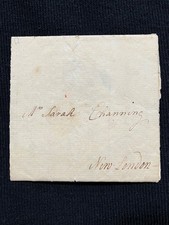
1788 Letter, U.S. Transitional Period Mail - AMERICAN REVOLUTION, New London, CT
$1795.00
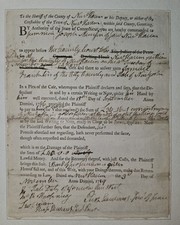
1789 New Haven, CT Legal Summons, Samuel Franklin v. Joseph Munson Debt Relief
$1750.00