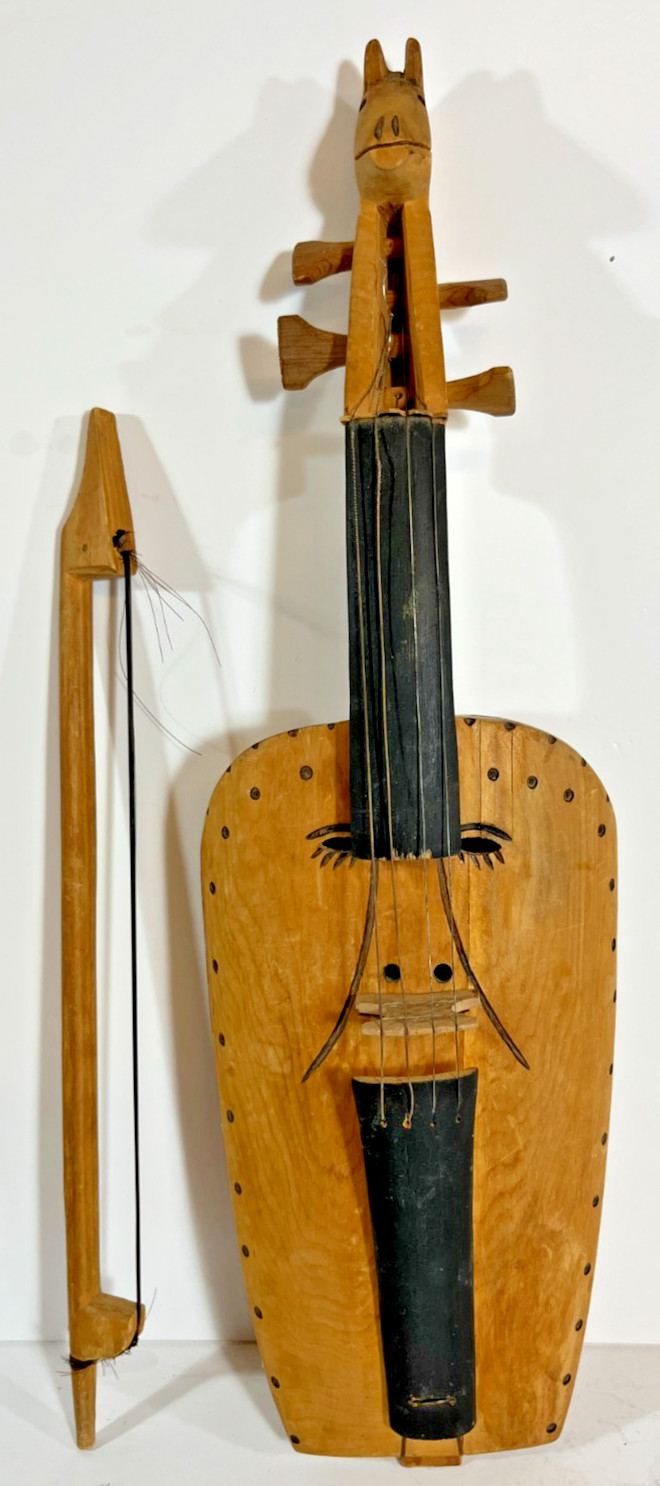
Vintage Rarámuri/ Tarahumara Native Indian Carved Folk Violin & Bow c. mid-1900s

When you click on links to various merchants on this site and make a purchase, this can result in this site earning a commission. Affiliate programs and affiliations include, but are not limited to, the eBay Partner Network.

Vintage Rarámuri/ Tarahumara Native Indian Carved Folk Violin & Bow c. mid-1900s:
$179.00
VintageRarámuri, or Tarahumara, Native American Indian Hand-Carved FolkViolin/ Fiddle & Bow, Ca. Mid-1900's
TheRarámuri, or Taramumara, native American peoples living in theCopper Canyon region of Chihuahua State of Northern Mexico and just south of New Mexico US, hand-carved this wonderful violin of the yellow pines that grow in the area. Peoples indigenous tothis region adopted the violin into their music fromSpanish missionaries in the sixteenth century, hand-carving their owninstruments in the form of the European violin.
This folk fiddle carved from yellow pine features a simple unvarnished hollow body, and instead of the usualf-holes, the body openings are the nostrils and open mouth of a humanface whose other features are thinly relief-carved and highlightedwith black paint, and a copper wire is used to hold the tailpiece inplace. The termination at the top of the peg-box is a fanciful horseor donkey head. The shape of the body is accentuated with a row ofdrilled shallow circular holes around three sides of the top that arealso painted with black paint. The hefty bow is carved from one pieceof pine and strung with black horsehair from the tail.
TheRarámuri, or Tarahumara, are believed to descend from the MogollonPeople who inhabited Southern New Mexico, SouthEastern Arizona andChihuahua State including the Great Pueblo of Casas Grandes west ofpresent day El Paso, Texas. The Rarámuri migrated into CopperCanyon and the Sierra Madre Mountains in response to pressure fromthe Spanish invasion of their lands in the 1500's and 1600's. Theyfiercely resisted the Spanish who sought to convert them toCatholicism and enslave them to work in the mines; winning importantwars but eventually losing around 1700. Attempts to Catholicizetheir religion has resulted in a hybrid belief system where Nativebeliefs and ceremonies persist alongside some Catholic rituals suchas Easter. They are famous for long distance running as well as forthe making of a fermented corn beer called tesgüino, which istypically consumed at the numerous ceremonies and festivalsthroughout the year, and these events are accompanied by the playingof fiddles and other musical instruments.
Dimensions: 18-3/4" tall/ long, 5-1/2" maximum wide, Bow: 14-1/2"long
Condition:Good. Structurally sound and not missing any parts. There is an old glue repair to a crack on the top of the body near and parallel to the fingerboard, and there is some repairable damage to the nut (where the base of the peg-box meets the fingerboard) (see the last 4 photos). The bridge is a replacement. The fiddle is strung with pieces of guitar string (?), one of which (the D-string or 2nd from the left) is broken.
Vintage Rarámuri/ Tarahumara Native Indian Carved Folk Violin & Bow c. mid-1900s:
$179.00
Related Items:

Large Heavy Authentic vintage Tarahumara (Rarámuri) Clay pottery vessel
$496.99
Vintage Rarámuri/ Tarahumara Native Indian Carved Folk Violin & Bow c. mid-1900s
$179.00
Vintage Tarahumara Rarámuri Wood Doll Lot Of 6 Mexican Folk Art Hand Carved
$149.99